Tour of Flanders · 1987
When the race car
ran over Skibby’s bicycle
A long Danish breakaway ended between the cobbles of the Koppenberg and the race’s own support car.
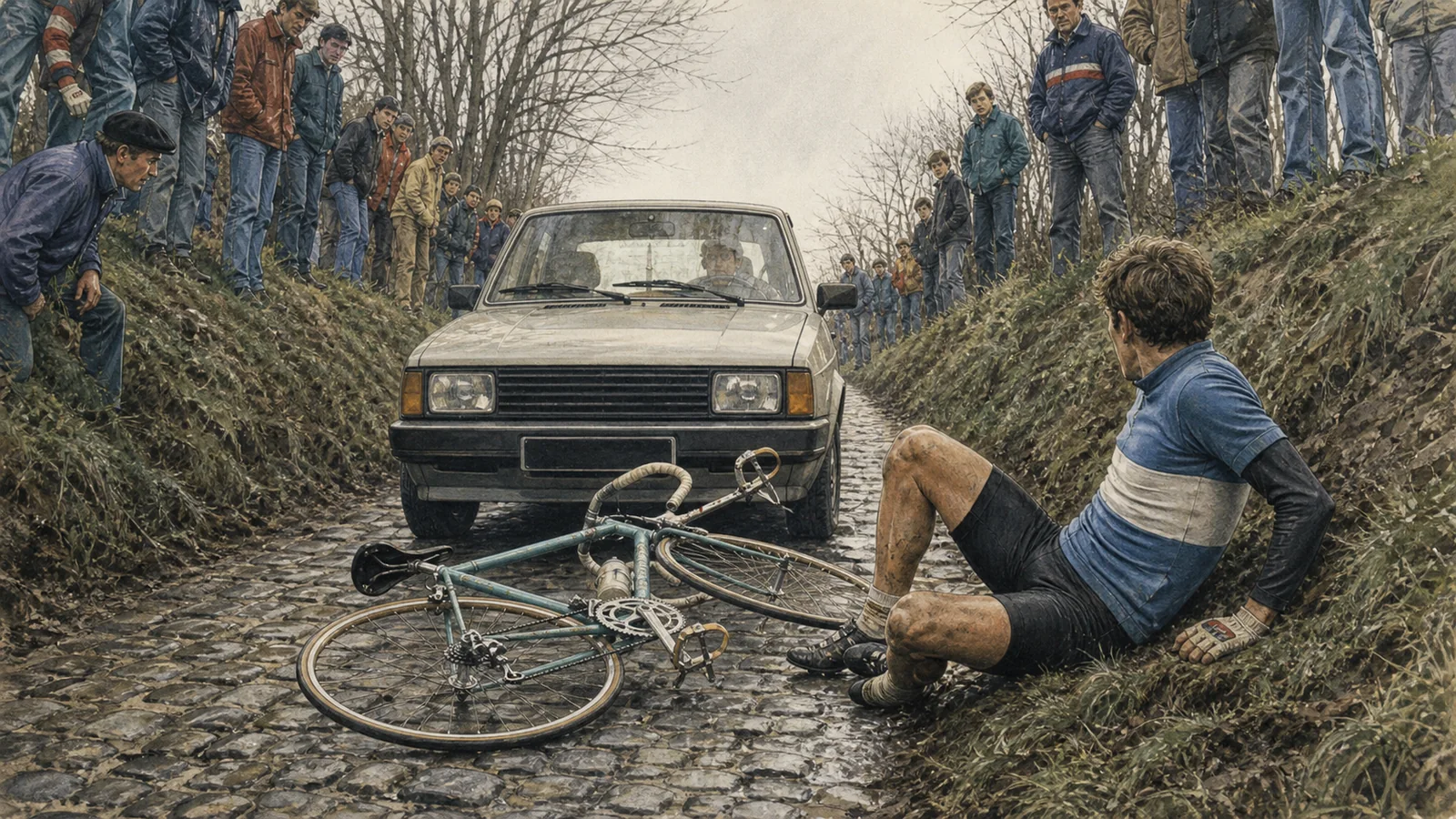
A few seconds on a narrow road
Jesper Skibby is barely moving. The bicycle wobbles on the wet cobbles, and an official race car is immediately behind him.
A long day ahead of the peloton
Skibby was 23 and in his second season as a professional. The Tour of Flanders was still unfamiliar ground. He escaped early and later continued alone. The breakaway kept him at the front of the race for much of the day, but his lead was being swallowed when he reached the Koppenberg.
The climb is short, but the numbers tell only part of the story. It is steep, the cobbles are uneven, and on a wet day the best line becomes narrow. If one rider loses speed, everyone behind can be forced off the bicycle. In 1987, the road was also so tight that a car immediately behind the leading rider had almost nowhere to go.
What the film actually shows
The archive footage shows Skibby struggling to keep the bicycle moving. It also shows the car close behind and the bicycle beneath it afterwards. On its own, the film cannot settle every detail. Later accounts disagree over whether the car struck him before he fell or whether he was already going down. They also disagree over which wheel was crushed.
What is certain is simpler: Skibby lost his momentum, the car continued, the bicycle was run over and his race was finished.
A defeat with an odd aftertaste
It could have become a bitter story about a young rider whose race was ruined by the organisation. Skibby later remembered it differently. In a 2020 interview, he said that he had been in the breakaway all day and that the Koppenberg looked impossible when he saw it. With his dry humour, he therefore described it as almost a relief that the car ran over the bicycle.
The recollection came 33 years later and should not be treated as a precise reconstruction of those seconds on the climb. It does, however, say something about the exhaustion behind the images. Skibby was not a probable winner snatched from the race a few metres before the finish. He was an early breakaway rider who had spent his strength while the favourites approached from behind.
The story inside the car
The documentation stops at the car door
Over the years, further details have been added to the story. The vehicle has been described as the race director’s car, a jury car, a commissaire’s car and a neutral support car. A later Dutch article names the driver and gives an explanation of why he chose to continue. The original newspaper cuttings have not yet been checked.
The story must therefore stop where the documentation stops. We can see what the car did. The images cannot tell us what was said inside it or what the driver was thinking. “An official race car” is the most precise description.
Fifteen years later
The Koppenberg disappeared after 1987. The Skibby incident became the strongest image of its problems — but it was not the whole explanation.
The climb had already shown the same problems repeatedly: a poor and slippery surface, crashes, riders on foot, bottlenecks in the peloton and almost no room for race vehicles.
The Koppenberg did not return until 2002. By then, the road had been restored, widened and relaid with cobbles. It was absent for 14 editions of the race — or 15 years from the incident to its return.
Meerbeke
The winner and the image that remained
The race continued without Skibby. Claude Criquielion attacked later and won ahead of Sean Kelly and Eric Vanderaerden. Of the 233 starters, 88 were recorded as finishers. In the results, Skibby is merely one of those missing at the finish. In the film, however, he is the race’s most recognisable rider.
The scene followed him for the rest of his career. That is understandable and unfair in equal measure. He later won stages in all three Grand Tours and had a long professional career. The winner in 1987 was Criquielion. The image many remember became Skibby’s.
Sources and image note
The illustration is a contemporary, AI-generated interpretation and is not used as historical documentation. The sequence of events has been checked against archive footage; later recollections and explanations are identified as such.
Continue exploring
More from cycling history
When Hinault rode into a workers’ protest
Paris–Nice met a road blockade by La Ciotat shipyard workers. Bernard Hinault was knocked down, got up and struck a demonstrator.
Read the story →
When pasta took over the breakfast table
Steak did not vanish in a morning, but during the 1980s carbohydrate became something teams could measure, mix into bottles and put on the plate.
Read the story →
When cycling became a control room
See the races, people, bicycles and changes that shaped the period.
Explore the period →