Giro d’Italia · 1953
When Coppi found
a loophole in the agreement on the Stelvio
Hugo Koblet led the Giro. Fausto Coppi had promised not to attack him. That lasted until a team-mate rode away.
31 May 1953
Fausto Coppi had won in Bolzano. Hugo Koblet still held the pink jersey and a lead of 1 minute 59 seconds. That evening, the two found a simple solution to the following day’s problem: Coppi would not attack.
It looked like an agreement both men could live with. Koblet was close to his first Giro d’Italia victory. Coppi had secured his stage win, but had not entirely abandoned hope of a fifth overall Giro. The next day brought the Passo dello Stelvio, which the race would cross for the first time.
The road climbed to 2,757 metres. Snow stood in high banks along the final kilometres, though the road itself had been cleared. There was not much technology to hide behind either. The Giro’s own historical account says Coppi used a 46-tooth chainring and a 23-tooth rear sprocket. By modern standards, that was a heavy mountain gear.
An agreement with an opening
The official Giro account describes the agreement quite precisely: Coppi would not attack Koblet. But if the Swiss rider chased an attack himself, Coppi considered himself free to respond.
About 12 kilometres from the summit, Coppi asked his young team-mate Nino Defilippis to raise the pace. Defilippis was not a direct threat to Koblet’s overall lead, but Koblet followed. In Coppi’s view, he had thereby opened the race himself.
Coppi did not attack the pink jersey first. He made sure somebody else gave the pink jersey something to chase.
Then Coppi went. Koblet could not follow.
Four minutes on one mountain
At the summit, Coppi was 2 minutes 48 seconds ahead of Gino Bartali. Defilippis followed at 3:27, while Koblet crossed 4:25 later. The Giro had been overturned on the final kilometres of a pass that had no previous history in the race.
Koblet was known for an exceptionally smooth riding style. On the Stelvio, style mattered less than limiting the loss. He hurled himself down towards Bormio, but crashed twice on the descent. With seven kilometres remaining, he also punctured.
Bormio
Koblet lost the Giro, but saved most of it
Coppi reached Bormio after 4 hours, 51 minutes and 32 seconds. Pasquale Fornara was second, 2:18 behind. Bartali arrived at 2:48, while Koblet, despite the crashes and puncture, limited his loss to 3:28.
It was enough. Coppi took the pink jersey and won the Giro the following day by 1 minute 29 seconds over Koblet. It was his fifth and final overall victory in the race.
The agreement between them has since become part of the Stelvio story. It should be read as the later official account of the tactics, not as a verbatim transcript of a conversation between the riders. But Defilippis’s move, Coppi’s attack and Koblet’s time loss all remain in the result.
A photograph with assistance
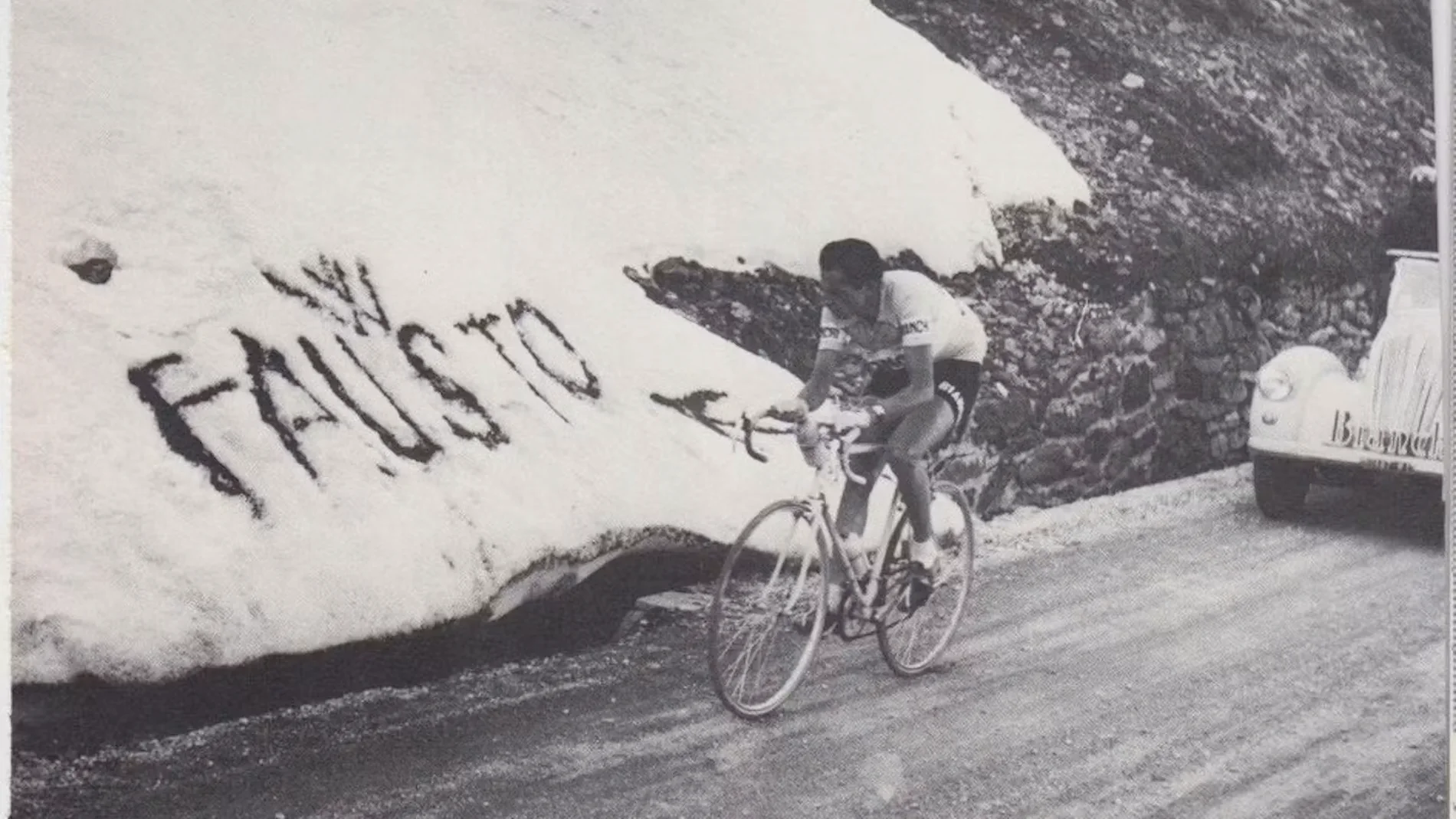
The snow celebrated Coppi.
The photographer had helped it along.
Valentino “Tino” Petrelli’s photograph of Coppi beside a snowbank bearing the words “W Fausto” became one of the race’s best-known images. It looks like an accidental popular tribute caught at just the right second.
The Lombardia Beni Culturali archive states, however, that Petrelli later admitted preparing the scene himself. More recent accounts have also linked the writing to a young spectator, so not every detail is clear. What is certain is that Petrelli took the photograph during the Giro on 1 June 1953. And that a good press photograph was not necessarily quite as spontaneous as it appeared.
The Stelvio’s first Giro
A pass acquired its founding story
The Stelvio has since served as the Giro’s highest point on several occasions. Snow, cancellations, unclear race instructions and long descents have given it more stories than most mountains.
The first remains particularly clear. One rider held the pink jersey. Another had given his word. Then a 21-year-old team-mate attacked, Koblet followed, and Coppi found the opening he needed.
Technically, the agreement held. Koblet’s lead did not.
Sources and image note
The stage result, time gaps and official account of the agreement are based on the Giro d’Italia’s historical material. The information about the arranged photograph comes from Lombardia Beni Culturali’s catalogue record for Petrelli’s negative.

Continue exploring
More from cycling history
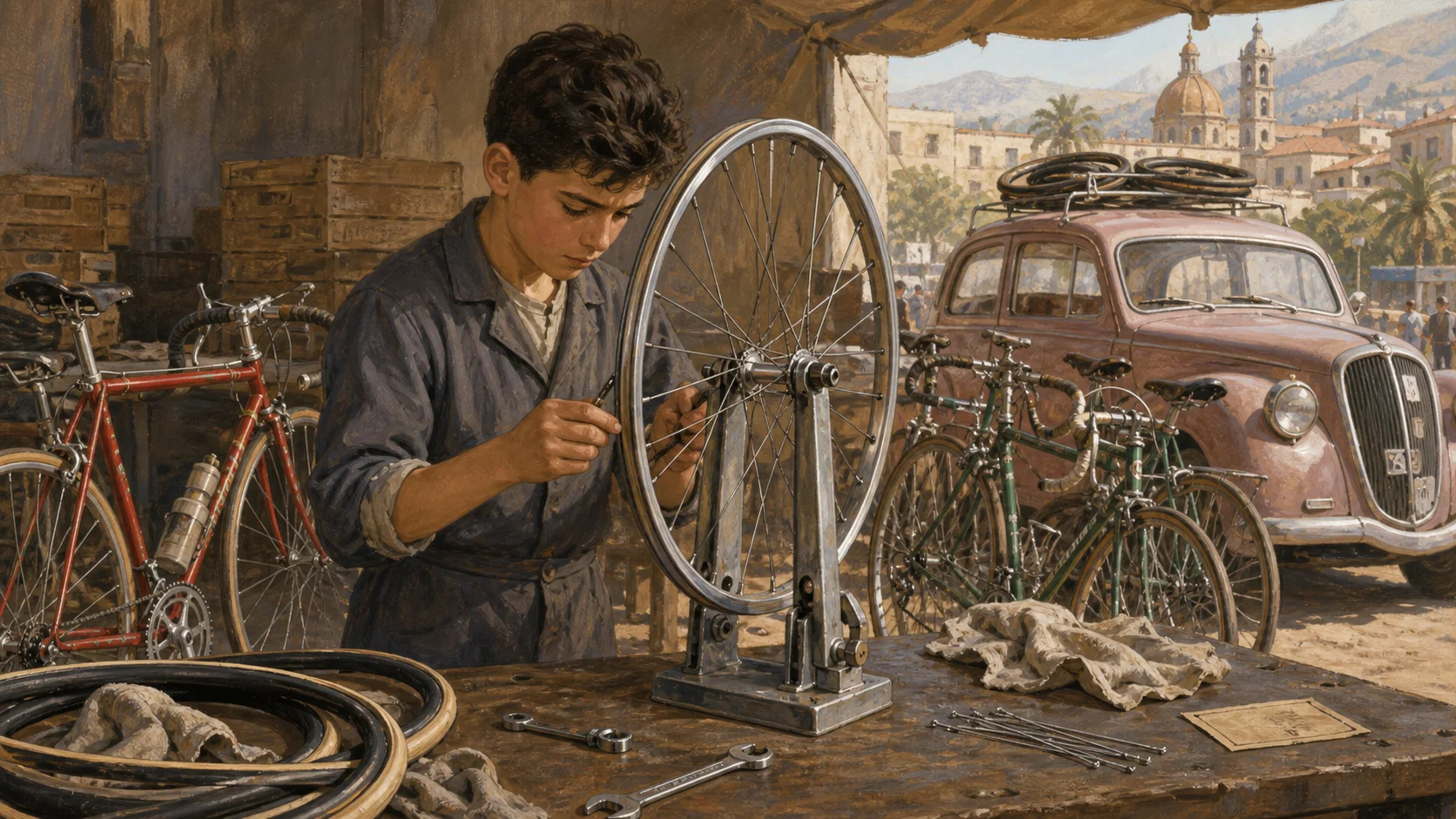
The 16-year-old mechanic who became two years older overnight
Ivo Faltoni was 16, good at building wheels and too young for the Giro service caravan. A false document made him eighteen on paper.
Read the story →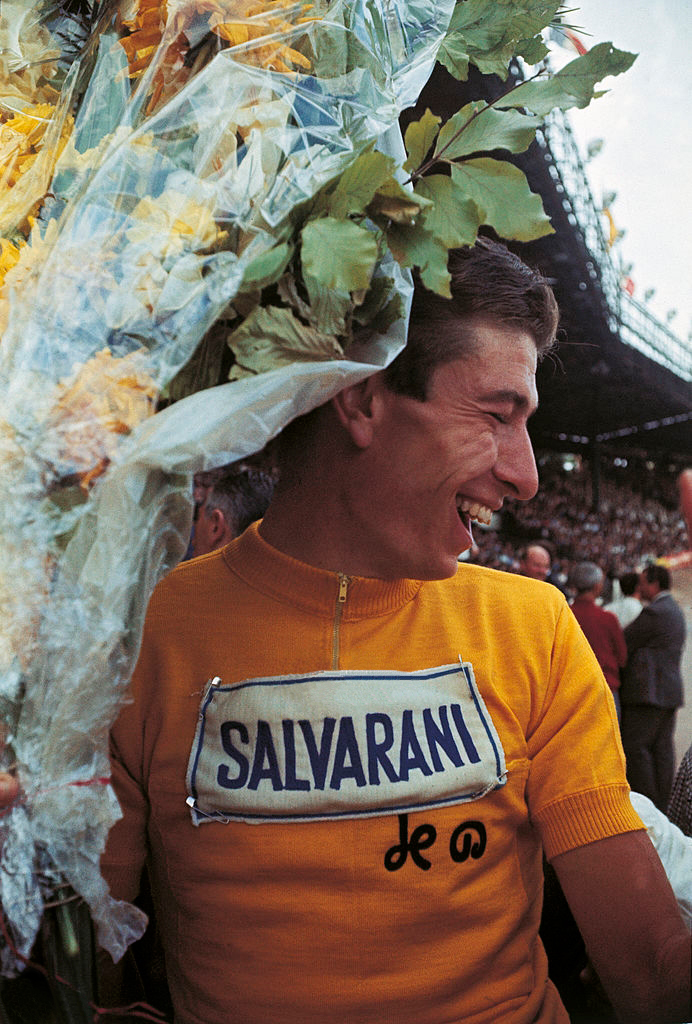
When Gimondi opened the sprint against Merckx
At the 1971 World Championships in Mendrisio, Eddy Merckx and Felice Gimondi reached the finish alone. Gimondi opened, but Merckx took his second rainbow jersey.
Read the story →
Between the Cannibal and the Badger
See the races, people, bicycles and changes that shaped the period.
Explore the period →