The period 1950–1959
When cycle racing
entered the living room
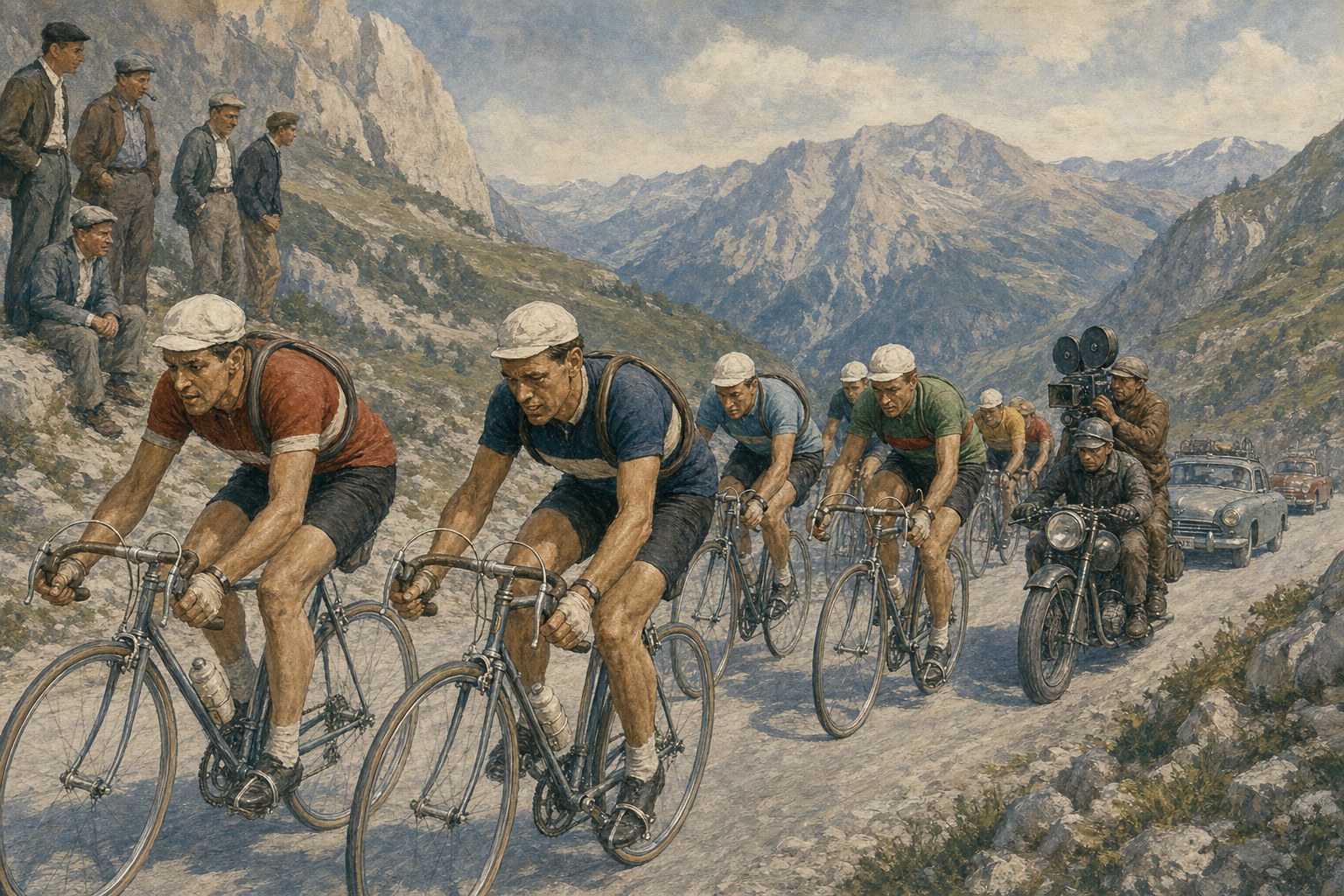
Modern gears, new mountain stages, radio and television made the sport faster, more international and far more visible.
The common period model
The 1950s in three views
The decade’s main development
The parallelogram derailleur made shifting reliable without moving the rear wheel.
What defined the period
Grand tours became international media events while mountains, radio and television created shared heroes.
Three changes to cycling
- The Tour started abroad
- Gran Sport established a lasting derailleur form
- Mountain-top drama became central to stage racing
Selected events
A short timeline
- Hugo Koblet becomes the Giro’s first foreign winner.
- Campagnolo Gran Sport brings the modern derailleur principle to the Italian racing bicycle.
- Coppi wins on Alpe d’Huez; his RAI interview discusses “la bomba”.
- Coppi turns the Giro on the Stelvio.
- The Tour starts outside France for the first time, in Amsterdam.
- Louison Bobet wins his third Tour in succession.
- Walkowiak wins the Tour; Gaul decides the Giro in the snow on Monte Bondone.
- Jacques Anquetil wins his first Tour.
Seven fixed themes
The decade, seen across the site
Races and defining moments
Walkowiak’s unexpected Tour and Gaul’s snowbound Bondone stage show how breakaways, weather and mountains could overturn a grand tour.
Follow this theme through cycling history →Riders of the period
Coppi, Koblet, Bobet, Gaul, Walkowiak and the young Anquetil represented very different routes to stage-race success.
Follow this theme through cycling history →Bicycles and technical change
Gran Sport made the parallelogram derailleur a prestigious standard. Double chainsets, five sprockets, tubular tyres and light steel frames defined the fine racing bicycle.
Follow this theme through cycling history →Nutrition, training and science
Training grew more systematic, but food still followed experience and stimulant use remained largely outside effective control.
Follow this theme through cycling history →Cycling culture and everyday life
Radio reports, film summaries and early television brought faces, riding styles and collapses into the home.
Follow this theme through cycling history →Society and the times
The Amsterdam start and an increasingly international peloton reflected a European sport extending beyond its traditional national frame.
Follow this theme through cycling history →The people behind cycling
Mechanics, soigneurs, broadcasters and organisers became more visible as the race convoy and technical support expanded.
Follow this theme through cycling history →From post-war heroes to a media sport
Bartali and Coppi were still great names. Around them, however, the sport itself was changing: new countries won the old races, mountains became stages with names of their own, and the camera began to follow.
1950
When the Italians went home
The Tour de France began the decade with a conflict extending beyond the result. After hostility and incidents involving the Italian team in the Pyrenees, Gino Bartali decided that both Italy’s A and B teams should leave the race.
Tour director Jacques Goddet personally sought out the delegation and tried to persuade Bartali to continue. The decision stood. In the Tour of national teams, riders were not merely sportsmen. They represented nations in a Europe where the war remained close to the surface.
That same year, Swiss rider Hugo Koblet broke another pattern. He became the first foreign winner of the Giro d’Italia. The following year he won the Tour and became an image of a new international elegance in the peloton.
The mechanism finds its form
The parallelogram changes gear shifting
Campagnolo had shown a Gran Sport prototype in 1949. The single-cable version arrived in 1951, making the modern derailleur principle visible on the racing bicycle.
An articulated parallelogram moved the derailleur sideways while two pulley wheels guided the chain and kept it tensioned. The rider still operated a friction lever on the down tube, but the rear wheel no longer had to be loosened and moved during a gear change.
Gran Sport did not immediately displace Simplex, Huret and other systems. But it gave the fine Italian racing bicycle a new technical centre and pointed towards decades of mechanical derailleurs.
1951–1953
The mountains acquire names of their own
Mont Ventoux first appeared on the Tour route in 1951. The following year, the organisers placed a stage finish at the summit of a Tour climb for the first time. Fausto Coppi won alone on Alpe d’Huez.
The Stelvio entered the Giro d’Italia in 1953. Coppi attacked on the new pass and overturned a race Hugo Koblet appeared to have won. The high roads were not simply terrain. They became dramatic stages to which newspapers, radio and photographs could give an identity of their own.
The organisers had found a formula that is still used: give the mountain a name, let the classification be decided on its road, and allow the place to enter the race’s memory.
Magni and the tubular tyre
Fiorenzo Magni rode the Giro with a broken collarbone. His mechanic attached a piece of tubular tyre to the handlebars so that Magni could relieve his arm by holding the bicycle with his teeth.
The snowstorm on Bondone
Snow and severe cold struck the Merano–Monte Bondone stage. Charly Gaul won, while Magni reached the finish in third place with his injured shoulder.
A workshop solution
Steering with the teeth
The image of Magni with the tubular tyre between his teeth captures much of cycle racing in the 1950s. Doctors, soigneurs and mechanics surrounded the rider, but solutions could still be improvised from whatever material lay in the car.
A piece of the bicycle’s own tyre became support for the body. It was ingenious and brutal at the same time. The story should not romanticise the injury; it shows instead how far a rider could be expected to continue.
On Monte Bondone, cold as well as pain sorted the field. Newspapers were pushed under jerseys, warm drinks were passed forward, and helpers tried to return frozen riders to a normal body temperature.
Radio, images and immediacy
The peloton could be experienced from afar
The Giro established Radio-Giro in 1951, allowing RAI to broadcast live reports from the race. The finish of the Tour had already been shown live on television in 1948, and through the 1950s the stages increasingly became part of news broadcasts and evening highlights.
There was still a long way to go before today’s live images from every kilometre. Even so, the camera changed the sport’s memory. The public could see riders’ faces, styles and collapses rather than merely reading their names the following morning.
The camera motorcycle and race convoy therefore became as characteristic of modern cycle racing as the new derailleur.
The body without a safety net
Ventoux gave warnings
On Mont Ventoux in the 1955 Tour, Jean Malléjac collapsed and had to be treated at the roadside. Ferdi Kübler also suffered badly and later abandoned the race. Heat, exhaustion and the period’s use of stimulants became mixed together in the explanations.
Malléjac himself believed that he had been doped without his knowledge. This cannot be turned into one simple explanation for every incident. The episode nevertheless shows a peloton without modern anti-doping controls and a culture in which the rider did not always have a full picture of what he was given.
The professionalisation of the 1950s made races better organised. It did not automatically make the treatment of the body modern or safe.
1956
The winner without a stage victory
Roger Walkowiak was not selected for the French national team and began the Tour with the regional Nord-Est–Centre team. He joined a breakaway, the favourites allowed it too much time, and suddenly he was part of the contest for the race.
Walkowiak won no stage. He did, however, defend himself in the mountains and regained the yellow jersey four days before Paris. His name was later used disparagingly for a lucky or unworthy winner.
That overlooks the story’s best point. When the favourites recognised their mistake, Walkowiak was strong enough to prevent them correcting it. He won through attention, endurance and tactical stubbornness — not through one great triumphal image.
Sources
The basis for this period
- Tour de France: the Italian team’s departure in 1950
- Tour de France: Alpe d’Huez and the first summit finish
- Giro d’Italia: historical archive 1948–1957
- Giro d’Italia: Monte Bondone 1956 and Magni’s tubular tyre
- Giro d’Italia: the Stelvio’s debut in 1953
- Tour de France: Roger Walkowiak’s victory in 1956
- Museo del Ciclismo: Campagnolo Gran Sport