The period 1970–1979
Between the Cannibal
and the Badger
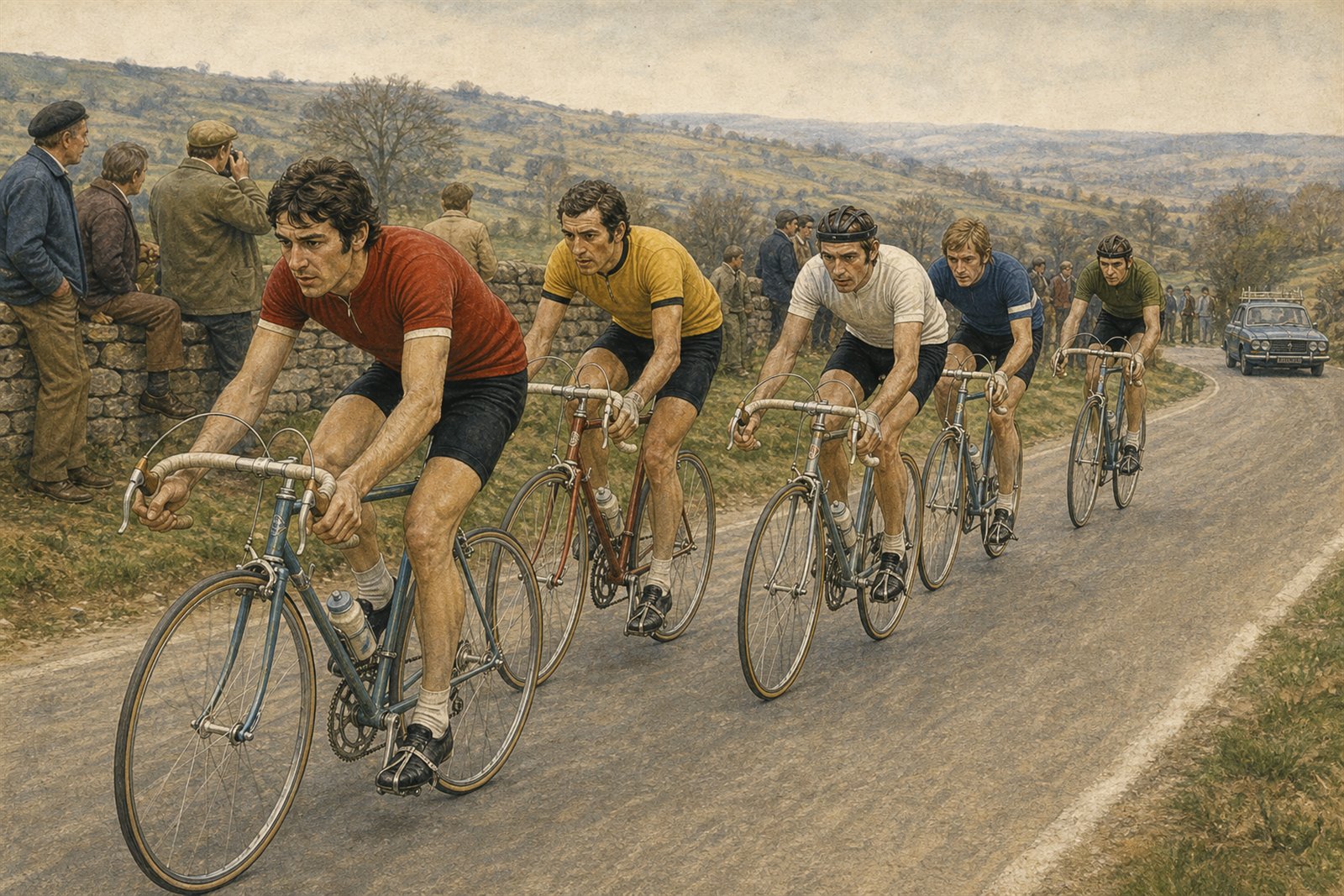
A decade of steel frames, friction shifting and a professional peloton moving from Merckx’s dominance towards Hinault’s new order.
The common period model
The 1970s in three views
The decade’s main development
Professional teams became more organised while Japanese components began to challenge the established European makers.
What defined the period
Merckx dominated the opening years, Hinault arrived at the end, and steel bicycles with friction shifting remained the familiar professional tool.
Three changes to cycling
- The Tour finished on the Champs-Élysées
- The polka-dot jersey appeared
- Team support, television and component competition grew
Selected events
A short timeline
- Mogens Frey is awarded the Tour stage to Mulhouse after Joaquim Agostinho obstructs him in the sprint.
- Luis Ocaña takes yellow from Merckx, but crashes out in the Pyrenees.
- Eddy Merckx completes his fourth Tour victory.
- Herning opens its temporary wooden track for six-day racing.
- The Tour finishes on the Champs-Élysées for the first time; Thévenet ends Merckx’s winning run.
- Lucien Van Impe wins the Tour de France.
- Bernard Hinault wins his first Tour; Shimano introduces 600 EX Arabesque.
- Hinault wins the Tour again as the decade closes.
Seven fixed themes
The decade, seen across the site
Races and defining moments
Merckx’s dominance, Ocaña’s lost lead, Thévenet’s 1975 victory and Hinault’s arrival made the decade a transition between two commanding champions.
Follow this theme through cycling history →Riders of the period
Merckx, Ocaña, Thévenet, De Vlaeminck and Hinault represented different strengths, while Mogens Frey and Ole Ritter gave Danish spectators their own points of entry.
Follow this theme through cycling history →Bicycles and technical change
Fine steel frames, tubular tyres, toe clips and friction levers remained standard. Japanese makers improved their position, and drillium showed how far the pursuit of low weight could go.
Follow this theme through cycling history →Nutrition, training and science
Steak and rice still appeared at breakfast, while musettes carried sandwiches, fruit, sugar and tarts. Practice rested largely on team experience rather than precise carbohydrate targets.
Follow this theme through cycling history →Cycling culture and everyday life
Television, six-day racing in Herning and the new Champs-Élysées finish gave professional cycling recognisable stages beyond the open road.
Follow this theme through cycling history →Society and the times
Sponsors became more visible, team roles grew clearer and riders occasionally acted collectively over working conditions and punishing transfers.
Follow this theme through cycling history →The people behind cycling
Soigneurs prepared bottles, food, clothing and massage, while mechanics managed tubular tyres, wheels and friction shifting. Their work made the visible race possible.
Follow this theme through cycling history →A hand down to the down tube
The gear change produced no click. The rider moved the lever, listened to the chain and adjusted it slightly if it made a noise. The bicycles already resembled modern racing bicycles, but demanded more from the hands.
A decade between two rulers
Merckx could do almost everything
As the 1970s began, Eddy Merckx was in the middle of his most dominant period. He could win stage races, classics, time trials and sprints and seldom let an opportunity pass. The nickname Cannibal was not hard to understand.
But the decade was not one long Merckx parade. In the classics, specialists could meet him on their own terrain. Roger De Vlaeminck had a cyclo-cross background and particular assurance on the cobbles. At Paris–Roubaix, the difference between him and Merckx was much smaller than in the grand tours.
In 1975, Merckx also lost his grip on the Tour de France. Bernard Thévenet took the yellow jersey after Merckx faltered on the road to Pra-Loup and kept it to Paris.
Steel, craft and established habits
The bicycle had to be felt
The best racing bicycles were still built from thin-walled steel tubing. Campagnolo was strong on finer European bicycles, and polished aluminium suited the slender frames.
Gear shifting had no fixed steps. Feet were held to the pedals with toe clips and straps. The tubular tyre was glued to the rim, so the mechanic’s preparation mattered long before a wheel was passed from the service car.
Technology moves
Japan knocks on the door
It was proven technology, but not static technology. Lighter materials, better designs and new component manufacturers pressed forward. Japanese equipment became harder to dismiss as merely a cheaper alternative to European products.
Shimano 600 EX Arabesque from 1978 is a good image of the transition: technically ambitious, visibly decorated and made for a customer who still associated a good racing bicycle with exposed metal and mechanics.
The change was not yet a farewell to steel and friction shifting. It happened in their midst.
De Vlaeminck against Merckx
Roger De Vlaeminck beat Eddy Merckx in the sprint on the velodrome. It was the third of his four victories in the race and strengthened the link with the name Monsieur Paris–Roubaix.
Hinault takes power
Bernard Hinault won his first Tour. Along the way, he was also a prominent force in the riders’ protest at Valence-d’Agen, where the peloton crossed the line together and the stage was annulled.
The team around the rider
More hands behind one man
The professional cyclist was not alone on the road, although photographs often make it look that way. Behind the peloton, mechanics worked on wheels, gears and brakes. Soigneurs handled food, drink, massage and practical matters throughout a stage race. The team manager distributed tasks from the car.
The roles became clearer. A leader had to be protected; a domestique fetched bottles, led the peloton or surrendered his wheel. Specialisation was not developed as it is today, and the greatest riders still rode extensive programmes. Merckx’s defining trait was precisely that he seemed to specialise in everything.
A modern appearance
The races enter the living room
Television had become a regular part of cycle racing. Team jerseys, leaders’ jerseys and the finish on the Champs-Élysées gave races a clearer visual language. It did not make the cobbles smoother or the mountains lower, but it made the sport easier to follow from home.
In 1975, the Tour finished on the Champs-Élysées for the first time, and the mountains competition received its polka-dot jersey. At the decade’s end, Bernard Hinault arrived and won his first Tour in 1978. The rider still changed gear by reaching down to the down tube. Almost everything around him had begun to move.
Sources
The basis for this period
- Tour de France: its history of 1975, the Champs-Élysées and the polka-dot mountains jersey.
- INA: contemporary television footage of the riders’ protest at Valence-d’Agen in 1978.
- Paris–Roubaix: the race’s official list of winners.