Mechanics · 1960s and 1970s
When the drill became
a weight-saving tool
A chainring, brake lever and derailleur could all be made a little lighter. Metal was removed one hole at a time.
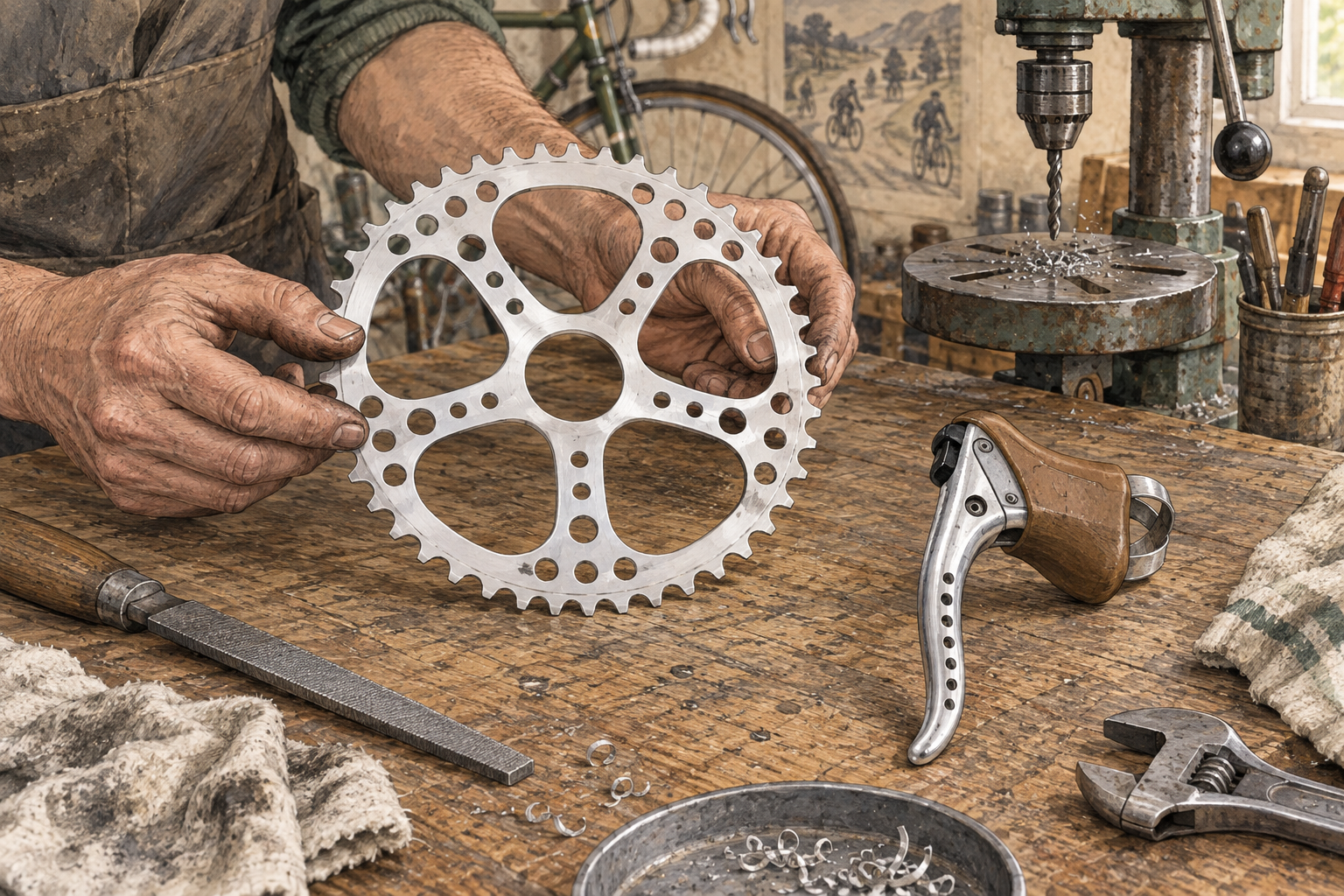
Even a chain could go under the drill if the pursuit of grams was taken far enough.
The chain went under the drill too
Ernesto Colnago later said that he drilled every chain link by hand when building Eddy Merckx’s bicycle for the 1972 hour record. According to Colnago, chain manufacturer Regina was not enthusiastic. The company believed the chain would be too weak for Merckx’s power.
This is a recollection from the bicycle’s builder, told many years after the attempt. Even so, it captures a concrete aspect of the period’s pursuit of low weight: a chain itself could be examined for material that might be removed.
According to Colnago’s company history, the finished record bicycle weighed 5.75 kilograms. Its low weight came from the complete construction and special parts, not from the chain holes alone.
A name for what was removed
Drillium sounds like an alloy. It is the name later applied to drilled and lightened bicycle components. No new material was added. Something already present was taken away.
On a chainring, holes could follow a circle inside the teeth. On a brake lever, they could form a row along the blade. Other parts were filed, milled or polished. Round holes, milled recesses and a completely new construction are different forms of work, even if several appear on the same bicycle.
A hole does not reveal who made it. The component may have been supplied that way, modified by a workshop or changed much later by an owner. That distinction matters when trying to understand a bicycle’s history.
Work for specialist workshops
Perfect Perforations is one example of the practice becoming a specialised small business. On the company’s own site, its founder says he began in 1974 with experience in both machining and bicycle repair. He drilled and polished components at a time when weight saving and decorative patterns went together.
A lighter axle may remain hidden inside a hub. A drilled chainring sits in full view by the right pedal. Repeated hole patterns, bright edges and the relationship between removed and retained material could turn a standard component into an individual object.
Weight saving was the starting point. Once the pattern also had to look right, the work had acquired another purpose.
When had enough been removed?
Every intervention raised the same question: was enough material still present for the component to do its job?
At LovelyLugs, Jeffrey Rumbold describes a heavily modified Campagnolo Nuovo Record derailleur whose parallelogram arms were reduced to narrow connections. While assembling a later example, the structure broke under spring tension. His first attempt was retired to the collection.
This is one later workshop example, not evidence of a wave of accidents in the 1970s peloton. It simply shows why counting the grams removed is not enough. The lightened component still had to function.
From weight saving to decoration
When Perfect Perforations resumed its work in 2010, the founder described the purpose as decorative. A 2011 Silk Hope project combined drilled Campagnolo parts with inlays and engraving. It is a modern collectors’ project, not an untouched 1970s racing bicycle.
Drillium on an old component is therefore not necessarily old drillium. The work may reveal as much about a later owner’s interest as about the rider who originally used the part. Documented workshop work from 1974 and careful modification from 2011 may both be worth showing when each receives the correct date.
The principle remains easy to see on the bicycle. Teeth must pull the chain, the lever must pull the cable and the derailleur must move the chain. Between those necessary functions, someone looked for metal that might be spared.
Sometimes the result was a slightly lighter part. Sometimes it was mainly a pattern. Both produced shavings.
Sources and image notes
Colnago’s chain story is his later recollection, not a contemporary workshop record. The 5.75-kilogram figure comes from the manufacturer’s history. Rumbold’s account describes one workshop failure and is not used as evidence of general faults or racing accidents. Later collectors’ work is kept separate from period components.
Continue exploring
More from cycling history

A Man of Steel
Albert is 82 and still rides every day. A photographic reader story about a yellow steel Gazelle, daily kilometres and an iron will.
Read the story →
When the Tour had to provide dinner
National teams made the Tour organiser responsible for the riders’ food and lodging. Menus were heavy, advice plentiful and nutritional science still far from the measuring cup.
Read the story →
When cycling became a control room
See the races, people, bicycles and changes that shaped the period.
Explore the period →