1950s · Story
Kay Werner turned down number one
Kay Werner wanted a number of his own. A choice in the 1950s became a tradition that outlasted changing partners.
Kay Werner was supposed to inherit a number. Willy Falck Hansen, who had raced as half of Pair Number 1, thought the Danish pairing of Kay Werner and Evan Klamer should continue under that figure. Kay Werner wanted his own. It became number 7.
That is how Dansk Bicycle Club recounts a choice that would grow far beyond a line in a race programme. It is a later account, not a preserved verbatim record of the conversation. We do not need the tone of voice to recognise the distinction: one number was offered as an inheritance, another chosen as a beginning.
Today seven is associated with Danish favourite pairings on winter tracks. When Kay Werner and Klamer put it on their backs in the 1950s, however, it did not yet carry all the history subsequently attached to it. That history first had to be ridden into existence.
Two names under one number
A pair number makes a complicated race easier to follow. Two riders may relieve one another, but their work contributes to the same result. Spectators therefore need to recognise the team when the other rider takes over. The number becomes the connection between them.
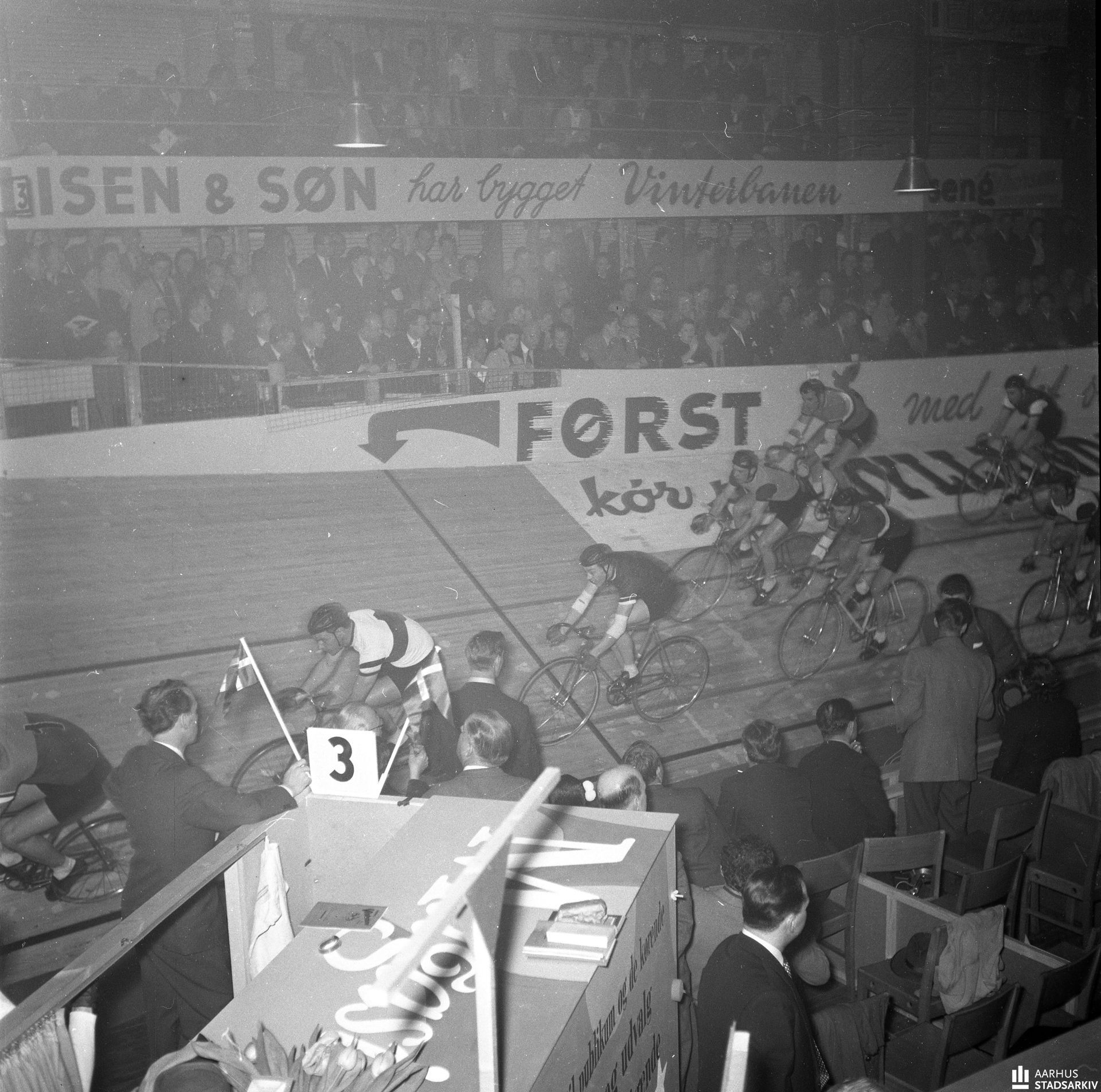
Kay Werner and Evan Klamer gave seven two recognisable faces. On 19 January 1954, Børge Andre Venge photographed them in Aarhus-Hallen. Aarhus City Archives catalogues the image as a 100-kilometre pairs race with number 7 the winning pair. Here the number is no retrospective memory of tradition; it belongs to an event being raced.
The photograph cannot prove the exact conversation with Falck Hansen. It does establish that the pair and the number belong together early in the story. Keeping those things separate is useful: the anecdote explains the choice; the race photograph documents its use.
A tradition is rarely completed on the day someone chooses a number. It requires repetition. Names are printed again, riders return, and spectators learn to find the same figure in the bunch. Something that initially distinguishes one pair from another can eventually generate expectations before racing begins.
Another partner arrived
Kay Werner later rode with Palle Lykke. They became a Danish favourite pairing strongly associated with the six-day races at Forum. A change of partner did not remove seven. The number could link different partnerships even when one of the two riders changed.
That suited a sport whose spectators followed both the standings and the people creating them. A win could add to a pair’s history, but even an evening without victory could make the riders more familiar. Their introduction did not have to begin afresh whenever a programme was printed.
This also helps explain why seven retained value beyond Kay Werner’s own time. Other Danish riders wore it. An audience could recognise the number before knowing every detail of a new partnership. Tradition made new names easier to place, while giving them expectations to fulfil.
The number remained
In the club’s later account, seven itself was a chance choice. No hidden numerology or explanation about luck is required. Meaning came from the riders wearing it and the spectators who continued watching it from the stands.
Falck Hansen’s number 1 does not disappear from the story. It was the actual alternative offered to Kay Werner. Choosing differently gave the new pair its own identifier instead of its predecessor’s.
In the Aarhus photograph, Kay Werner and Klamer still have to do the work. The number rides no laps for them. When others later take their places, however, they do not have to choose a new figure too.