2005 · Story
The world champion worked for Schleicher
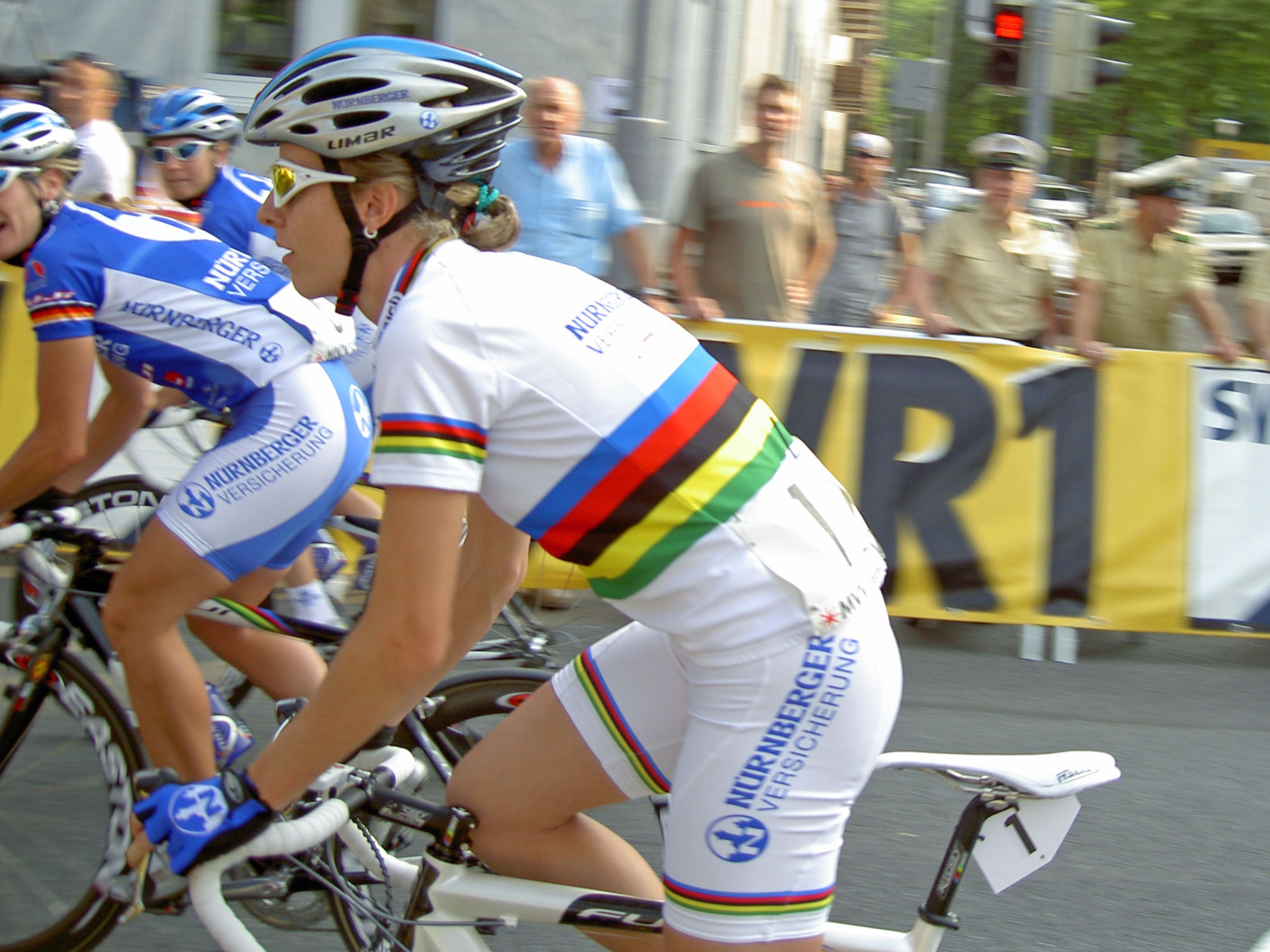
Judith Arndt brought the rainbow jersey to Madrid. On the final lap, her task was to deliver another German rider to the sprint.
Back to the team
Judith Arndt was behind the peloton with a puncture while her German teammates worked farther up the road. It was the World Championships in Madrid on 24 September 2005. The defending champion first had to regain contact before she could help in the finish.
Arndt had also been ill. According to the contemporary German report, she had considered not starting on the evening before the race. By morning she felt well enough to ride. A national team could still use a world champion who lacked the strength to defend her own title.
She returned after the puncture. Up ahead was Regina Schleicher, saving a sprint for the final metres. The German riders now had to protect that possibility through a finish in which several other teams had quite different plans.
They already knew each other well as trade teammates. Arndt, Schleicher and Trixi Worrack all rode for Nürnberger Versicherung. At the Worlds they wore national jerseys, but the work was being done by riders familiar with one another's strengths. Arndt's experience remained useful on a day when her body could not offer her the usual possibilities.
Oenone Wood also belonged to the Nürnberger team, but in Madrid she rode for Australia. On ordinary race days these riders could work for the same jersey. Here Wood would finish by competing against Schleicher for the medals. Racing for national teams divided a familiar working team afresh, while Arndt, Worrack and Schleicher still had each other to rely on in the German line-up.
A sprint still had to be earned
Schleicher could not simply wait for everyone else to tire of attacking. The Americans tried to open up the race, and several teams wanted a small group to escape. Keeping the finish together required sustained work.
There was a very practical purpose to the job. A sprinter's speed is useful only if she is still in contact with the riders contesting the victory. Each climb and each attack can make that final acceleration irrelevant. Her teammates therefore had to retrieve escapes and ensure that Schleicher was not left behind when the pace increased.
In the German account after the race, Schleicher explained that Arndt and Worrack had helped her towards the finish and waited for her on the last climb. This was no title being handed from one champion to her successor. Rivals still followed their wheels, corners still had to be negotiated, and Schleicher had to win the sprint herself.
The riders reached the finish outside the Santiago Bernabéu stadium. Worrack performed the last part of the work for Schleicher. The Germans had kept their fast finisher in the race; now she had to use the energy they had helped her preserve.
The final hundred metres
Schleicher made her move in the final hundred metres. Nicole Cooke finished second and Oenone Wood took bronze. Denmark's Dorte Lohse Rasmussen was fourth. Germany had won the women's road world title for a second successive year, with a different rider on the top step.
Arndt's own result appeared farther down the list. She finished 35th. That number says little about the work she had done. Delivering a teammate and then losing positions is a different task from saving everything for a sprint of your own. A results sheet can reduce both efforts to a single number.
Schleicher arrived in Madrid as German champion and a fast finisher. Arndt arrived as the reigning world champion and finished as a helper. Their roles had changed without requiring a grand explanation. The team had an opportunity to win with Schleicher, and Arndt helped keep that opportunity alive all the way to the line.
After the finish, Schleicher had a rainbow jersey to collect. Arndt had not defended hers. She had helped secure the next one.