From the first races to 1899
Cycling’s wild pioneer years
The safety bicycle was new, roads were poor and rules were often written after the race. Yet cycling rapidly became transport, industry and spectator sport.
The common period model
From the first races to 1899 in three views
The period’s main development
The safety bicycle, pneumatic tyre and chain drive turned cycling from an experiment into transport, industry and organised sport.
What defined the period
Road races, track meetings and solo six-day contests tested riders and machines before stable rules, team cars or sports science existed.
Three changes to cycling
- Two equal-sized wheels replaced the high wheeler
- Pneumatic tyres made distance more practical
- Newspapers turned races into public spectacles
Selected events
A short timeline
- A commonly cited early organised road race is held from Paris to Rouen.
- The Rover safety bicycle establishes the chain-driven layout with two similarly sized wheels.
- John Boyd Dunlop patents a practical pneumatic tyre.
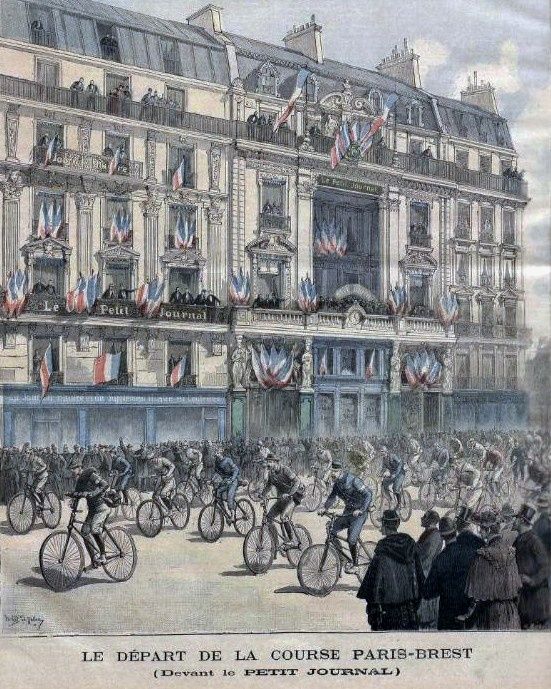
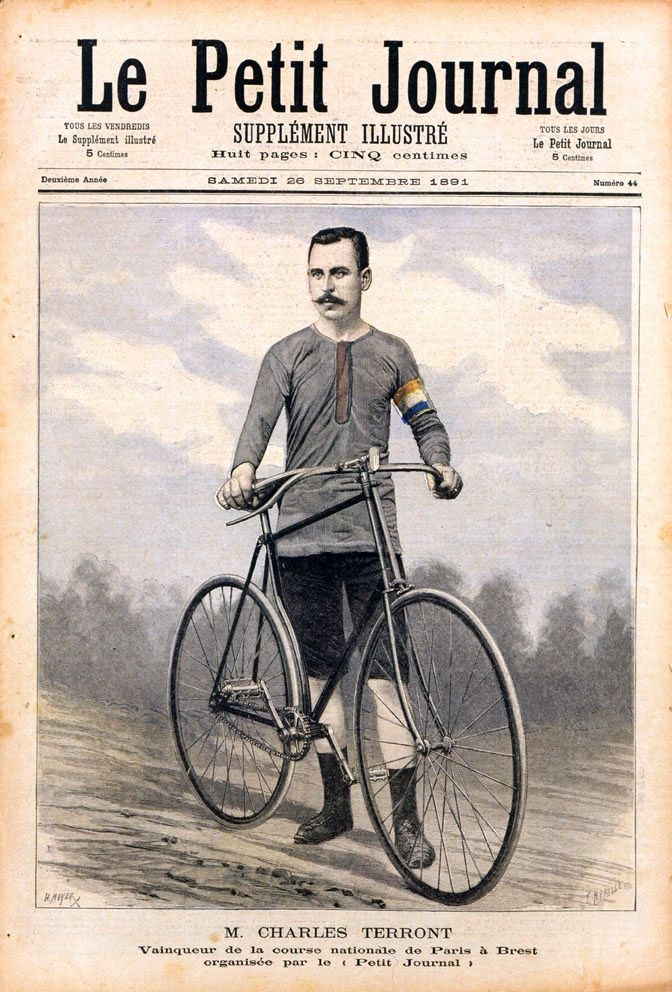
- Charles Terront wins the first Paris–Brest–Paris after 1,200 kilometres.
- The first Liège–Bastogne–Liège is held for amateurs.
- The first documented six-day solo race is held at Madison Square Garden.
- Paris–Roubaix is held for the first time.
- Major Taylor becomes world sprint champion in Montreal.
Seven fixed themes
The decade, seen across the site
Races and defining moments
Paris–Brest–Paris, Liège–Bastogne–Liège and Paris–Roubaix made distance, poor roads and mechanical survival part of the competition.
Follow this theme through cycling history →Riders of the period
Charles Terront, Major Taylor and the six-day specialists belonged to a generation that had to invent both the athletic role and its working methods.
Follow this theme through cycling history →Bicycles and technical change
The safety bicycle, chain drive and pneumatic tyre created the basic machine. Brakes, freewheels and practical gearing were still unsettled questions.
Follow this theme through cycling history →Nutrition, training and science
Food, stimulants and recovery followed experience, trade custom and rumour. Modern distinctions between nutrition, medicine and doping did not yet exist.
Follow this theme through cycling history →Cycling culture and everyday life
The bicycle became transport, fashionable possession and spectator sport. Newspapers promoted races while velodromes brought crowds close to the riders.
Follow this theme through cycling history →Society and the times
Industrial production expanded access, but class, gender and racism shaped who could compete and under what conditions.
Follow this theme through cycling history →The people behind cycling
Promoters, newspaper editors, inventors, pacers and mechanics created the courses, machines and spectacles around the rider.
Follow this theme through cycling history →Before the grand tours
Cycle racing did not begin with the Tour de France. Before 1900 there were already long newspaper races, crowded velodromes, professional specialists and a bicycle industry learning through invention and failure.
From city to city
The road was part of the resistance
Early road races ran from one city to another. Paris–Rouen in 1869 is often counted among the first major events, followed in the 1890s by Paris–Brest–Paris, Liège–Bastogne–Liège and Paris–Roubaix.
Courses crossed gravel, wheel ruts and loose stones. Rain turned roads into mud, and a puncture cost far more than a modern wheel change. The rider had to stay awake, find the route and make the bicycle usable again.
Newspapers were not neutral observers. They created races to create news and sell copies. Rider, bicycle and media became parts of the same new spectacle.
The velodrome
Six days with very little sleep
The first six-day races were solo contests. One rider covered as many laps as possible over six days, often riding 18–20 hours each day. Spectators came and went while the rider continued under electric light.
Sleep deprivation became part of the show. Accounts describe riders hallucinating, weaving or being helped from the track. Teddy Hale won the major Madison Square Garden race in 1896 after more than 3,000 kilometres. The feat was admired, but the format was also condemned as brutal entertainment.
The six-day race later became a two-rider team event. It did not make the sport gentle, but the riders could at least take turns being awake.
The machine takes shape
Two equal wheels and air in the tyres
During the 1880s, the safety bicycle established chain drive to the rear wheel and two similarly sized wheels. Its basic layout still resembles the modern bicycle. It was a substantial advance from the high wheeler and its long fall.
The pneumatic tyre made rough roads less destructive to speed and body. Brakes, freewheels, chains and gearing were still developing. Some solutions worked; others quickly disappeared.
Fixed gears were common, so the pedals continued to turn whenever the wheel turned. Practical gear changing still lay ahead. On a long race, a spanner could therefore matter almost as much as a strong sprint.
Food, medicine and belief
The body was kept going with what people knew
Sports nutrition did not exist as a discipline. Riders ate ordinary heavy food and drank coffee, cocoa, beer or wine. In very long races, the immediate task was to consume something and continue.
Stimulants and painkillers faced no prohibited list. Caffeine, alcohol and stronger substances occupied an unclear territory between medicine, alertness and belief. Later accounts mention cocaine, strychnine and ether, although practices varied and many details are better documented in the first decades after 1900.
What is clear is that the boundary between care and performance enhancement was not the boundary the sport later tried to draw.
1899
Major Taylor won despite the sport around him
Marshall “Major” Taylor became world sprint champion in Montreal in 1899. He was 20 years old and became one of the first Black world champions in international sport.
The result tells only part of the story. Taylor was excluded from tracks, threatened, assaulted and deliberately blocked in races. He did not win in a sport that had made room for him. He won while parts of that sport actively tried to keep him out.
By the end of the century, cycling was already international, commercial and technically curious. It was also marked by the inequalities of its time. Both characteristics followed it into the new century.
Stories from the period
Three days on the road
Continue with the individual story of Charles Terront and the first Paris–Brest–Paris.