Track cycling · Paris · 1912
Three men held still
before the track releases them
A photograph from Buffalo velodrome shows Thorvald Ellegaard between two French sprinters. It tells us more about 1912 than a later caption did.
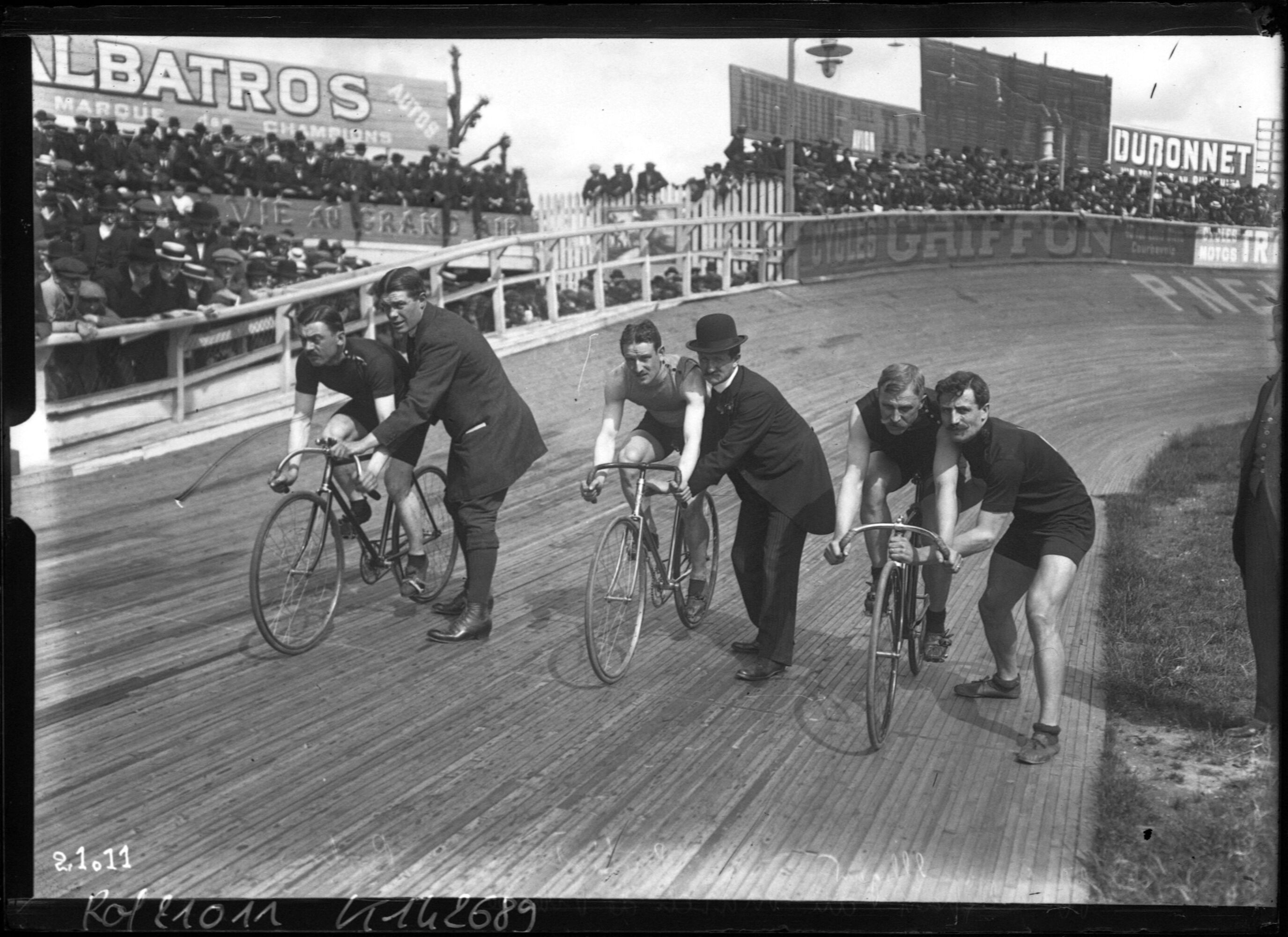
Three riders are already sitting on their bicycles. Three handlers keep them upright. Behind them, spectators crowd the steep wooden track and advertising covers the rail. In a moment, a slow tactical contest may turn into a few seconds of violent acceleration.
The photograph was taken at Vélodrome Buffalo near Neuilly-sur-Seine on 2 June 1912. From left to right, according to the archive record, it shows the Dane Thorvald Ellegaard and the French riders André Perchicot and Gabriel Poulain before a sprint match.
A caption that changed the story
A later collectors’ version of the photograph carried the words “Prix Lion” and associated Léon Hourlier with the scene. It appeared convincing, but it did not match the original registration at the Bibliothèque nationale de France, where the date, venue and three riders are named.
This is not a trivial difference. When a historical photograph is copied, cropped and given a new caption, the event itself can acquire a new identity. This story therefore begins with the original press archive, not the later inscription.
The Dane in an international field
Thorvald Ellegaard was 35 in the summer of 1912 and already one of the most successful track riders of his generation. He had won the professional world sprint championship six times: in 1901, 1902, 1903, 1906, 1908 and 1911.
Born Thorvald Kristian Kristensen at Fangel near Odense, he later adopted the name Ellegaard. He trained as a bricklayer at home before becoming a professional specialist in sprint, tandem and motor-paced racing. The Danish Biographical Dictionary credits him with 154 tandem victories alongside 49 different partners.
The Buffalo photograph does not show a Danish visitor making a chance appearance. Ellegaard belonged to the international professional circuit and lived in France for long periods.
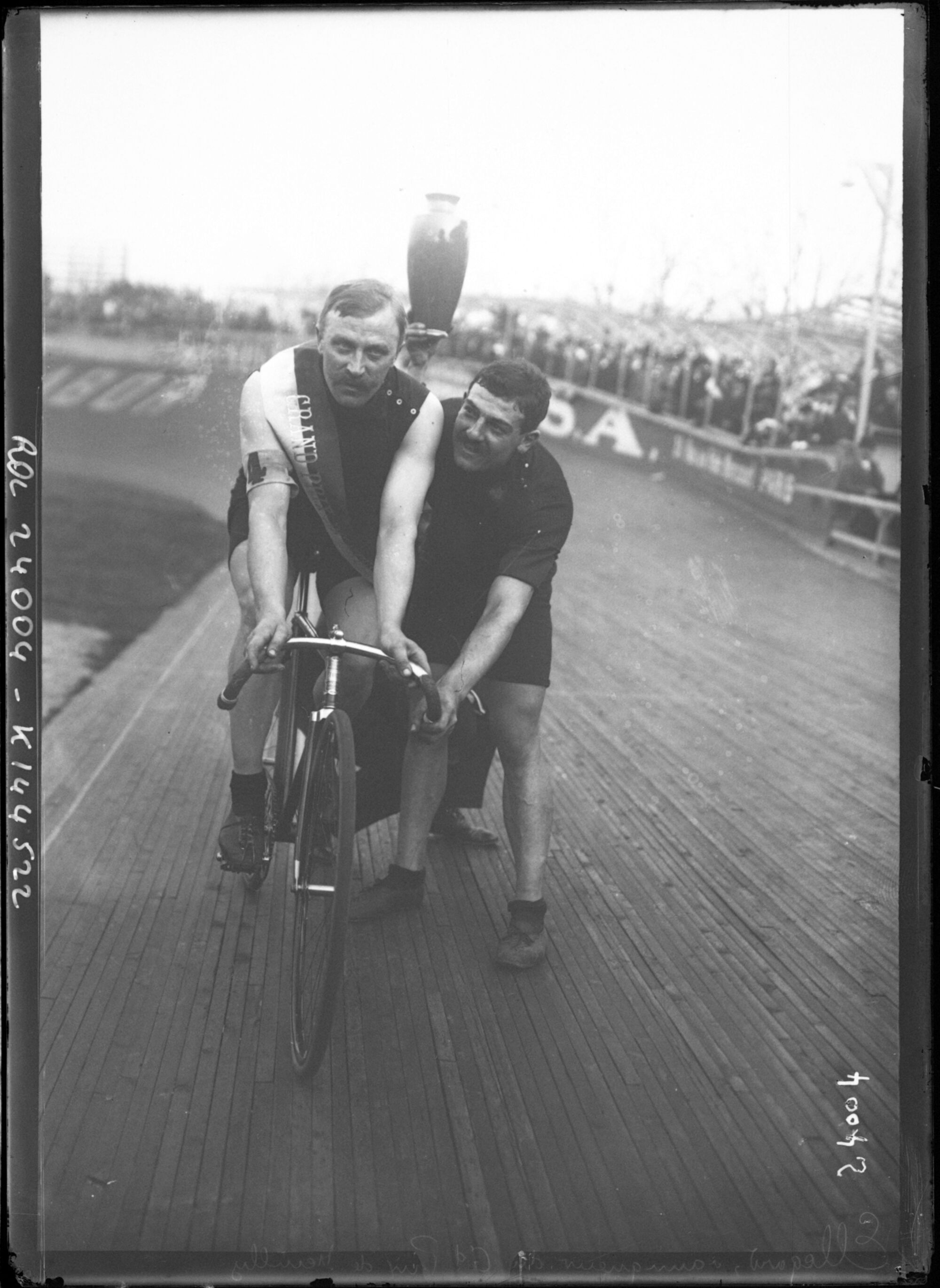
The sprinter’s bicycle was almost bare
The machines in the start photograph are built for the track. They have fixed gears, one ratio and no visible brakes. The bars are narrow and low, and the riders sit far forward over the front wheel. Anything that does not contribute to speed or steering has gone.
A sprint did not necessarily begin at full speed. Riders could hold back, look for an opponent’s wheel and try to force someone else to open the sprint. The handlers in the photograph provide a standing start without a foot touching the track. Position, observation and timing then decided who gained the best line.
Perchicot and Poulain were not extras
André Perchicot and Gabriel Poulain were established French sprinters in their own right. It is tempting to let Ellegaard’s name dominate the frame, but the picture records the international strength of the sport: three professional specialists on one start line in front of a paying crowd.
No secure result for this particular match on 2 June has been found. The article therefore names no winner. A photograph can document who was on the track without telling us who crossed the finish line first.
The same year, another discipline
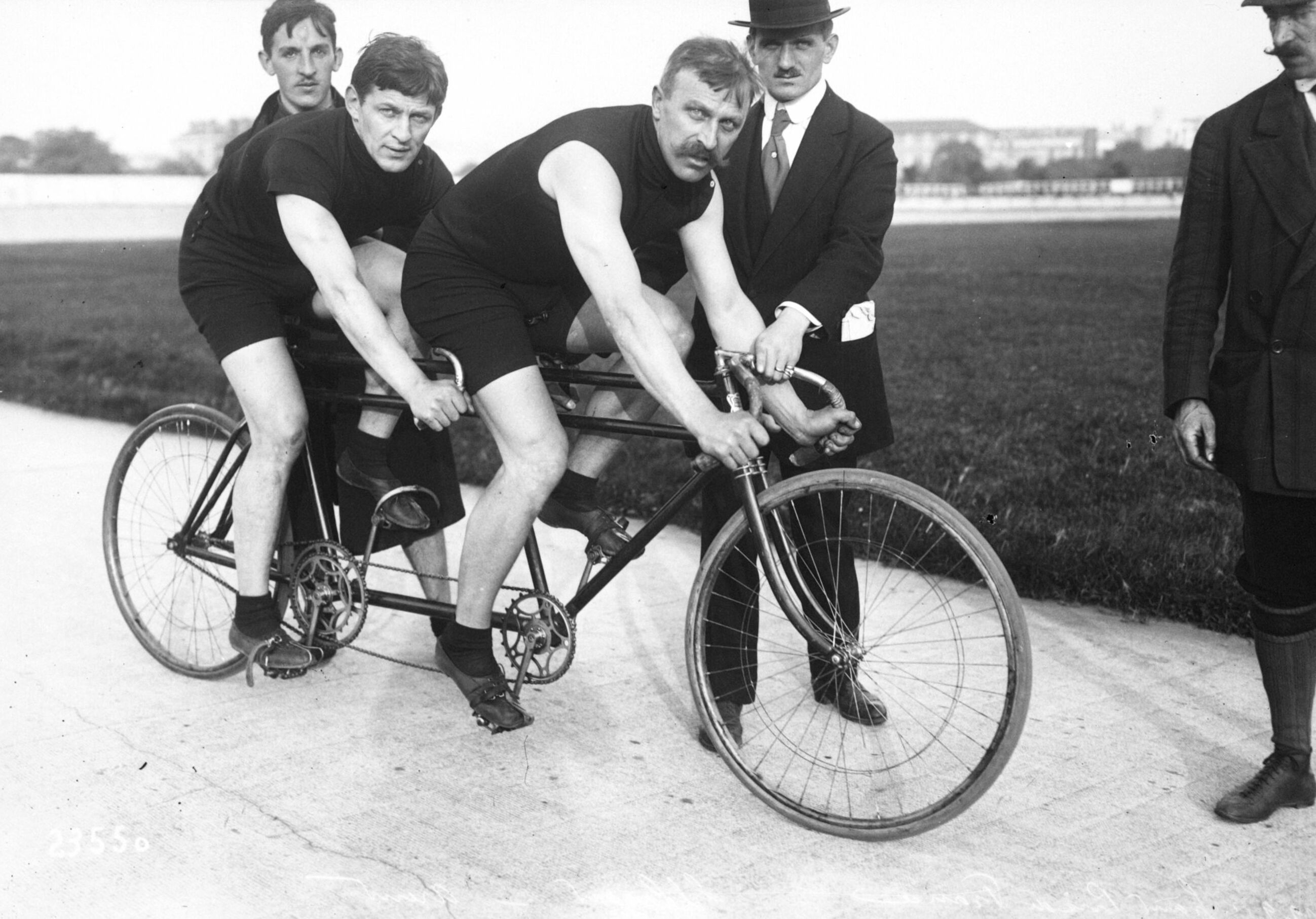
The third photograph shows another side of Ellegaard’s work. He sits at the front of a tandem with the German Willi Arend behind him. The archive describes them as winners of the tandem final at the 1912 Grand Prix de France.
The front rider steered. Both riders had to deliver power in the same rhythm while the long bicycle was guided around the track. Ellegaard’s many tandem victories show that professional track riders of the period did not necessarily remain within a single discipline.
The track as a stage
Buffalo was one of several major tracks around Paris. Track racing was not a sideshow to road cycling but a spectator industry of its own, with stars, programmes, advertising and events across much of the year. Spectators saw the riders at close range and learnt the difference between a sprinter, a stayer and a tandem pairing.
There is no speed yet in the start photograph. That is precisely why it works. It holds the brief moment in which the mechanics, riders and handlers are still while the rest of the track waits.
Sources and image notes
All three photographs are Agence Rol press images held by the Bibliothèque nationale de France and made available as public domain through Wikimedia Commons. The result of the sprint match on 2 June has not been established from the sources used here.
- Wikimedia Commons/BnF: Buffalo sprint match, 2 June 1912
- Wikimedia Commons/BnF: Ellegaard wins the Grand Prix de Neuilly, 13 October 1912
- Wikimedia Commons/BnF: Ellegaard and Arend at the 1912 Grand Prix de France
- Danish Biographical Dictionary: Thorvald Ellegaard
- Conservatoire numérique des Arts et Métiers: Paris velodromes


Continue exploring
More from cycling history
The Tour winner nobody expected
Roger Walkowiak won no stage in the 1956 Tour. He won the race because the favourites first underestimated his breakaway and later could not drop him.
Read the story →
When the Tour de France moved into the children’s room
Small cast cyclists turned pavements, sandpits and carpets into stage races — and later became collectibles with their own moulds, poses and peculiarities.
Read the story →
When cycle racing entered the living room
See the races, people, bicycles and changes that shaped the period.
Explore the period →