Tour de France · 1913
Christian Christensen
on to Paris
The first Danish Tour rider arrived too late on stage 13 in 1913. His official race ended there. According to later accounts, he nevertheless rode the final two stages to Paris.
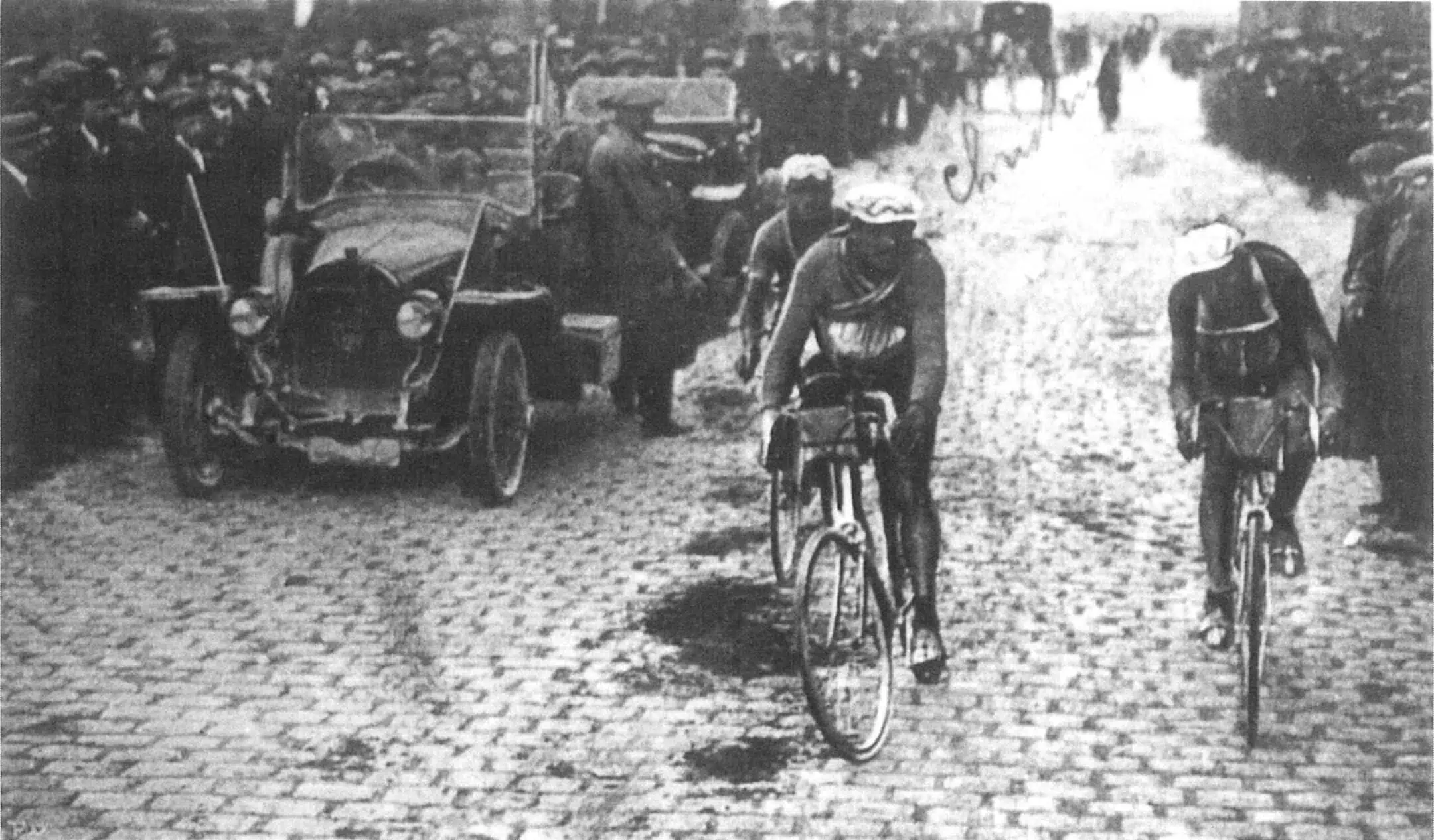
Christian Christensen reached Longwy, but went no further in the classification. It was 23 July 1913, and after almost four weeks in the Tour de France he had missed the time limit. His participation ends in the results on stage 13 from Belfort. Two stages remained.
Later descriptions of his Tour say that he rode those stages too. He therefore reached Paris by bicycle, but without an overall placing. That distinction is essential to the story of the first Dane in the race.
The dairy worker from Veflinge
In Denmark his name was Knud Kristian Kristensen. He was born in Veflinge on the island of Funen on 4 April 1889 and trained as a dairy worker. In 1908 he moved to France to work in dairy production. He was nineteen and had a trade he could practise abroad.
In Normandy he found work and a new everyday life. He stayed, married a French woman and entered the cycling community around Cherbourg, where he was associated with the Cherbourg Pédale club. In race records his name became Christian Christensen. That is the form under which he appears in the Tour lists.
He was therefore a Danish-born rider whose life was based in France when he started the 1913 Tour. There was no Danish team around him. He entered as an isolé, an individual rider without a place on one of the large factory teams.
Smaller races before the great tour
Later Danish accounts say that the Tour was not his first experience of racing and that he had distinguished himself in smaller events. One account also mentions victories. The sources found so far do not, however, provide secure race names or result lists. His club membership and the later descriptions are useful traces, but not a complete record of his career.
Far behind, but still in the race
The race began on 29 June with 388 kilometres from Paris to Le Havre. Christensen finished 100th. Two days later, stage two ended in Cherbourg, the centre of his French life. He placed 68th, a little over two hours behind stage winner Jules Masselis.
It would therefore be misleading to describe him as a rider who immediately appeared near the front. His achievement lay in keeping going. On stage three to Brest he was 54th, almost four hours behind the winner. Such time losses could still be survived in that Tour, provided a rider remained within the day's limit.
The stage from Cherbourg to Brest was 405 kilometres. The next, to La Rochelle, was longer still at 470 kilometres. Long before the mountains were behind them, the riders had already spent several very long days on the road.
Christensen made it through both the Pyrenees and the Alps. On 21 July he finished 25th on the stage from Geneva to Belfort, his best placing in the race. Three stages remained, and the next became his last in the official record.
The wrong road to Longwy
Something went wrong on stage 13. The later story says that Christensen took a wrong turn and lost enough time to arrive in Longwy after the time limit.
Østfyns Museer gives a fuller version: while passing through Alsace-Lorraine, he left the correct road and German soldiers failed to warn him. The soldiers' role has not been confirmed in a contemporary source found for this article, so it remains part of the story as it was later handed down.
At the time, the area formed part of the German Empire following its annexation in 1871. That is more precise than simply calling it German-occupied. The name Tour de France did not mean that the entire route lay inside the French borders of the day.
The accounts also differ over his arrival. In one version he was turned away at the control; in another, the officials had already left. What they share is that the delay ended his right to continue in the classification. The results record his official exit on this stage.
Two stages without a placing
His journey could have ended there. According to both the Danish museum account and the French local-history account, however, Christensen rode the final two stages anyway. He followed the Tour to Paris outside the competition.
We do not have official times for those two days, and there was no longer an overall placing to be won. He should therefore not be given an imagined final position or added to the list of official finishers.
Christensen was the first Danish rider to participate in the Tour de France. The first Dane to finish with an official placing was Hans Andresen in 1958. The Tour's own historical presentation makes precisely that distinction.
Christensen's story lies in the space between those two statements. He was out of the race in Longwy. According to the story handed down, he still had two stages he intended to ride.
Sources and image notes
The stage results have been compared with historical result databases. The wrong turn and the continuation to Paris are based on later accounts. The episode involving the soldiers has not been confirmed in a contemporary source. The smaller races before the Tour have not yet been identified through secure event names and results.
- ProCyclingStats – Christian Christensen's 1913 Tour results
- Wikimanche – Christian Christensen
- Østfyns Museer – Fyn forrest i feltet
- MyHeritage – Christian Christensen from Veflinge
- Ruder 7 – Mit liv med Tour de France 1
- Wikimanche – stage two of the 1913 Tour
- ProCyclingStats – stage three of the 1913 Tour
- Library of Congress – Alsace-Lorraine
- Tour de France – 2022 press kit
Continue exploring
More from cycling history
When the Giro paid Binda to stay at home
Alfredo Binda had made the Giro so predictable that the organisers paid him 22,500 lire not to start.
Read the story →
French champion at 52
Jeannie Longo won the 2011 French time trial championship at the age of 52, finishing 42 seconds ahead of the runner-up.
Read the story →
When war closed the roads
See the races, people, bicycles and changes that shaped the period.
Explore the period →