The period 1940–1949
When war closed
the roads
The major stage races disappeared. When they returned, cycle racing reflected both continuity and reconstruction.
The common period model
The 1940s in three views
The decade’s main development
War interrupted the international calendar. After 1945, races, teams and bicycle production had to be assembled again.
What defined the period
Shortages, occupation and closed borders were followed by reconstruction, renewed rivalries and cycling’s return as mass entertainment.
Three changes to cycling
- The grand tours disappeared and returned
- The Cambio Corsa made shifting possible while riding
- Coppi completed the first Giro–Tour double
Selected events
A short timeline
- Fausto Coppi wins the Giro d’Italia at the age of twenty.
- The six-stage Circuit de France attempts to replace the absent Tour.
- Coppi is captured in North Africa; Bartali begins courier work after the German occupation of Italy.
- The Giro returns; Bartali wins ahead of Coppi.
- Jean Robic overturns the Tour on its final stage.
- Bartali wins the Tour ten years after his first victory.
- Coppi becomes the first rider to win the Giro and Tour in the same season.
- Campagnolo introduces the single-lever Paris–Roubaix gear.
Seven fixed themes
The decade, seen across the site
Races and defining moments
The grand tours vanished during the war. Their return produced Robic’s final-day victory in 1947, Bartali’s comeback in 1948 and Coppi’s Giro–Tour double in 1949.
Follow this theme through cycling history →Riders of the period
Bartali’s courier work and Coppi’s captivity belonged to lives larger than the result sheet. When racing returned, both men became central to Italy’s sporting reconstruction.
Follow this theme through cycling history →Bicycles and technical change
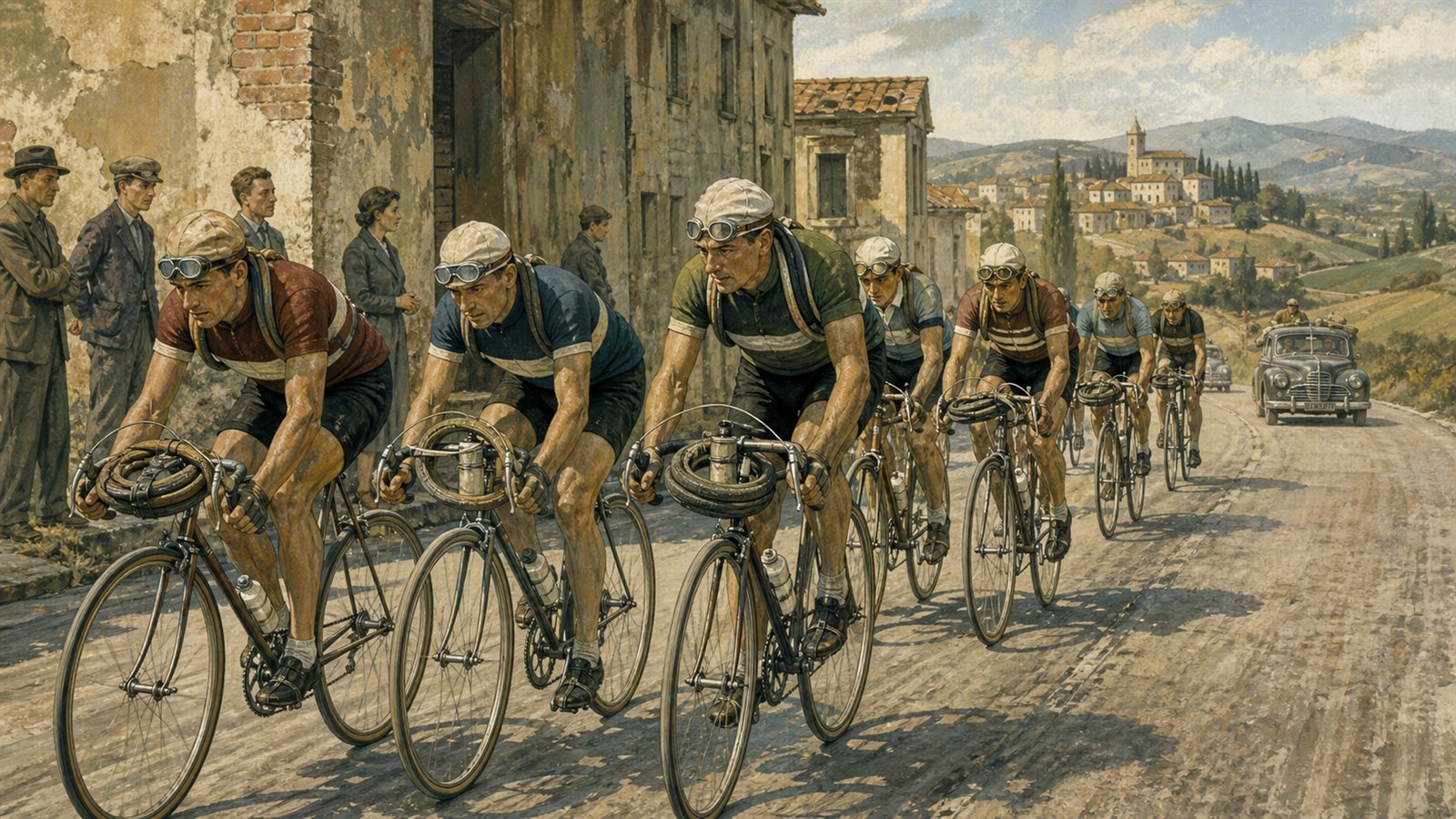
Cambio Corsa and the Paris–Roubaix gear still moved the rear wheel during a shift. The Stella Veneta from 1947 makes this demanding transition visible.
Follow this theme through cycling history →Nutrition, training and science
Rationing made access to food part of the conditions. After the war, military amphetamine stocks entered civilian life and sport, but precise anecdotes require careful sourcing.
Follow this theme through cycling history →Cycling culture and everyday life
Where fuel and public transport were scarce, the bicycle remained practical transport as well as sporting equipment. Racing returned to crowds hungry for ordinary public life.
Follow this theme through cycling history →Society and the times
Occupation, persecution and reconstruction shaped every part of the decade. Cycling could serve propaganda, clandestine work and, later, a renewed shared calendar.
Follow this theme through cycling history →The people behind cycling
Couriers, mechanics, organisers and families kept cycling’s networks alive. Their work explains how the sport survived years without its familiar international races.
Follow this theme through cycling history →A break in the middle of the calendar
A decade is normally a continuation. The 1940s first became an interruption. Races, factories, newspapers and the lives of riders were drawn into the war — and the sport later had to rebuild its rhythm.
1940–1945
The grand tours disappear
Fausto Coppi won the Giro d’Italia in 1940 at just 20 years of age. The race was then suspended until 1946. The Tour de France had last been held in 1939 and did not return until 1947.
Cycle racing did not cease entirely. Local and national races were organised when conditions allowed, but the international calendar had broken down. Borders, transport, fuel, materials and security imposed entirely different limits from those before the war.
For many riders, the lost seasons were not merely a gap in a results list. They fell in the middle of the few years when a professional would normally be at his physical best.
1946
The Giro returns
When the Giro d’Italia was held again in 1946, its route crossed a country with visible war damage and deep political tensions. La Gazzetta dello Sport had resumed publication in 1945 and announced the race’s return in January 1946.
Gino Bartali won ahead of Fausto Coppi. Their rivalry had roots before the war, but now acquired a meaning that extended beyond the two riders. Bartali was often presented as the traditional and devout hero; Coppi as the lean, modern and methodical challenger. Reality was more complicated, but the contrast made good newspaper copy.
Coppi won the Giro the following year. In 1949, he won both the Giro d’Italia and the Tour de France and became the first rider to take the two major stage races in the same year.
The Tour finds a new winner
Jean Robic reached the final stage without ever having worn the yellow jersey. An attack on the road to Paris overturned the standings, and he won the first post-war Tour.
Bartali, ten years later
Gino Bartali won the Tour de France for the second time — ten years after his victory in 1938. His attacks in the Alps decided the race after rain, cold and snow in the mountains.
Mechanics between two ages
The wheel still had to be loosened
In 1946, Campagnolo applied the name Cambio Corsa to its two-lever system. The rider could change between sprockets without dismounting, but had to reach backwards, release the rear axle, move the chain and tighten the wheel again while the bicycle was rolling.
The design is often called the “suicide shifter” today. That was not its usual contemporary name. For professionals of the time, it was a demanding but usable step between the reversible rear wheel and the spring-loaded derailleur.
In 1949 came the single-lever system later known as Paris–Roubaix. It simplified operation, but the rear wheel still had to move to keep the chain tensioned.
Last place becomes visible
The black jersey
When the Giro returned in 1946, the black jersey was associated with the rider at the bottom of the general classification. Luigi Malabrocca finished last in both 1946 and 1947 and became the first major figure in the jersey’s peculiar afterlife.
Prizes and publicity made last place attractive enough for some riders to try to lose time without exceeding the time limit. There are many stories of hiding places, punctures and deliberately slow riding, but the individual incidents deserve to be investigated as stories in their own right.
In 1948, Aldo Bini finished last after completing the race with a broken hand. His position was therefore quite different from a comic contest to progress as slowly as possible.
Food, medicine and experience
Before sports science became a system
Riders’ diets relied more on tradition, team habits and what could be obtained than on precise plans for carbohydrates and fluids. Bread, rice, pasta, eggs and meat appeared in large meals, while coffee, wine and other drinks could also accompany riders through long days.
It is tempting to turn the period into a parade of steaks and red wine, but wartime and post-war rationing made reality far less uniform. Access to food was itself part of the conditions.
Stimulants had long been used in endurance sport. Amphetamine was used by the military during the war and spread through civilian life and sport after 1945. There was not yet an effective anti-doping system, but this does not mean that every precise cocktail recipe or later quotation from a rider can serve as reliable evidence for the 1940s.
Sources
The basis for this period
- Giro d’Italia: official historical archive, 1933–1947
- Giro d’Italia: official historical archive, 1948–1957
- Tour de France: the Tour’s return and Robic’s victory in 1947
- Disraeli Gears: Campagnolo documents and gear history
- Journal of the History of Medicine: military use of amphetamine during the Second World War