1933–1945 · Story
Jan van Hout and the 44,588 metres
An hour on the track left a distance of 44,588 metres and an argument about measurement. Beyond the record lay a café in Eindhoven and the people Jan and Anneke helped into hiding.
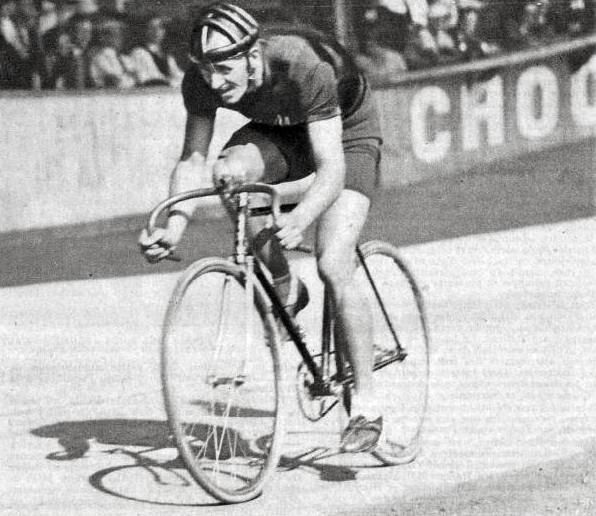
An hour at Maasniel
Jan van Hout has ridden for an hour on the track at Maasniel, near Roermond. It is 25 August 1933, and the distance is calculated as 44 kilometres and 588 metres. That is 341 metres farther than the 44,247 metres recorded by Switzerland’s Oscar Egg in 1914. Nineteen years of waiting appear to be over. Then the argument about the length of the track begins.
It is a rather thankless ending to an hour-record attempt. A rider can provide the speed. He cannot pedal the track any longer afterwards if someone questions its measurement. And the objection comes from the very man whose distance he has surpassed.
One lap at a time
Van Hout was born in Valkenburg in 1908, but his cycling life is based in Eindhoven. The year before Maasniel, he has already set a Dutch hour record in Tilburg. Now the target is international, and the extra distance must come from repeating the same movement, lap after lap, without giving anything away.
An hour record is easy to explain and less pleasant to ride. There is no partner to take a turn and no bunch to shelter in. Start too fast and the bill arrives while the clock is still running. Start too cautiously and there is less time to recover the missing metres. A good lap only helps if the next ones hold together too.
On paper, the attempt is a calculation involving time, laps and track length. On the bicycle, the rider must supply the required speed. That makes measurement essential: the same number of laps produces different distances if two different lengths are used. The legs have done their work. The rest depends on measuring and checking.
Van Hout’s calculated distance puts him ahead of Egg. But the Swiss rider comes to measure the track himself. Later accounts say he considers each lap more than three metres shorter than claimed. That may sound trivial. Multiply it by more than two hundred laps and it exceeds the entire improvement.
Metres and paperwork
Egg’s objection is itself disputed. The Dutch sports-history publication De Sportwereld describes his calculation as wrong and reports that the Dutch federation failed to send the necessary documents to the UCI. Other later accounts place more weight on the unresolved argument about the track.
The precise administrative sequence remains disputed. Van Hout’s performance does not receive the straightforward place on the record list that the distance suggests. Both points matter: a distance was calculated, and a dispute followed. Separating the effects of measurement from those of paperwork is harder.
France’s Maurice Richard subsequently rides 44.777 kilometres at Sint-Truiden. Van Hout’s distance is surpassed, while his attempt remains caught between measurement, paperwork and later recognition. Several subsequent record histories include his 44,588 metres. A short hour on the track can leave a very long aftermath.
Sportpaleis closes
Track racing provides Van Hout with a living, including appearances at six-day events. He later opens a café in Eindhoven called Sportpaleis. A rider cannot live indefinitely on the next appearance fee; a café offers a more tangible plan for life after racing.
During the German occupation, he closes the business. Later accounts say he refuses to serve the occupying soldiers. He and his wife Anneke help people into hiding. Here the story leaves the track: their work concerns keeping people concealed.
Neuengamme’s digital register records resistance activity as the reason for his arrest. He arrives from Amersfoort on 10 September 1944 and dies in Neuengamme concentration camp on 22 February 1945, aged 36. His arrest therefore cannot have occurred in 1945, as some short biographies claim.
In 2006 a memorial to Van Hout is unveiled in Valkenburg with Anneke and Bernard Hinault taking part. A results list gives him a line containing a name, a date and a distance. At the memorial there is reason to stay a little longer. The 44,588 metres still belong to the story. So do the café and the help given to people who had to hide.