The period 1930–1939
When the racing bicycle
became modern
The Tour took control away from the bicycle manufacturers. The Vuelta was born. And eventually riders were allowed to change gear without reversing the rear wheel.
The common period model
The 1930s in three views
The decade’s main development
The racing bicycle moved from stopping to change ratio towards practical gear changes made while riding.
What defined the period
National teams, the publicity caravan and new stage races made cycling more organised, commercial and politically visible.
Three changes to cycling
- The Tour introduced national teams
- The first Vuelta was held
- Derailleurs were admitted to the Tour
Selected events
A short timeline
- The Tour replaces trade teams with national selections and launches its official publicity caravan.
- The Giro pays Alfredo Binda not to start after four overall victories in the 1920s.
- Tullio Campagnolo establishes the company that grows from his wheel-release patents.
- The first Vuelta a España is held; Gustaaf Deloor wins.
- Romain Maes leads the Tour from the first stage to Paris.
- Derailleurs are admitted to the Tour; Roger Lapébie wins with Super Champion.
- Gino Bartali wins his first Tour de France.
- Sylvère Maes wins the final Tour before the Second World War.
Seven fixed themes
The decade, seen across the site
Races and defining moments
The first Vuelta, Romain Maes in yellow from start to finish and the last Tour before the war made the decade far more than a technical interlude.
Follow this theme through cycling history →Riders of the period
Binda’s dominance became an organisational problem, Bartali emerged as Italy’s great stage-race rider, and the Deloor brothers carried the first two Vueltas back to Belgium.
Follow this theme through cycling history →Bicycles and technical change
Quick-release hubs shortened wheel changes, while Super Champion finally brought the derailleur into the Tour. The Wonder Saint-Étienne shows the transition in metal and cable.
Follow this theme through cycling history →Nutrition, training and science
Food and drink still followed habit, availability and individual experience. Later stories about alcohol, tobacco and stimulants must be separated from documented daily practice.
Follow this theme through cycling history →Cycling culture and everyday life
The publicity caravan turned the road before the riders into a travelling advertising show. Toy cyclists later brought the spectacle into homes and onto pavements.
Follow this theme through cycling history →Society and the times
National teams made flags and politics more visible in sport. The Spanish Civil War interrupted the new Vuelta, while the 1939 Tour became the last before a far larger interruption.
Follow this theme through cycling history →The people behind cycling
Desgrange and his organisation changed the Tour’s economy and team structure. Inventors such as Lucien Juy changed what riders could do without stopping.
Follow this theme through cycling history →A yellow bicycle without a manufacturer’s name
For the 1930 Tour, the organiser supplied the bicycles. They were yellow, uniform and lacked the brand names that had previously controlled the teams. Henri Desgrange wanted his own competition back.
The organiser takes control
From trade teams to national teams
Henri Desgrange believed that the large bicycle manufacturers had gained too much influence over the Tour de France. In 1930, trade teams were replaced by national teams, and the organisation supplied anonymous yellow bicycles to the riders.
It was expensive. With manufacturers no longer paying for the riders’ accommodation, transport and meals, the race needed new income. The answer was the publicity caravan: a long line of vehicles that drove ahead of the peloton, bringing products, entertainment and the atmosphere of the Tour to spectators along the road.
The change made nationality more visible. France, Belgium, Italy, Spain and Germany each appeared in their own colours. In a Europe of growing nationalism, this was not a neutral detail.
The Vuelta begins
The first Vuelta a España started on 29 April 1935. Its route comprised 14 stages and 3,425 kilometres, starting and finishing in Madrid. Belgian Gustaaf Deloor won and repeated his victory in 1936 before the Civil War interrupted the race.
Maes from start to finish
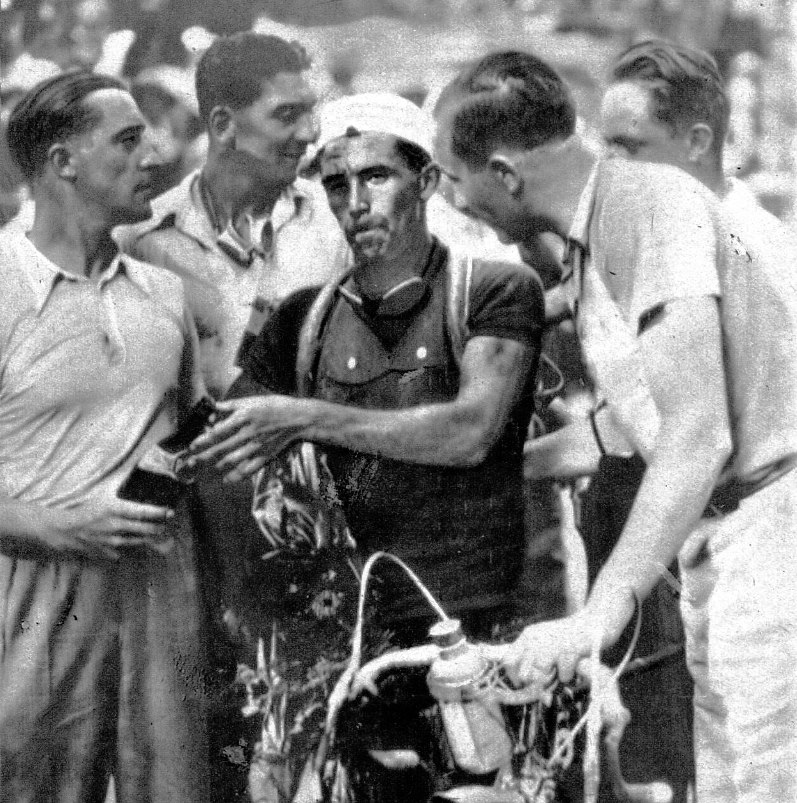
Romain Maes took the Tour’s yellow jersey on stage one and kept it all the way to Paris. The photograph above shows something the result does not: how a winner looked immediately after another hot day.
Mechanics enters the race
Changing gear without turning the wheel
The reversible rear wheel was simple: one sprocket on either side of the hub. A lower gear required the rider to dismount, loosen the wheel, reverse it and fit it again. It worked, though not while moving.
Derailleurs already existed, but Henri Desgrange had long kept them out of the Tour. In 1937, the Super Champion system was permitted for the whole field. A chain guide moved the chain between the sprockets while an arm kept it tensioned. The rider had to pedal backwards during the shift, but the wheel could stay in place.
It was not yet the modern parallelogram derailleur. It was, however, a clear farewell to the roadside stop.
The new gears are tested
A solution with consequences
Super Champion made it possible to choose another gear before the climb was over. It changed more than the bicycle. The rider could react to terrain and attacks without first losing time at the roadside.
Roger Lapébie won the 1937 Tour de France with the new system. That same year, Jules Rossi became the first Italian winner of Paris–Roubaix. It is tempting to let one classic victory prove the gear’s entire value, but the race shows primarily that the new technology could be used at the highest level.
The collection’s 1937 Wonder Saint Étienne makes the development tangible. It shows how different a gear system could look immediately before the derailleur acquired its more recognisable form.
Food on the road
A feed stop could also be a café
Feeding had become more organised around the national teams, but the day’s food and drink remained far removed from today’s carefully calculated plans. Riders ate bread, fruit, rice, eggs and meat and drank coffee, water, wine and beer among other things. It varied from team to team and day to day.
A frequently repeated story from the 1935 Tour says that Julien Moineau had friends waiting with beer along the stage between Pau and Bordeaux. When other riders stopped in the heat, he continued and won alone. It is a good story, but the colourful details rely on later accounts and deserve their own article if they are to be fully explored.
The same applies to doping stories from the period. Stimulants existed, and there was no modern testing, but precise recipes involving cocaine, strychnine, ether and nitroglycerine are often repeated without a contemporary source. They should not be treated as a certain standard description of the entire peloton.
1938–1939
First Bartali won.
Then the calendar closed.
Gino Bartali won the Tour de France in 1938. His victory was used in Fascist Italy’s public narrative, but Bartali’s own relationship with the regime was cool and cannot be reduced to a propaganda poster.
Sylvère Maes won the Tour in 1939. It was the last edition before the Second World War. When the race returned in 1947, its organisation, its riders and Europe itself had changed.
Sources and image note
