Paris–Roubaix · 1934
The spectator's bicycle that cost Lapébie Paris–Roubaix
Roger Lapébie punctured near the finish, borrowed a spectator's bicycle and crossed the line first. The rules awarded victory to Gaston Rebry.
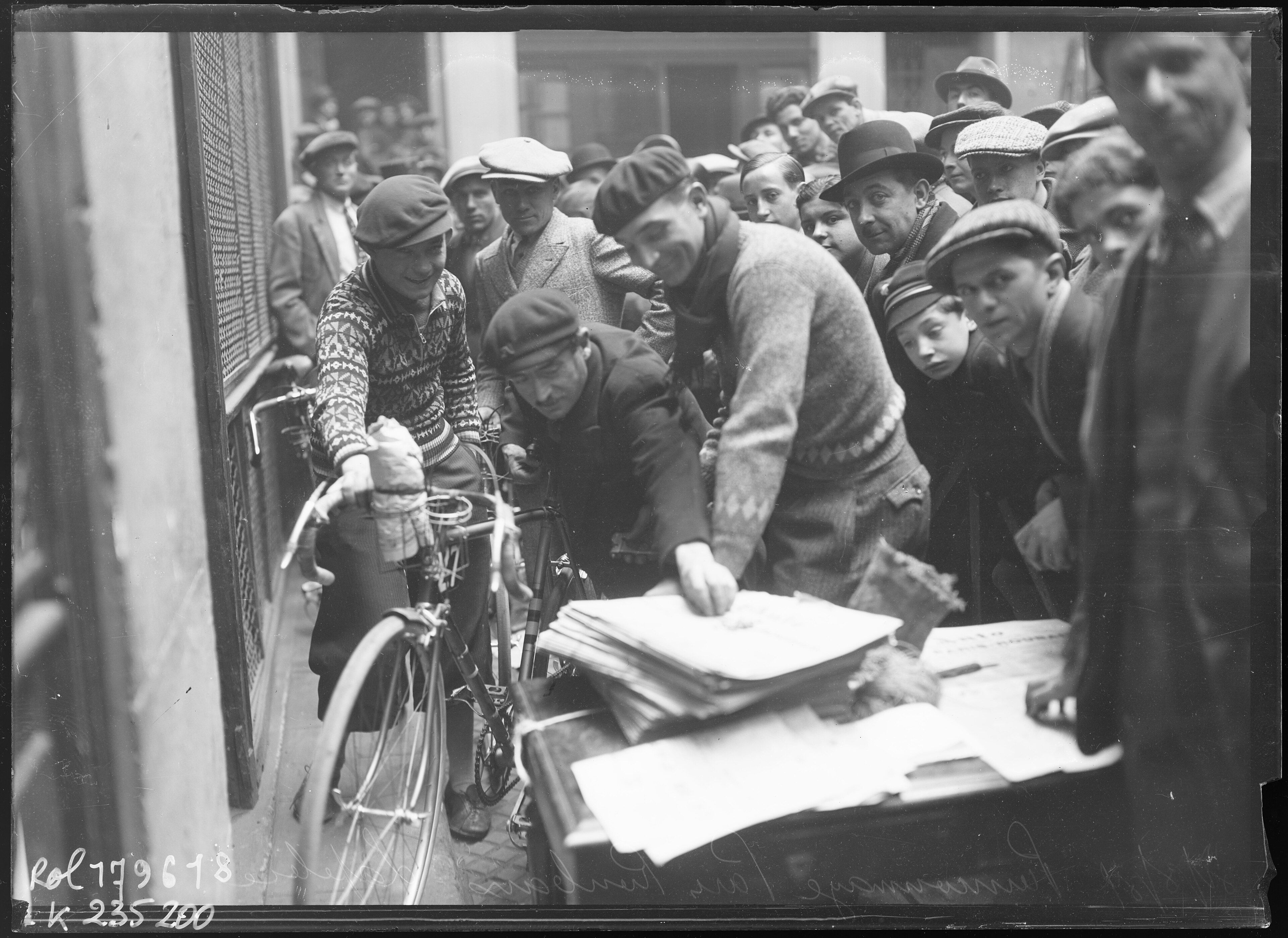
Roger Lapébie punctured near the finish, borrowed a spectator's bicycle and crossed the line first. The rules awarded victory to Gaston Rebry.
Fifteen kilometres from Roubaix
On 1 April 1934, Roger Lapébie was approaching the finish of Paris–Roubaix when he punctured roughly fifteen kilometres from the line. Today a mechanic would offer a wheel. In 1934 the help was less straightforward, and the rules did not allow a rider simply to change to any bicycle he could find.
A bicycle from the roadside
Lapébie found a way forward. He took a spectator's bicycle and continued towards Roubaix. A later French account says the bicycle had been lying in a ditch. It is a vivid detail, but one preserved in a later retelling. What is certain is that the bicycle belonged to a spectator and that the change was forbidden.
First across the line
The unfamiliar bicycle was good enough to carry Lapébie back into the race. Sources differ over whether he arrived alone or settled the result against Gaston Rebry. They agree on the important point: Lapébie crossed the finish line first.
The rule held
The result did not stand. Lapébie was reported for the illegal bicycle change and disqualified. His legs had not failed him; the problem was the solution he chose after the puncture. Paris–Roubaix was already a race in which mechanics and rules could matter as much as speed.
Rebry received the victory
Gaston Rebry was declared the winner. The Belgian had already won the race in 1931 and would win it again in 1935. The 1934 victory officially belongs to him, although the first rider into the velodrome that day was Lapébie.
The lost victory
Lapébie later won the Tour de France in 1937. At Paris–Roubaix in 1934, however, he became the man who arrived first without receiving the victory. A puncture, a borrowed bicycle and a rule produced a result that the finish line alone could not decide.
Sources
- L’Équipe: Gaston Rebry and Paris–Roubaix 1934
- Le Monde, 19 April 1949: retrospective on Lapébie's disqualification
- Le Monde, 14 April 1970: the puncture and spectator bicycle
- Paris–Roubaix: official history
- DirectVelo: wheel changes and the rules of Paris–Roubaix
- Wikimedia Commons/BnF: Roger Lapébie at bicycle inspection, 31 March 1934
Continue exploring
More from cycling history
When Oosterbosch found the time trial again
On 6.6 wet kilometres through Winschoten, Bert Oosterbosch beat team-mate Eric Vanderaerden by eleven seconds and briefly recovered his speciality.
Read the story →
Ole Ritter's hour in Mexico City
On 10 October 1968, Ole Ritter rode farther in one hour than anyone before him. The thin air of Mexico City helped the speed, but it did not make the effort easier.
Read the story →
Pioneers and endurance
See the races, people, bicycles and changes that shaped the period.
Explore the period →