Tour de France · 1935–1937
When gears arrived
— and beer fooled the peloton
Two stories from a Tour balancing raw strength, new technology and refreshment at the roadside.
Technical resistance
In 1937 the Tour took a long-awaited step: riders on the official national teams were allowed to use derailleurs for the first time.
Derailleurs had existed for years, but Tour founder Henri Desgrange had resisted them. He believed the race should test raw strength, endurance and personal will. Modern assistance might make it too easy.
Gears were often presented as equipment for older cyclists, tourists and riders too weak to climb on their own legs.
Changing gear at the roadside
Riders were not necessarily limited to one gear. Many bicycles had several rear sprockets, but no way to move between them while riding.
When the terrain changed, the rider stopped, loosened the wing nuts and moved the chain. Sometimes the entire wheel had to be reversed. The process cost time and strength before a mountain — and had to be repeated afterwards.
For Desgrange, the trouble was part of the test. For the riders, it was time lost at the roadside.
The yellow L’Auto bicycles
Since 1930, organisers had supplied national-team riders with identical yellow bicycles bearing the name of L’Auto. This reduced manufacturers’ influence and suggested victory belonged to the rider, not the maker.
As Jacques Goddet took over from the ageing, ill Desgrange, rules were modernised. In 1937 national-team riders could finally change gear without dismounting. It changed mountain racing and marked the beginning of the modern Tour bicycle.
Two years earlier
While technology was held back,
a cold beer could still change a bicycle race.
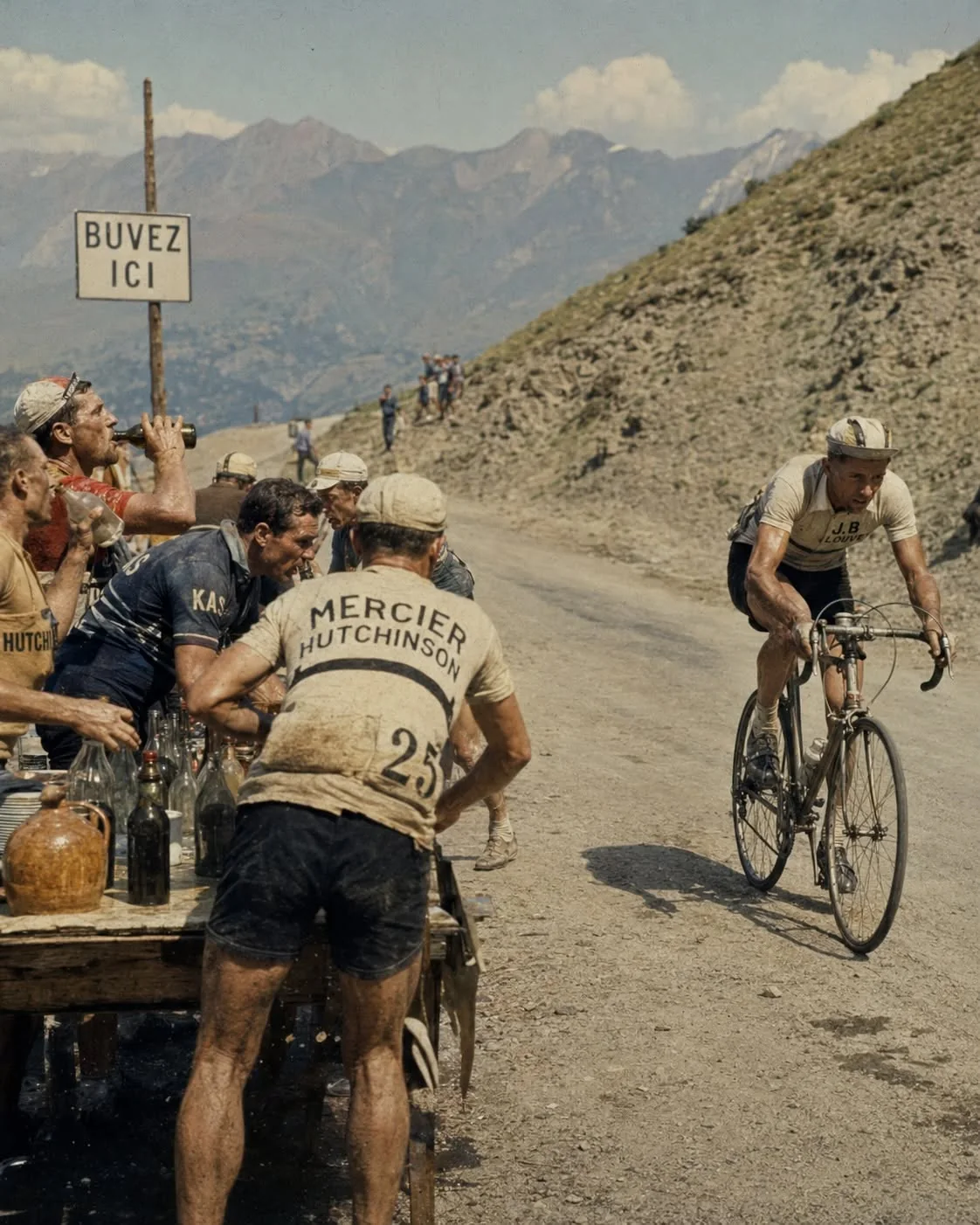
The 1930s Tour was more improvised than today’s tightly organised event. Riders accepted food and drink from spectators, shopped en route and sometimes stopped at cafés. Wine and beer were ordinary provisions, and cold drinks were hard to resist on a hot day.
In 1935 this produced one of the Tour’s best-known and most disputed episodes.
A table near Le Barp
On 24 July the riders covered the 224-kilometre 17th stage from Pau to Bordeaux. Julien Moineau, a 31-year-old French individual rider, knew the area and had connections near Arcachon.
After an early move was caught, he attacked again. Near Le Barp, about 50 kilometres from the finish, local spectators waited with cold beer and other drinks.
Many riders slowed or stopped. Moineau continued alone while his rivals were delayed by the refreshments and confusion.
Plan or opportunity?
The story soon spread that Moineau had arranged for friends to set up the table and keep his rivals occupied.
The plan has never been proved. Later Tour journalist Félix Lévitan said Moineau had placed friends there, but Moineau denied a plot. Perhaps he simply recognised an exceptional opportunity — and had the discipline to ride past.
Alone to Bordeaux
Moineau finished in 7 hours, 34 minutes and 30 seconds. Belgian sprinter Jean Aerts won the sprint for second 15 minutes and 33 seconds later. It was Moineau’s third and final Tour stage victory.
The story belongs to a time when the boundary between spectators, helpers and riders was less fixed. Modern rules, official feed zones and television coverage would make a repeat nearly impossible. In 1935, a few bottles at the roadside could decide a Tour stage.
First Moineau rode away.
Then the beer ensured the peloton stayed away.
Continue exploring
More from cycling history
When a bent crank gave Colnago access to the Giro
Ernesto Colnago was 23 when a mechanical observation on Fiorenzo Magni's bicycle took him into the Giro service crew.
Read the story →
When Coppi found a loophole in the Stelvio agreement
Koblet led the Giro by almost two minutes. Then Coppi sent a young team-mate up the road on the Stelvio.
Read the story →
Cycling’s wild pioneer years
See the races, people, bicycles and changes that shaped the period.
Explore the period →