Tour de France · 1998
When the Festina affair
made the Tour fall apart
It began with a car at the border. Three weeks later, the peloton removed its race numbers.
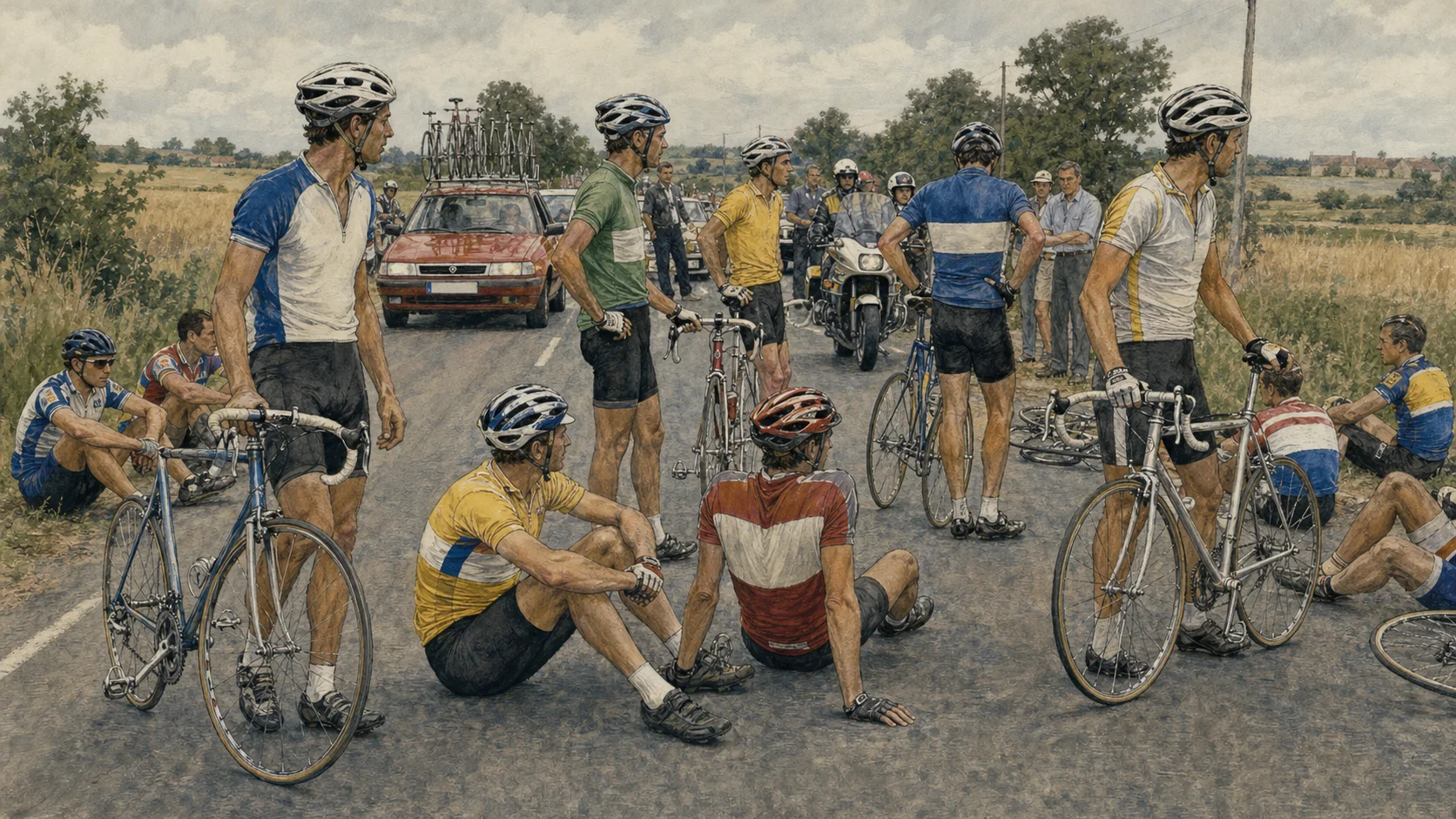
Neuville-en-Ferrain
Early on the morning of 8 July 1998, French customs officers stopped a car bearing the Festina name near the Belgian border.
At the wheel was the team’s soigneur, Willy Voet. The car contained a large supply of products, including EPO, growth hormone, testosterone and amphetamines.
Three days later, the Tour de France began in Dublin as though nothing had happened.
That was how the 1998 edition began: one race on the road and another story waiting with the police and the courts. Once the two met, the Tour did not stop all at once. It fell apart piece by piece.
The Tour continued while the case grew
Festina was not a minor team at the edge of the peloton. Richard Virenque was a favourite with the French public and had won the mountains classification five times. Alex Zülle had won the Vuelta a España twice. The team came to the Tour with sporting ambitions and a name most spectators knew.
On 15 July, after stage four to Cholet, team manager Bruno Roussel and doctor Eric Rijckaert were arrested. Police searched the team’s hotel and vehicles. On 17 July, Roussel admitted that the team operated an organised system for supplying doping products, under medical supervision according to his account.
Shortly before 11 p.m., race director Jean-Marie Leblanc announced Festina’s expulsion. The team was therefore removed nine days after the discovery in Voet’s car.
The following morning, the riders nevertheless appeared at the time trial. After a meeting, they left the Tour. Virenque cried in front of the cameras and continued to maintain publicly that he had not doped. It was not until the Festina trial in October 2000 that he admitted using doping products.
The rest day became a police day
On the rest day, 23 July, the nine Festina riders selected for the Tour and three staff members were questioned in Lyon. That same day, police searched the TVM team’s hotel in Pamiers.
The TVM investigation was a separate case. A vehicle connected with the team had already been stopped near Reims with EPO in March. The Festina discovery had not exposed TVM, but the summer investigation caused the older case to flare up again.
The Tour did not fall apart because of one shared supply. Several investigations, searches and interrogations converged in the middle of the race.
On the day after the rest day, the peloton initially refused to ride stage 12 from Tarascon-sur-Ariège. Several Festina riders had now admitted using EPO, but the protest was not simply a defence of Festina. The riders protested against police methods, the treatment by the press and the sense that the entire peloton had been placed under suspicion. After a delay, the stage was ridden.
29 July
The stage without a winner
The day after another search involving TVM, the riders stopped stage 17 after about 32 kilometres. Bjarne Riis emerged as one of the peloton’s spokesmen. Race numbers were removed, and the race continued as a slow procession. The TVM riders were allowed to cross the finish line first as a symbolic gesture.
But there was no stage winner. The result was annulled.
ONCE withdrew early in the day. Banesto and Riso Scotti did not finish the stage. The following day, Kelme and Vitalicio Seguros departed, and TVM later left the race as well. Some teams withdrew in protest, others were pushed out by the investigation, while Festina had been expelled. The disintegration took several forms.
Paris · 2 August
189 riders started in Dublin. 96 reached Paris.
Marco Pantani won overall ahead of Jan Ullrich and Bobby Julich. It was still a bicycle race with mountains, time trials and a yellow jersey, but the size of the peloton told its own story.
A Grand Tour field normally shrinks through crashes, illness and riders unable to keep up. In 1998, entire teams disappeared. The most unusual stage had no result at all.
The aftermath
The explanations changed
The Festina affair is often told as the moment when doping in cycling was exposed. That is too simple. Doping was neither new nor unknown. What was new was the collision between a closed professional environment, a police investigation involving detentions and a Tour organisation trying to keep the race going in full public view.
The trial in Lille ended in December 2000. Bruno Roussel and Willy Voet received suspended prison sentences and fines. Virenque was acquitted of the criminal charge of helping to obtain and encourage doping, but his own account of his use had already changed.
The 1998 Tour had a winner. It began with a car at the border. It ended with a peloton removing its numbers.
Sources and image note
The illustration is a contemporary, AI-generated interpretation and is not used as historical documentation. The Festina and TVM investigations have been checked and treated as separate cases.
- Le Monde: Voet’s journey and the customs discovery
- Le Parisien: chronology from the border check
- Le Monde: Festina’s expulsion
- INA: Richard Virenque’s reaction
- Le Monde: the first riders’ protest
- Le Monde: overall chronology
- Tour de France: official historical guide
- Le Monde: Virenque’s admission in 2000
- Le Monde: verdicts in the Festina case
Continue exploring
More from cycling history
A Man of Steel
Albert is 82 and still rides every day. A photographic reader story about a yellow steel Gazelle, daily kilometres and an iron will.
Read the story →
When the Tour had to provide dinner
National teams made the Tour organiser responsible for the riders’ food and lodging. Menus were heavy, advice plentiful and nutritional science still far from the measuring cup.
Read the story →
When the bicycle became a laboratory
See the races, people, bicycles and changes that shaped the period.
Explore the period →