The period 1980–1989
When the bicycle became
a laboratory
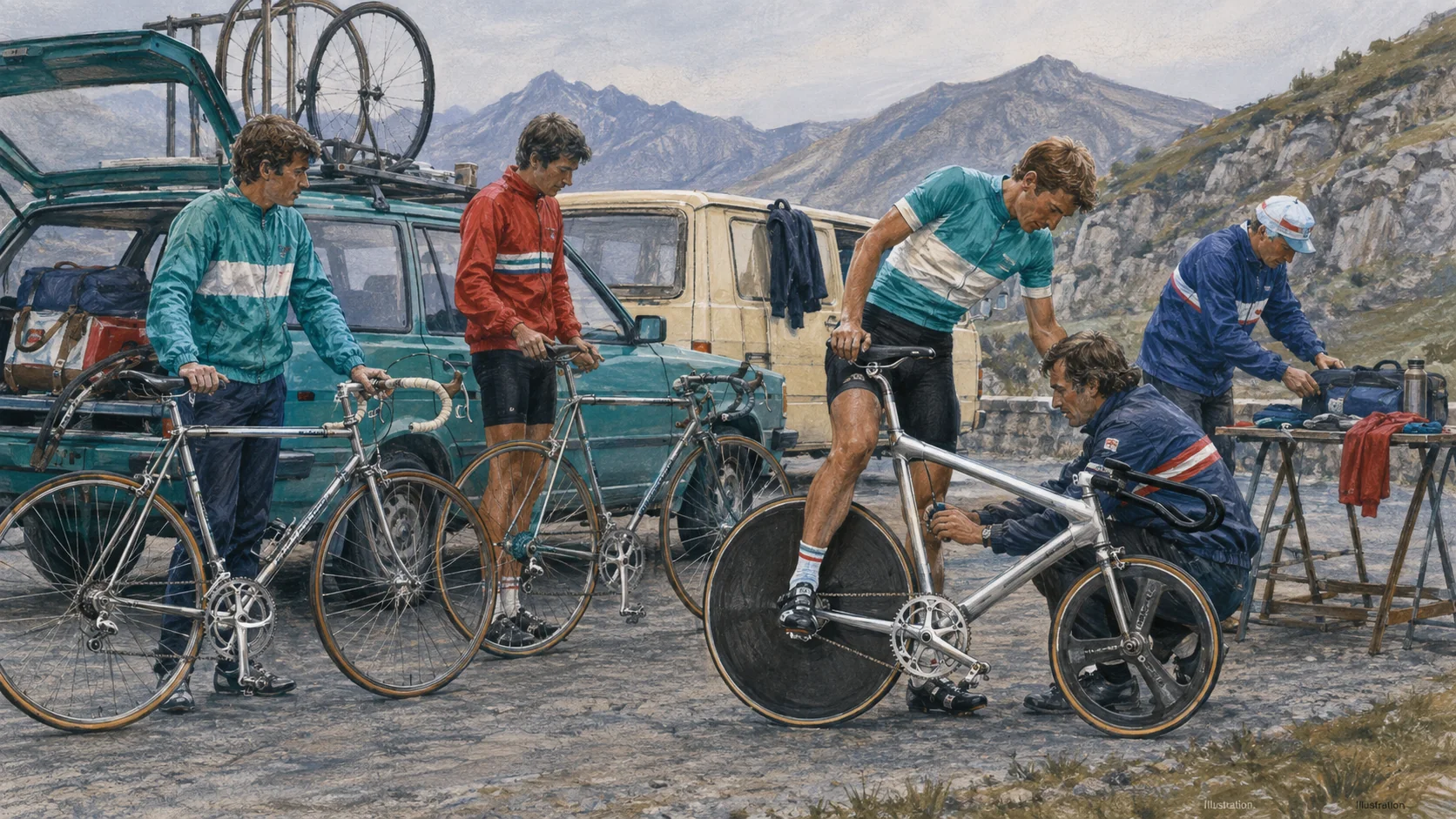
The steel frame remained strong. Around it appeared clipless pedals, disc wheels, indexed gears and aero bars. Not every idea became a lasting solution.
A lever on the down tube
A rider could begin the decade with toe straps and friction shifting and finish it with clipless pedals, indexed gears and aero bars. Change arrived part by part, often in the middle of a race.
The common period model
The 1980s in three views
The decade’s main development
Aerodynamics, indexed shifting and clipless pedals turned the complete rider–bicycle system into an object of development.
What defined the period
Steel still dominated, but television, international sponsors and laboratory methods changed professional racing around it.
Three changes to cycling
- Moser made airflow visible
- LOOK changed the rider’s connection to the bicycle
- LeMond showed that seconds could be designed as well as ridden
Selected events
A short timeline
- Hinault wins the Giro; steel and friction shifting still define the professional racing bicycle.
- Wireless heart-rate monitors bring training data onto the road.
- Kim Andersen becomes the first Dane to wear the Tour’s yellow jersey.
- Moser sets two hour records in Mexico City; LOOK introduces its clipless road pedal.
- Hinault wins a fifth Tour using LOOK pedals.
- Greg LeMond becomes the Tour’s first American winner.
- An official car runs over Jesper Skibby’s bicycle on the Koppenberg.
- Snow turns the Giro stage over the Gavia into a fight against cold.
- LeMond overturns 50 seconds and wins the Tour by eight.
Seven fixed themes
The decade, seen across the site
Races and defining moments
The Gavia snow stage, Skibby on the Koppenberg and the final time trial in Paris made weather, race traffic and seconds into unforgettable drama.
Follow this theme through cycling history →Riders of the period
Hinault, Moser, LeMond, Fignon and Hampsten represented different routes to the top, while Danish riders became increasingly visible in international racing.
Follow this theme through cycling history →Bicycles and technical change
Disc wheels, aero positions, clipless pedals and indexed gears appeared around steel frames. Some experiments vanished; their questions remained.
Follow this theme through cycling history →Nutrition, training and science
Heart-rate monitors and physiological testing moved the laboratory closer to daily training. Pasta and carbohydrate drinks replaced part of the older, heavier food culture.
Follow this theme through cycling history →Cycling culture and everyday life
Lycra, bright colours and global sponsor names changed the peloton’s appearance. Live television made both equipment and personalities more valuable.
Follow this theme through cycling history →Society and the times
American teams and riders challenged European habits, while commercial television carried professional cycling to a wider international market.
Follow this theme through cycling history →The people behind cycling
Doctors, aerodynamicists, mechanics and soigneurs gained influence. Their work ranged from legitimate innovation and daily care to the decade’s medical grey zones.
Follow this theme through cycling history →New balances of power
From Hinault to LeMond
Bernard Hinault dominated the first half of the decade. He won the Tour de France in 1981, 1982 and 1985 and the Giro d’Italia in 1980, 1982 and 1985. He rode as the patron of the peloton and also intervened beyond the results. During Paris–Nice in 1984, a confrontation with demonstrators ended in a scuffle. That is a better story than another list of victories.
La Vie Claire later brought Hinault and Greg LeMond together on the same team. In 1986, LeMond won the Tour ahead of Hinault and became its first American winner. Three years later, he closed the decade with the smallest winning margin in Tour history: eight seconds ahead of Laurent Fignon.
Fignon began the final time trial in 1989 with a 50-second lead. LeMond used aero bars and a more compact aerodynamic position. The bars do not explain the result on their own, but they made the technical difference visible all the way onto the Champs-Élysées.
Aerodynamics is allowed to decide
Small front wheels and solid discs
Francesco Moser’s hour records in Mexico City in January 1984 made disc wheels and a radical riding position subjects of discussion far beyond the track. Time-trial and track bicycles gained sloping top tubes, small front wheels and a very low front end. They were called funny bikes because their proportions looked wrong after decades of level top tubes and two equally sized wheels.
The experiments showed that aerodynamic drag could matter more than a few grams. They also created a whole family of solutions that later rules either restricted or made redundant.
Feet and fingers
The pedal clicks
LOOK transferred the principle of the ski binding to the bicycle and developed the PP65 pedal in 1984. Instead of a toe clip and leather strap, the rider pressed a cleat into a spring-loaded mechanism. The foot could be released by turning the heel outwards.
Bernard Hinault won the 1985 Tour on the new pedals. It gave the solution a demonstration no catalogue could match. Toe straps did not disappear that day, but the direction was clear.
At the same time, Shimano SIS made fixed clicks in gear shifting commonplace. The levers remained on the down tube, but the rider no longer had to feel his way to each sprocket. Integrated brake and gear levers only arrived in the early 1990s.
Summer clothing in snow
On stage 14 of the Giro, rain turned to snow near the summit. Johan van der Velde crossed first but had to seek shelter on the descent and lost 47 minutes. Erik Breukink won the stage, while Andy Hampsten took the pink jersey and later the Giro.
The first yellow jersey
Kim Andersen became the first Dane to wear the Tour’s yellow jersey. The decade later gave Danish cycling several more visible moments — among them Jesper Skibby’s encounter with the race car on the Koppenberg in 1987.
Food and measurement
The body moved closer to the laboratory
Pasta, rice and carbohydrate-rich drinks acquired a clearer place around races. Teams worked more systematically with fluids and energy, while commercial powders and energy products became more common. The old meal of meat, wine and experience did not disappear from every hotel at once.
The first wireless heart-rate monitors made it possible to follow the heart during training without an entire laboratory. Together with tests of oxygen uptake and workload thresholds, they gave coaches more figures around which to plan.
The figures brought better training, but also the idea that almost everything could be optimised. That thought did not stop at pasta and pulse.
The hidden development
Blood, cortisone and EPO
Blood transfusions were used in international elite sport in the 1980s. The method increased the quantity of red blood cells and was difficult to detect with the testing available at the time. It was prohibited by the IOC in 1985, but a ban was not the same as a usable test.
Corticosteroids and other substances also formed part of the sport’s medical grey areas. Documentation varies for individual teams and riders, and a period page should not make the entire peloton identical.
Recombinant EPO was approved as a medicine at the end of the decade. Its later role in cycling is well documented. Precisely when and how systematically it entered professional cycling is harder to establish. The EPO story therefore begins here as a shadow, not as a claimed explanation for the decade’s speeds.
Sources and image note
The basis for this period
- Tour de France: LeMond, Fignon and the eight seconds in 1989
- Giro d’Italia: Passo Gavia and the snow stage in 1988
- LOOK: the PP65 pedal and Hinault in 1985
- IOC: historical research into blood doping and EPO
The submitted photographs and route maps were used as research references but not published because usage rights are not documented. The two colour photographs from the 1987 Tour also carry visible Shutterstock watermarks.