The period 1990–1999
When shifting moved
to the handlebars
Riders could change gear without letting go of the bars. Aluminium, carbon and deep rims changed the bicycle, while EPO changed the sport in a much darker way.
The common period model
The 1990s in three views
The decade’s main development
Training, equipment and nutrition became more professional and more closely measured.
What defined the period
Larger budgets, new materials, international television coverage and a growing doping shadow.
Three changes to cycling
- Integrated shift levers became standard
- Carbon fibre gained ground
- Training and fuelling became more scientific
Selected events
A short timeline
- Shimano introduces integrated brake and shift levers.
- Miguel Indurain wins his first Tour de France.
- Campagnolo launches Ergopower.
- Indurain sets an hour record in Bordeaux.
- Bjarne Riis wins the Tour.
- The first L’Eroica is held in Tuscany.
- The Festina affair brings raids and rider protests to the Tour.
Seven fixed themes
The decade, seen across the site
Races and defining moments
Indurain controlled the Tour through long time trials, while Pantani changed races in the mountains. The Festina affair made the 1998 Tour a contest shaped as much by police raids and protests as by racing.
Follow this theme through cycling history →Riders of the period
Indurain, Rominger, Riis and Pantani represented very different ways of winning. Their results also belong to a decade whose medical culture later altered how those performances were understood.
Follow this theme through cycling history →Bicycles and technical change
Integrated shift and brake levers changed the rider’s position and timing. Aluminium grew common at the top level, carbon fibre gained ground, and deep-section wheels became a visible part of the racing bicycle.
Follow this theme through cycling history →Nutrition, training and science
Heart-rate monitors, laboratory testing and planned nutrition became more systematic. At the same time, EPO showed how sports medicine could be used for something rather different from rider health.
Follow this theme through cycling history →Cycling culture and everyday life
International television made the largest races easier to follow across borders. L’Eroica, first held in 1997, also showed the beginning of a new interest in older bicycles and unpaved roads.
Follow this theme through cycling history →Society and the times
Professional teams grew larger and more commercial. In 1998, customs officers, police investigators and legal proceedings moved into the Tour and changed the public discussion of the sport.
Follow this theme through cycling history →The people behind cycling
Doctors, soigneurs, mechanics and team managers became part of increasingly specialised organisations. Their work shaped preparation, equipment and recovery, although it rarely appeared in the result sheet.
Follow this theme through cycling history →One hand stays on the bars
The most visible change sat in front of the rider. The lever left the down tube and joined the brake lever, allowing shifts during a sprint or while climbing out of the saddle.
Five years with the same man
Indurain won back the time
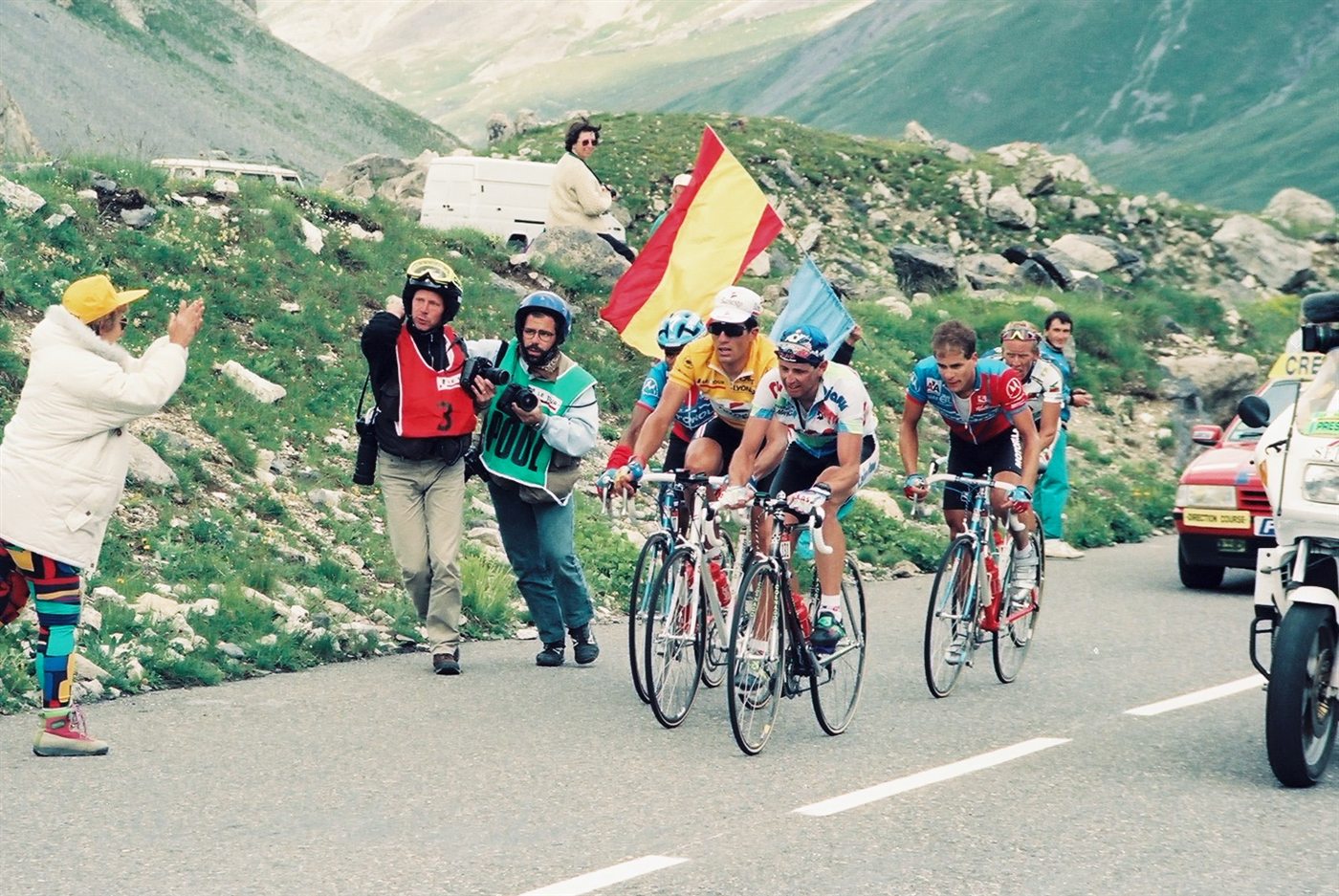
Miguel Indurain won the Tour every year from 1991 to 1995, usually building his lead in long time trials and defending it in the mountains. It was less theatrical than a summit attack, but difficult to answer.
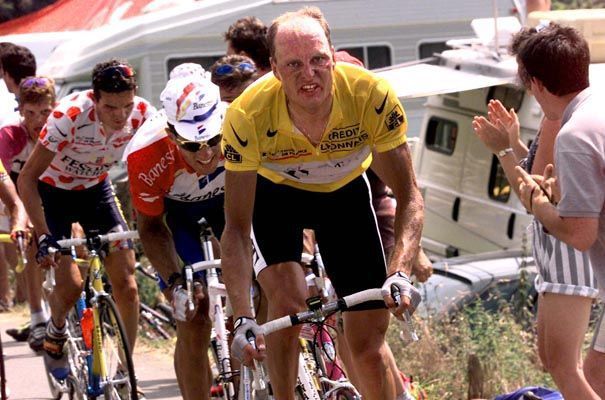
His run ended in 1996 when Bjarne Riis attacked repeatedly on Hautacam. Riis won the Tour, but his later admission of EPO use — including in 1996 — cannot be separated from the result.
A modern cockpit
STI, Ergopower and more sprockets
Shimano introduced Dura-Ace Dual Control in 1990. Campagnolo followed with Ergopower, and handlebar shifting became the new normal. Indexed systems and shaped teeth improved changes, while top groups grew from eight to nine rear sprockets.
Changing materials
Steel was no longer the default
Large aluminium tubes gave frames a more angular appearance. Carbon progressed from joined tubes to more unified structures. Campagnolo’s 1992 Shamal made the factory-built deep-section wheel an obvious part of road racing.
Time-trial bicycles became highly specialised. At Disneyland Paris in 1997, Riis suffered mechanical trouble, dismounted and threw his expensive machine into the grass. Modern equipment could still receive a very simple response.
The big man made it over first
The 194-centimetre domestique Eros Poli began Ventoux with more than 20 minutes in hand. He lost most of it climbing, but enough remained for victory in Carpentras.
Pantani attacked where Indurain waited
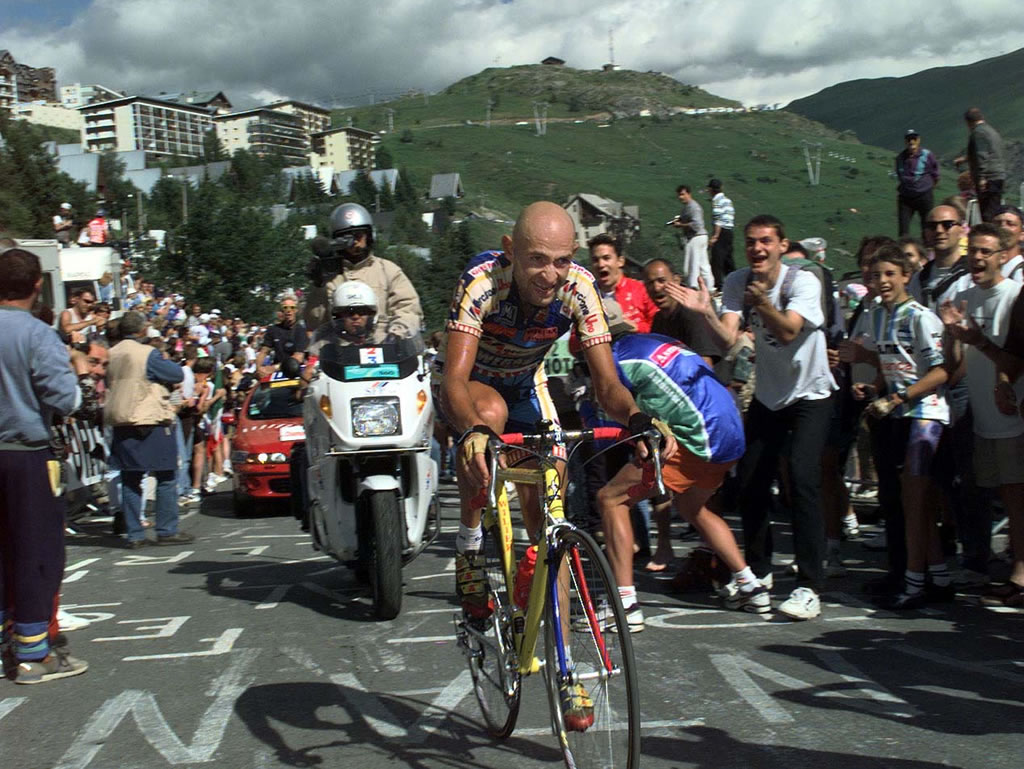
Marco Pantani sought decisions on steep climbs and won both the Giro and Tour in 1998. No male rider has repeated the double since.
Energy by numbers
Food acquired a plan
Teams worked more precisely with carbohydrate, fluids and recovery. Heart-rate monitors and laboratory tests produced more data. Professionalisation improved load management, but also enabled doping to be organised with the same attention to schedules and measurement.
The peloton was not uniform, and one substance cannot explain every result. Yet EPO increased the blood’s oxygen-carrying capacity, while no direct test could detect it.
Tour de France · 1998
When the Festina affair opened the car door
Festina soigneur Willy Voet’s car was stopped with large quantities of EPO, growth hormone and other drugs. Investigations, arrests and the team’s expulsion followed. Riders protested and stage 17 was neutralised.
Only 96 of 189 starters reached Paris. Pantani won, but 1998 was remembered for the system exposed behind the race. The affair also helped prompt the creation of WADA in 1999.