1990–2012 · Story
Michele Ferrari, training science and the doping era
He could measure a rider’s work in minute detail. Explaining everything surrounding the numbers proved more difficult.
Ten litres of orange juice
In April 1994, Michele Ferrari is asked about EPO. His answer is that the drug is not dangerous in itself; abuse is dangerous. A person can also die from drinking ten litres of orange juice, he explains. At the same time, he denies prescribing EPO.
The remark follows a day on which Ferrari’s team has been difficult to overlook. Gewiss-Ballan has taken the first three places at Flèche Wallonne with Moreno Argentin, Giorgio Furlan and Evgeni Berzin. It is a performance that brings questions, and the team doctor has supplied an answer remembered longer than the race itself.
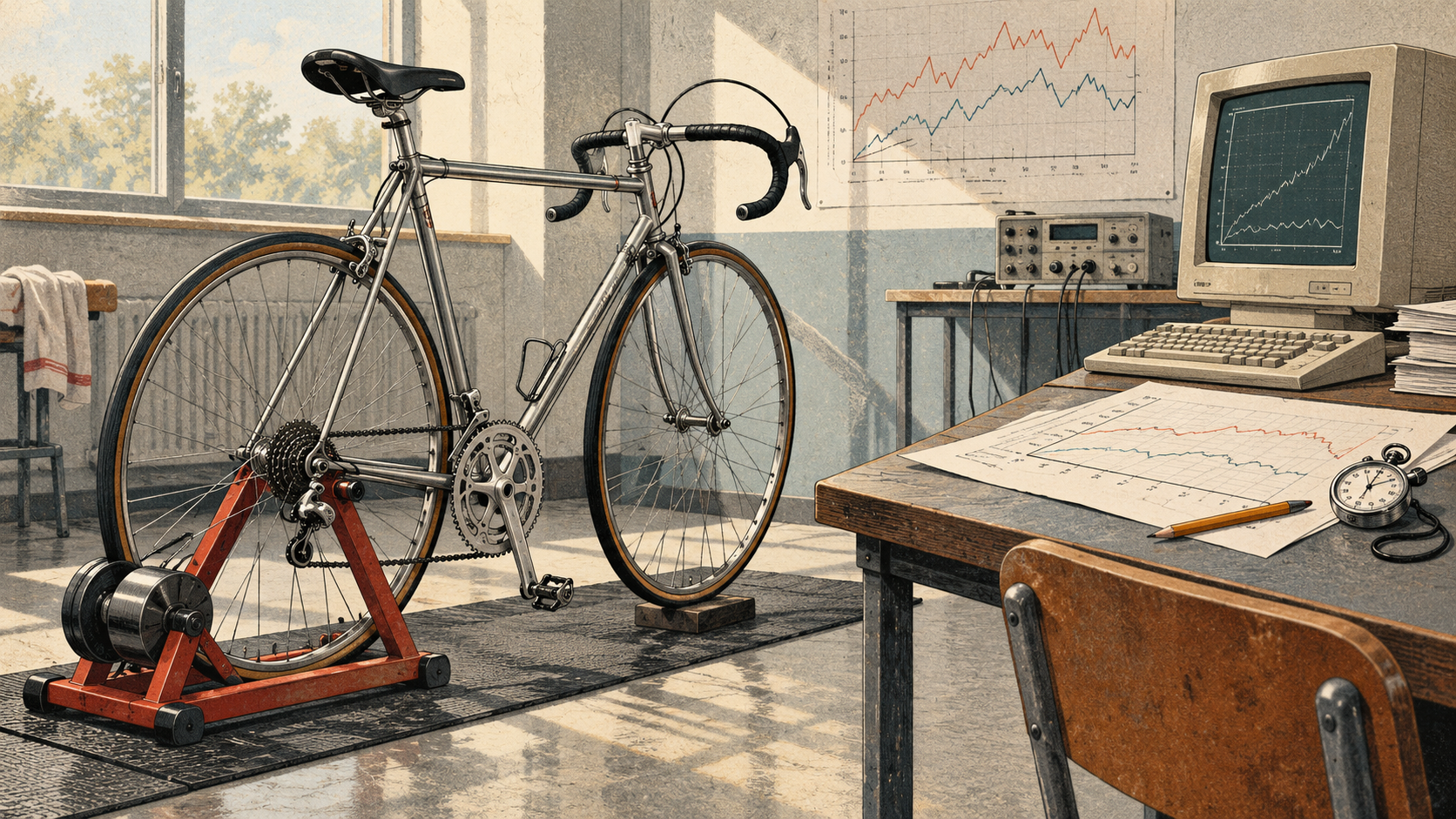
Ferrari did not enter cycling as a man carrying a bag of random remedies. He trained as a doctor and worked in the circle around Francesco Conconi at the University of Ferrara. Here riders were measured. Heart rate, workload and performance were connected so that training could be planned with greater precision.
A new rider in the plan
Ferrari did not invent the power meter, but he belonged to a period in which numbers moved into training. Heart rate showed how the body responded. Power showed the work the rider produced. An interval on a climb could now be described more precisely than by telling someone to ride hard, but not too hard. This was useful. The spreadsheet never became tired, although the man on the bicycle still did.
For the rider, this meant a training ride no longer ended merely as a feeling in the legs. The work could be compared with yesterday’s effort and with what would be required in a race. Ferrari could alter the load, schedule recovery and see whether form was moving in the right direction. That precision made him attractive to riders who wanted more than ordinary advice from the team car.
Late in 1995, Lance Armstrong entered Ferrari’s plans. Ferrari later said Eddy Merckx had introduced them. Armstrong was not yet the rider who would go on to win the Tour de France. For Ferrari, however, the relationship became the one that tied his name to the US Postal team more than any other.
In 2003, Ferrari was still describing the work as athletic preparation. He also explained the special marks found in training plans. According to him, they referred to vitamins, amino acids and days on which the rider had to pay particular attention. The plans were no longer merely working papers shared by doctor and rider. They were being read by people looking for something other than intervals and rest days.
That is the difficult part of Ferrari’s story. His work with workload, heart rate and power was tangible and useful. The figures could show whether a rider had completed the day’s work. They could not show everything else happening around him. In time, it was precisely the material beyond the ordinary training numbers that the anti-doping authorities examined.
The plans change hands
On 10 July 2012, the decision came from the United States Anti-Doping Agency. Ferrari received a lifetime ban for anti-doping rule violations in the US Postal case. The agency stated that he had advised on EPO, assisted prohibited blood doping and written training plans in which codes referred to doping products.
The charges were not contested through USADA’s arbitration process. Ferrari rejected them and said he had not been properly notified. USADA replied that the material had been delivered to the people involved or their lawyers. The lifetime ban was a sporting sanction under anti-doping rules, not an Italian criminal conviction.
The plans therefore acquired a different meaning from the one Ferrari had given them. He had described the marks as aids concerning vitamins, amino acids and training days. USADA read them as part of a doping system. Ferrari’s explanation remained on record, but it did not alter the agency’s decision.
Eighteen years had passed since Flèche Wallonne. Argentin, Furlan and Berzin still occupied the first three places on the result sheet, and Ferrari’s comparison with ten litres of orange juice still followed him. The race figures fitted on a few lines. The papers surrounding the doctor grew considerably longer.