1949–1950 · Story
Jacques Moujica’s great season and final journey
In the spring of 1949, Jacques Moujica stood on the podium at major races. In November the following year, his name appeared beside Jean Rey’s in a death notice.
All the way from Bordeaux
Jacques Moujica won Bordeaux–Paris in 1949. He was 22 and had earned a victory requiring something beyond saving a fast finish for the last few metres. Bordeaux and Paris were separated by more than five hundred kilometres. This was a working day which had long since grown into something much larger than an ordinary working day.
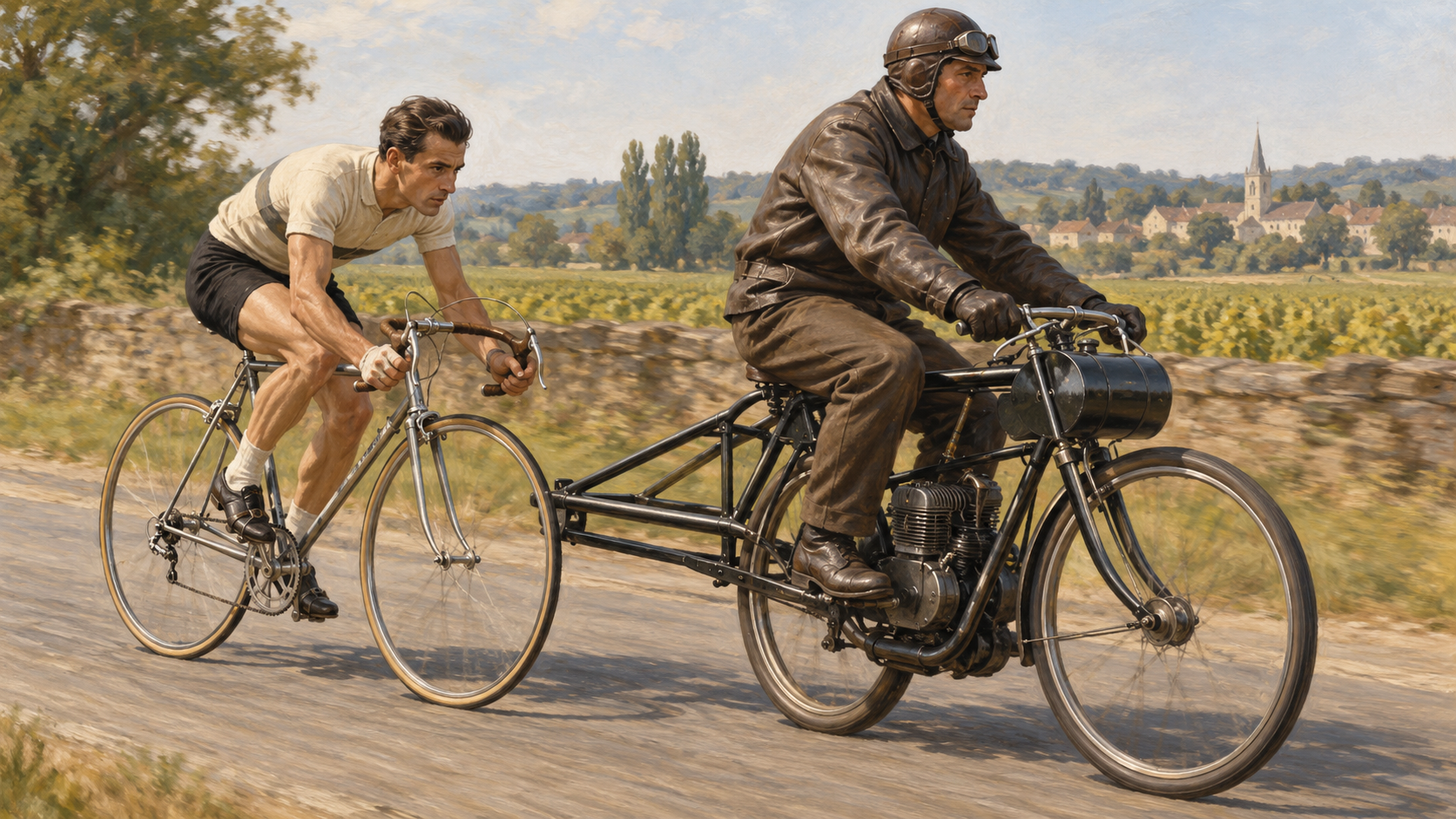
Motor pacing gave the race part of its character. For part of the journey, the cyclists followed pacers on small motorcycles. They gained shelter from the wind but still had to maintain their speed, distance and connection to the machine ahead. An engine could take the wind. It could not turn the bicycle's pedals.
Moujica reached Paris ahead of Émile Masson and Éloi Tassin. He now had a major victory of his own, following a spring in which he had already made an impression among riders capable of handling a long day.
He was born in Urretxu in the Basque Country in 1926 as Jesús Múgica. French results lists recorded him as Jacques Moujica. He became a French citizen in 1948 and rode for Mercier in 1949 and 1950. The names lead back to the same man and a career which developed on the other side of the Pyrenees.
More than one place on a podium
Earlier in 1949, Moujica had finished third in Paris–Roubaix. He belonged to the leading group misdirected at the velodrome. The argument about the victory came to occupy much more attention than his own placing. André Mahé and Serse Coppi eventually shared the win; Moujica was left with third.
He took another third place in Paris–Brussels. The Bordeaux–Paris victory therefore belonged to a season in which he could handle cobbles as well as an unusual combination of distance and motor pacing. Together, those results show a rider moving into the company of established names.
It is easy to let the later accident take over his entire story. In 1949, however, there was a living career to follow. He raced, won and reached the podium in events demanding quite different things of the same body. His promise rested on more than one unusual race.
Motor pacing also made the victory dependent on cooperation. The cyclist had to use the shelter created by his pacer without losing his position behind the machine. If a gap opened, there was immediately more wind to work against. Across such a long journey, the connection between the two became a practical racing problem rather than a small detail in the regulations.
Two names in one announcement
On 13 November 1950, Moujica died in a car accident near Montélimar. The French cyclist Jean Rey also lost his life. Rey had been the French road champion in 1949. Two men with their own good results from the previous year were now being mentioned together in a very different setting.
Moujica was 24. The following day, Le Monde carried the announcement of the two cyclists' deaths. There would be no next stage to recover on and no new season in which to put a poor race right. His short professional career had ended.
The car had been travelling from Saint-Étienne towards another sporting engagement, the contemporary newspaper reported. Both cyclists were passengers. A collision with a stationary lorry on the N7 had interrupted the journey. In the year after his major victories, Moujica never reached the next engagement.
The Bordeaux–Paris winners' list still places Jacques Moujica against 1949. It adds no explanation of how little time he had as a professional. His name stands among the other winners, after the long road from Bordeaux.