1903–1973 · Story
When the rider was his own mechanic
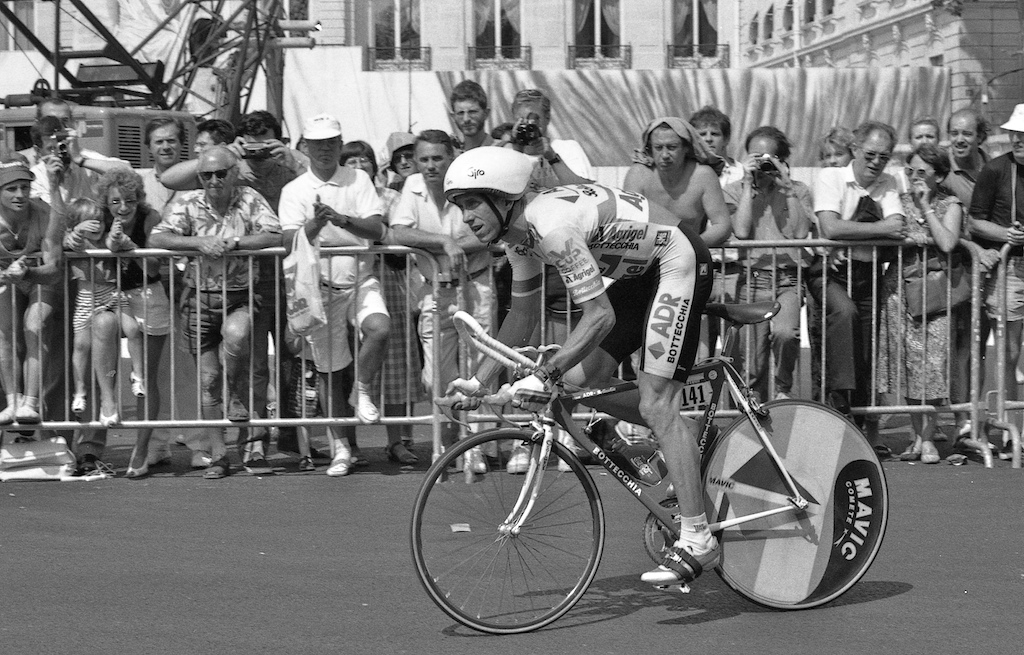
A broken fork could cost hours because the hands on the tools had to belong to the rider. Only much later did the roadside mechanic become routine.
A fork in two pieces
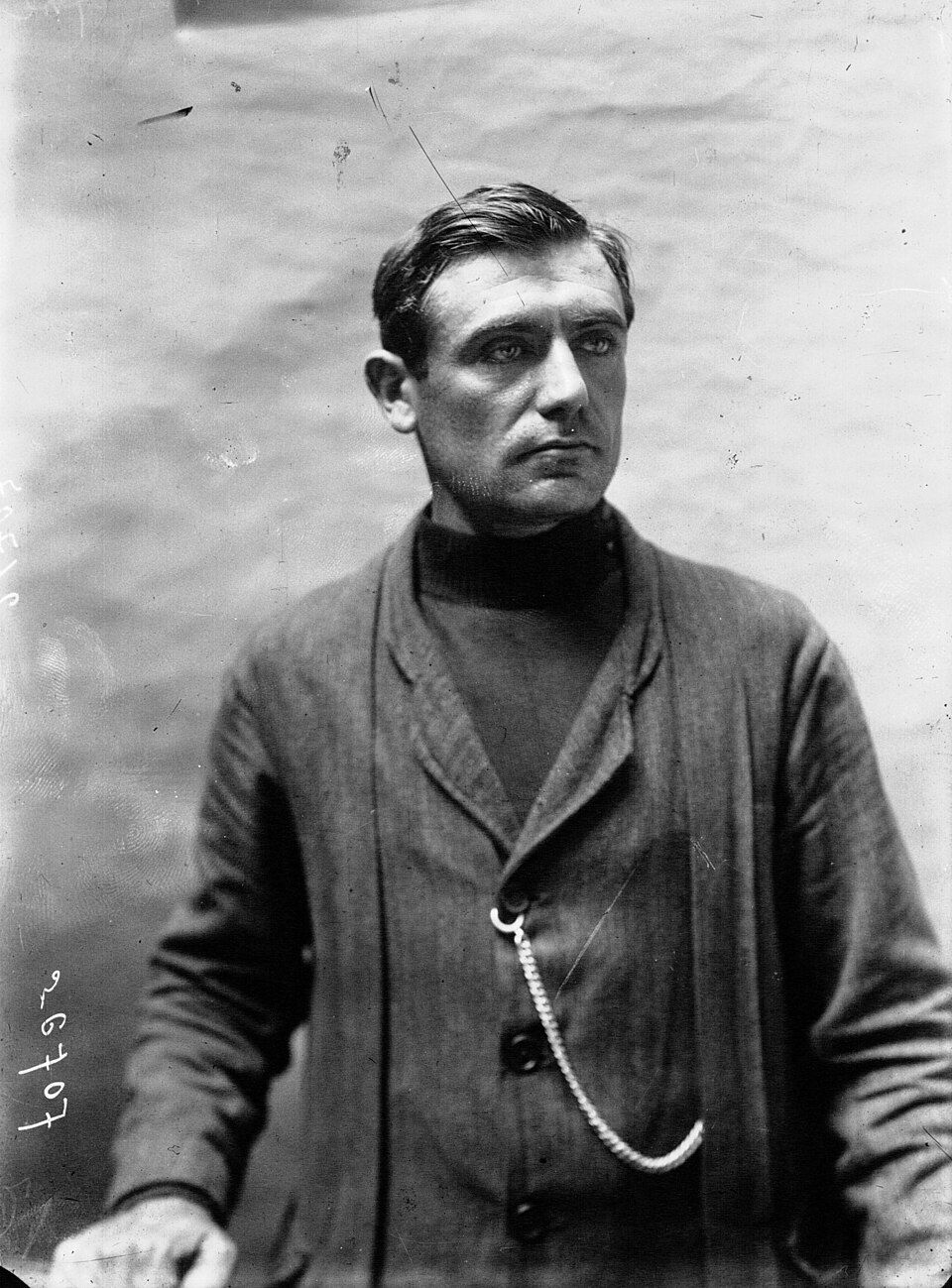
Eugène Christophe stood with a broken front fork on the descent from the Tourmalet in 1913. The race had gone and the bicycle would not roll. He put it on his shoulder and walked, not towards a team car carrying a spare bicycle, but to the forge at Sainte-Marie-de-Campan, where there was fire, a hammer and a man who understood hot metal.
The rule was simple and severe: Christophe had to perform the repair himself. The blacksmith could explain, but not take over. The story even says Christophe received a time penalty because a boy helped with the bellows. Accounts differ in their smaller details, but the central fact remains. The rider was also the mechanic.
The bicycle had to come home
This was not merely a device for making riders suffer. Early road races were tests of the machine as well as the person. Manufacturers sold strength and reliability, and organisers wanted a rider to manage with the bicycle on which he had started. Outside help could look like a shortcut and therefore like cheating.
Riders carried tubes, tools and spares. A puncture was not a brief pause while a wheel appeared from a car. The tyre came off, the damage had to be found, the repair made and everything fitted again with cold fingers, grit by the roadside and the clock still running. It was not elegant, but it worked. Usually.
The team moves closer
Henri Desgrange’s idea of the self-reliant rider survived for years. In 1920 the Tour still described a participant as a man who should ride as though training alone, without assistance prepared along the route. As a rule, the same bicycle was expected to carry him through the race, apart from serious accidents.
Yet the sport grew around him. Trade teams, directors and mechanics gained influence, while following cars moved closer to the race. When the Tour adopted national teams in 1930, the organiser supplied standard bicycles. The old ideal did not disappear overnight, but responsibility for the machinery gradually moved from the rider’s pockets to the organisation around him.
A wheel from a team-mate
René Vietto showed in the 1934 Tour that assistance could still carry another price. When team leader Antonin Magne had trouble, Vietto turned back and surrendered his own front wheel. The mechanic was not necessarily holding the hammer now; sometimes he was riding the bicycle and sacrificing his own race.
A service car could be a long way behind on a narrow mountain road. Domestiques therefore retained a practical reserve function. They handed over wheels, bicycles and opportunities. The modern team apparatus was emerging, but the distance between failure and assistance still mattered. A puncture ahead of the car and one behind it were different events.
Help without the correct jersey
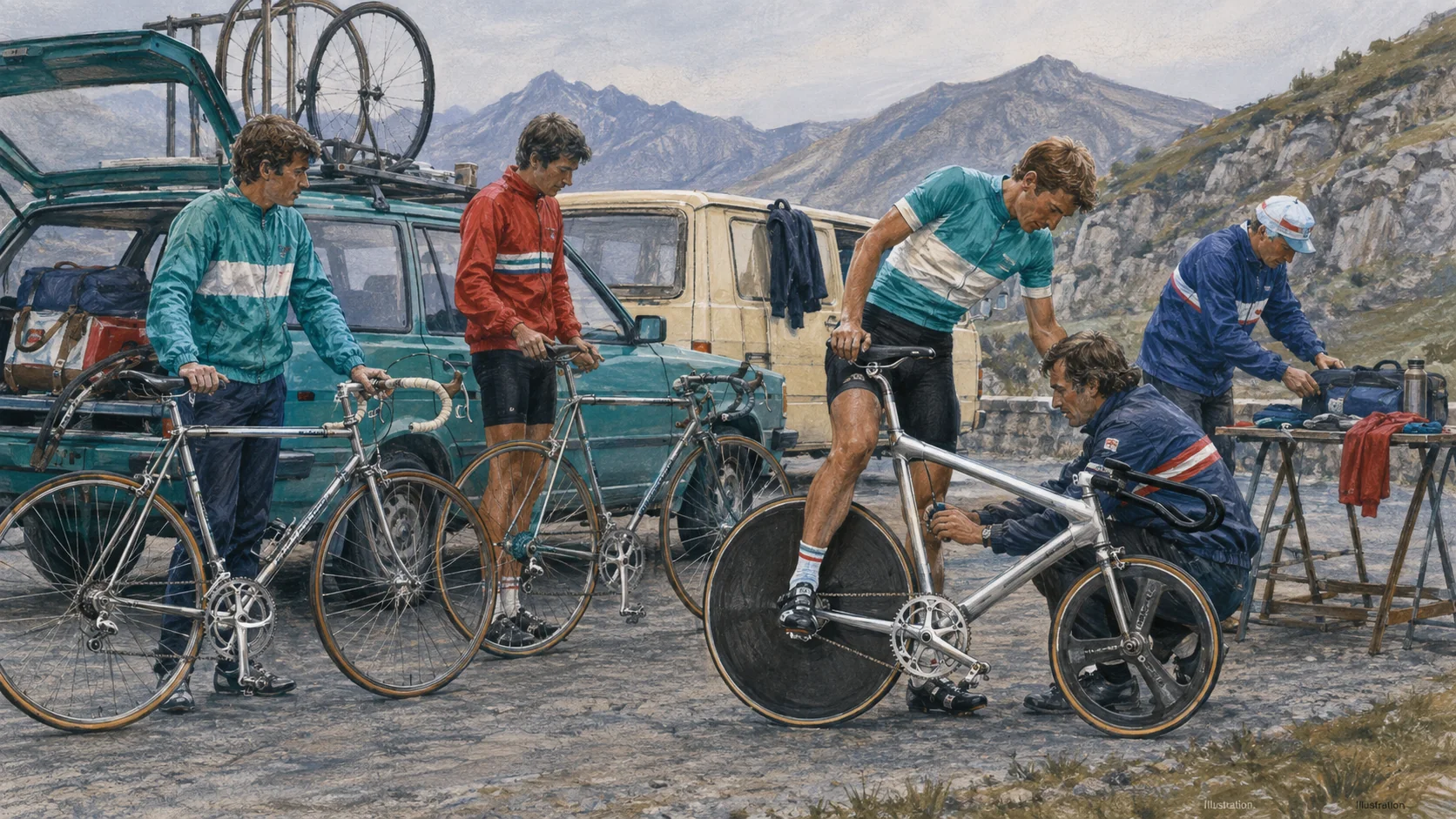
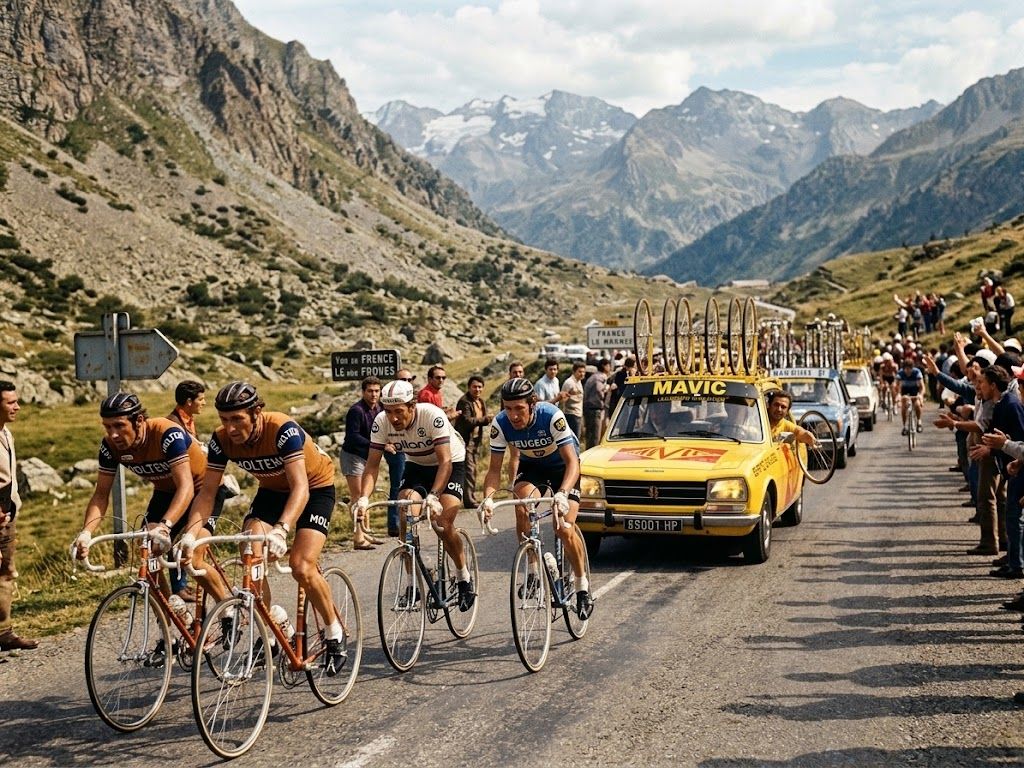
Team service did not solve everything. A rider from a small squad might be stranded while major teams had cars full of wheels. Neutral service addressed that imbalance. Mavic tested the idea in the early 1970s and made it a regular feature of races such as Paris–Nice: a mechanic could help regardless of the name on the jersey.
Today the sight seems ordinary. A car or motorcycle draws alongside, a wheel is changed and the rider is pushed away. The task still demands calm hands, but they no longer have to belong to the man wearing the race number. That may be the greatest change: a mechanical failure remains bad luck, but it need not also be an examination in blacksmithing.
The hammer stayed in the car
Christophe returned to the road in 1913, but the repair cost hours and his chance of winning the Tour. His walk to the forge endured because it compressed the rules of the age into one scene: one of the race’s finest riders bent over a fork while his rivals continued.
The tools later moved into the following cars. The rider kept responsibility for feeling the fault, stopping in the right place and getting under way again. The rest became the mechanic’s work. In my view, that is a sensible division of labour. A man may be able both to race quickly and use a hammer. He need not do both on the same afternoon.