1953–1976 · Story
Ugo De Rosa and the workshop in Cusano Milanino
A frame was measured for a rider, not a catalogue. When Merckx arrived, the demands grew and the nights shortened.
The first workshop
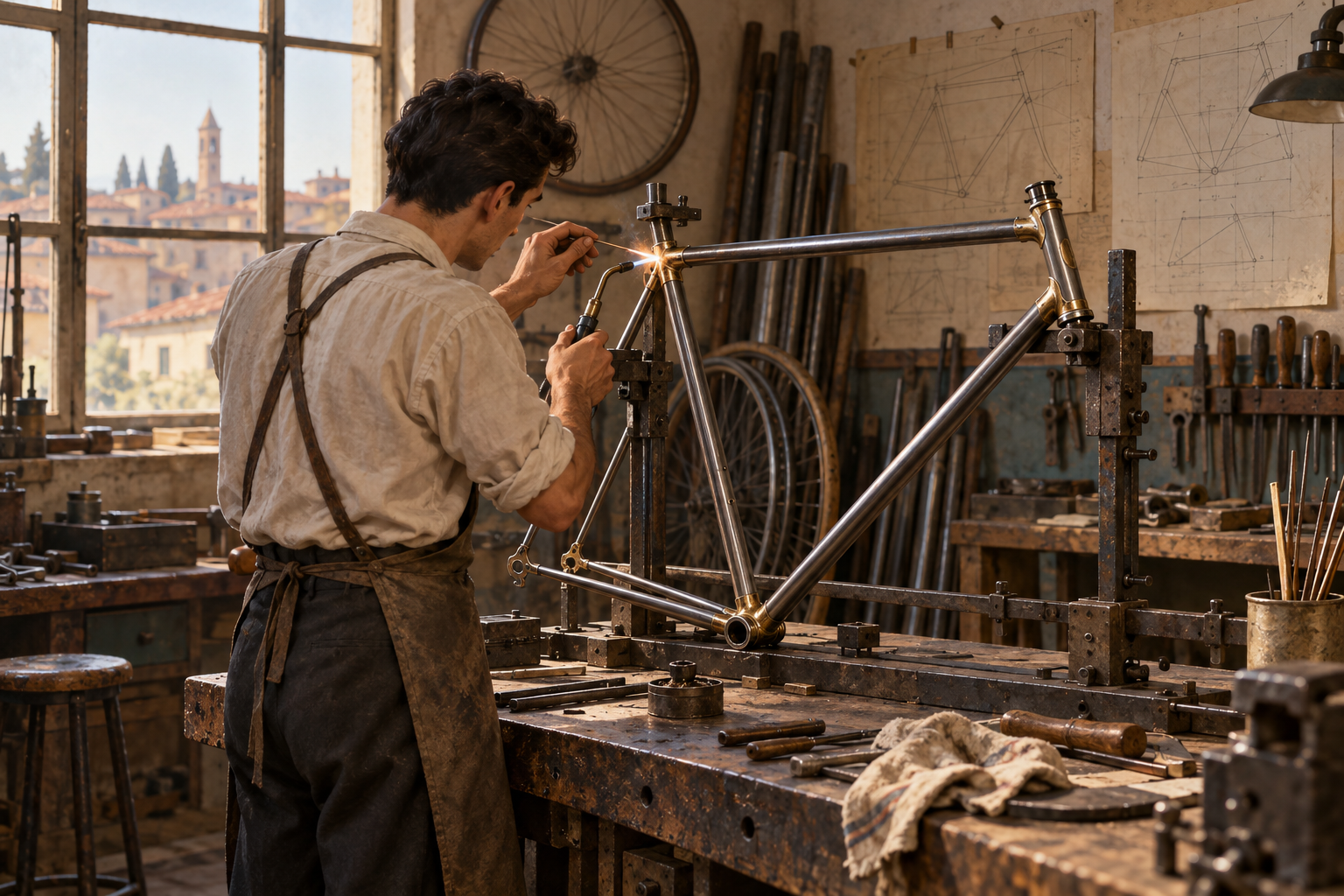
Ugo De Rosa was nineteen when he opened his own place in the Milan area in 1953. He had raced, studied mechanics and worked in his brother-in-law’s shop. Now he wanted to build racing bicycles for people intending to win. His reputation began among amateurs, where a poor joint or wrong measurement was quickly noticed.
In 1958 Raphaël Géminiani asked him to build a bicycle for an event at the Vigorelli velodrome. The order opened the professional door. The frames did not always carry De Rosa’s name; a builder’s work could remain hidden under team colours.
The rider as measuring instrument
From the mid-1960s De Rosa worked ever closer to riders and teams. He built for Max Meyer, worked with Gastone Nencini and followed Rik Van Looy as mechanic. A partnership with Gianni Motta began in 1969. It remained a craft of tubes, lugs, angles and a rider’s precise sense that something did not feel as it had before.
Eddy Merckx made that conversation more demanding. In 1972 he asked De Rosa to become his official Molteni mechanic. The company history says Merckx could request fifty or sixty bicycles in a season. That meant night work, but also constant feedback from a rider who noticed small changes.
The heart in the lug
The heart appeared on a professional team in 1973. According to the company, it grew from lightening holes in the head lug which together resembled a heart. A practical cut became the badge.
In 1974 Merckx won the Giro, Tour de Suisse, Tour de France and world title on bicycles from the partnership. Two years later De Rosa also built for Francesco Moser. The workshop had become famous, but the method remained: one rider, one geometry, and a frame finished only when the measurements worked.
The frame emerged from a conversation
A custom frame began with the rider rather than the paint. Height, leg length and position supplied the first dimensions, but the conversation continued after training rides. A few millimetres of top tube or a changed angle could alter the balance between quick steering and calm behaviour over a long stage. Merckx could feel such differences, and De Rosa had to translate them into tubes, lugs and joints. Another frame was not necessarily extravagance. It could be another attempt to reproduce the right sensation for different roads, races and working positions.
The work was still done in steel. Tubes were cut, mitred and brazed, and an attractive joint was not enough. The frame had to remain composed when a rider stood on the pedals, while surviving transport, crashes and hurried race mechanics. De Rosa became known for combining direct contact with riders and clean workmanship. The heart later made the bicycles recognisable, but the reputation existed before spectators could read the badge. Many early frames worked anonymously beneath other names and team colours.
More champions and new materials followed Merckx. The company grew and the family joined the work. Even so, the small workshop remains the useful key to the story. De Rosa did not become interesting when the heart appeared on a frame. He became interesting because he could listen to a rider’s imprecise description of a sensation and turn it into exact dimensions. The bicycle did not merely have to be correct on paper. It had to feel right when a demanding rider mounted it and rolled out of the door.
Professionalisation made this conversation still more important. Teams could supply times, positions and requests, but early custom builders worked before digital calculations and standard sizing programmes. Experience lived in the hands and in an eye for the meeting of tube and lug. When a rider returned asking for a small alteration, the workshop’s memory became part of development. De Rosa later sold bicycles to a much wider market, but the link between feedback and construction remained the brand’s strongest story.