The period 1960–1969
When the racing bicycle found
its modern form
Two chainrings, five sprockets, friction levers and a light steel frame. The basic form was established. Around the bicycle, the sport became more visible — and its problems harder to hide.
The common period model
The 1960s in three views
The decade’s main development
The lightweight steel racing bicycle settled into a form that would remain familiar for decades.
What defined the period
Televised rivalries, international track success and the difficult beginnings of formal doping control.
Three changes to cycling
- The parallelogram derailleur became standard
- Aluminium spread through components
- Training and physiology gained influence
Selected events
A short timeline
- Jacques Anquetil wins his second Tour de France.
- The Tour returns to trade teams.
- Anquetil and Poulidor ride shoulder to shoulder on Puy de Dôme.
- The Tour’s doping controls prompt a rider protest.
- Niels Fredborg becomes world champion; Tom Simpson dies on Mont Ventoux.
- Fredborg takes Olympic silver in Mexico City.
- Eddy Merckx wins his first Tour de France.
Seven fixed themes
The decade, seen across the site
Races and defining moments
Anquetil and Poulidor’s duel on Puy de Dôme, Bordeaux–Paris behind a derny and Merckx’s first Tour show a decade in which old race forms met a new television audience.
Follow this theme through cycling history →Riders of the period
Anquetil’s precision, Poulidor’s persistence, Burton’s endurance, Fredborg’s speed and Merckx’s appetite made the decade unusually varied.
Follow this theme through cycling history →Bicycles and technical change
Steel frames grew lighter, aluminium spread through components, and the parallelogram derailleur with down-tube friction levers became the expected arrangement.
Follow this theme through cycling history →Nutrition, training and science
Food still followed habit and experience, but physiology and systematic training moved closer to the sport. Drugs and testing became part of the same medical discussion.
Follow this theme through cycling history →Cycling culture and everyday life
Television turned mountain duels into shared images. At the same time, inventive weight saving and specialised bicycles began to attract attention beyond the professional peloton.
Follow this theme through cycling history →Society and the times
Riders increasingly appeared as workers as well as heroes. Their 1966 protest against testing revealed a conflict over authority, health and working conditions.
Follow this theme through cycling history →The people behind cycling
Doctors, mechanics, officials and team staff gained influence as racing became more organised, although their daily work remained largely outside the result sheet.
Follow this theme through cycling history →The familiar silhouette
Remove the jersey, support car and newspaper names, and a good racing bicycle from 1969 already resembles what many would call classically modern: diamond frame, parallelogram derailleur, two chainrings and rim brakes.
Puy de Dôme · 1964
Shoulder to shoulder
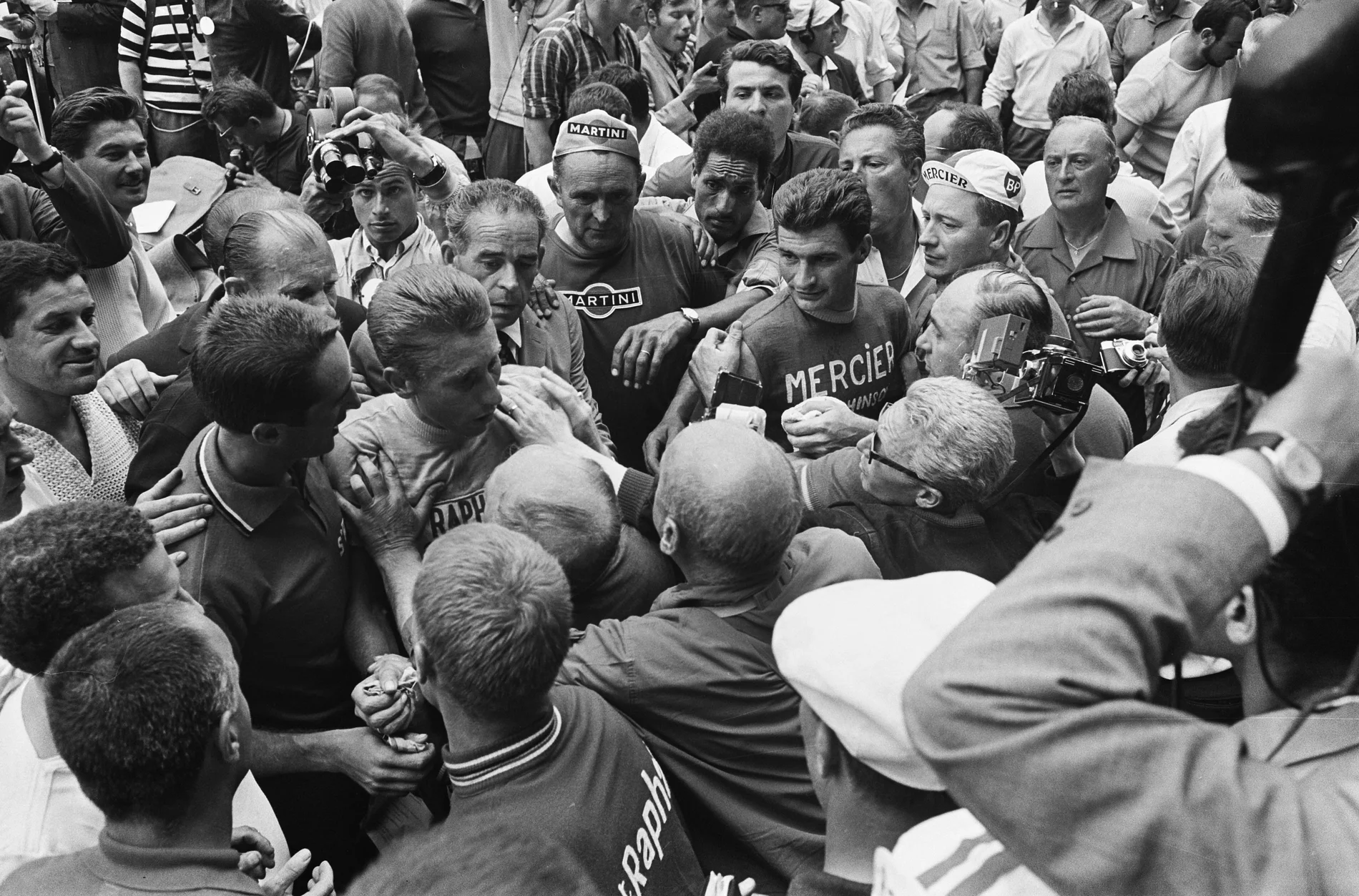
Jacques Anquetil and Raymond Poulidor divided France in a way that was not merely about results. Anquetil was cool, precise and outstanding against the clock. Poulidor appeared more approachable and kept coming back, although he never wore the Tour’s yellow jersey.
On Puy de Dôme, they rode close beside each other for a long time. Julio Jiménez won the stage farther up the road. Behind him, Poulidor only opened a gap to Anquetil in the final kilometre and gained about 40 seconds. Anquetil retained the lead by just 14 seconds.
The final time trial to Paris suited him better. He won the Tour for a fifth time, 55 seconds ahead of Poulidor. The close mountain image remained the race’s defining scene, although the decision came against the clock.
The mechanism settles
Ten gears and a hand on the down tube
The parallelogram derailleur was not new, but in the 1960s it became the natural solution on the best racing bicycles. Campagnolo’s Record and, from 1967, Nuovo Record became reference points. The rider still moved a friction lever on the down tube and listened for whether the chain was running cleanly.
Two chainrings at the front and five sprockets at the rear normally gave ten combinations. Six sprockets became more common later. There were no indexed clicks, but the principle of guiding a chain sideways between several sprockets was the same one that would dominate for decades.
Thin tubes and polished aluminium
Lighter without changing material
Steel remained the frame’s basic material. The difference lay in the alloy, butted tubes and the framebuilder’s work. Reynolds 531 had been introduced as early as 1935, but the manufacturer’s own history highlights both Anquetil’s 1964 Tour bicycle and Merckx’s 1969 bicycle as being built with 531.
Aluminium was used for rims, chainsets, brakes, handlebars and stems. MAFAC’s centre-pull brakes were widespread, while Campagnolo’s brakes used side-pull operation. The two types should not be confused, although both belong on bicycles from the period.
Holes drilled in components to save grams existed, but “drillium” is particularly associated with the pursuit of low weight that became more visible around the transition to the 1970s. The gain could be measured in grams. A weakened component could be measured in a less pleasant way.
Fredborg’s first world title
Niels Fredborg won the 1,000-metre time trial at the track world championships in Amsterdam. He repeated the victory in 1968 and took Olympic silver in Mexico City that same year, just 0.7 seconds behind Pierre Trentin.
Merckx takes everything
Eddy Merckx won his first Tour by 17 minutes and 54 seconds. He also won the points, mountains and combination classifications. The polka-dot mountains jersey did not yet exist; it arrived in 1975.
Food between habit and measurement
Nutrition did not become modern in a single summer
Large breakfasts, meat, eggs, rice, pasta and sugary foods did not disappear with the 1950s. Riders still carried food in their jersey pockets and received supplies from team staff along the way. Tea, coffee, fruit juice and water were mixed according to the habits of the team and rider.
At the same time, physiology and more systematic training moved closer to the sport. This does not mean that the entire peloton suddenly followed identical diet plans. Jacques Anquetil’s reputation for champagne and rich meals became part of his legacy, but individual colourful menus should not be treated as a recipe for an entire decade’s nutrition.
The certain shift was gradual: the body increasingly became something people tried to measure and plan around, rather than merely something replenished through experience and appetite.
1966–1968
Testing came before the turning point
Doping was not concealed in the same way as it would be later. Amphetamines and other stimulants formed part of a culture in which riders, helpers and doctors did not necessarily draw the same line between treatment and performance enhancement.
The Tour de France carried out doping controls as early as 1966. Riders responded with a short protest against what they saw as interference in their working conditions. It is therefore too simple to say that testing only began after Tom Simpson’s death.
His death on Mont Ventoux on 13 July 1967 nevertheless made the problem visible to many more people. Simpson collapsed during stage 13 and could not be revived. Tests found amphetamine and alcohol; heat, exhaustion and dehydration were also part of the sequence.
In 1968, both the Tour and the Olympic Games conducted more formalised testing. The system remained far removed from today’s, but the sport could no longer treat drugs as a purely internal matter.
Sources and image note
The basis for this period
- Tour de France: Anquetil and Poulidor on Puy de Dôme
- Reynolds Technology: the history of 531 tubing
- UCI: track world championship results
- Olympedia: 1,000-metre time trial at the 1968 Olympics
- INA/TEPAS: Tom Simpson’s final moments on Ventoux
- Nationaal Archief via Wikimedia Commons: main image and CC0 licence

The images supplied by the user from the 1964 and 1966 Tours were used as research references. They were not placed on the page because the files contain no certain source or usage licence.