1986–1989 · Story
Colnago C35: When the Ferrari project became a bicycle you could buy
First came the experiment and the striking concept bicycle. With the C35, the collaboration had to become a road bike that could leave the display stand and reach a customer.
From project to product
In 1989 Colnago faced a difficult task. Its work with Ferrari had already shown how far a racing bicycle could move beyond thin steel tubes. Now those ideas had to be gathered into something more practical: a bicycle that could be made and sold.
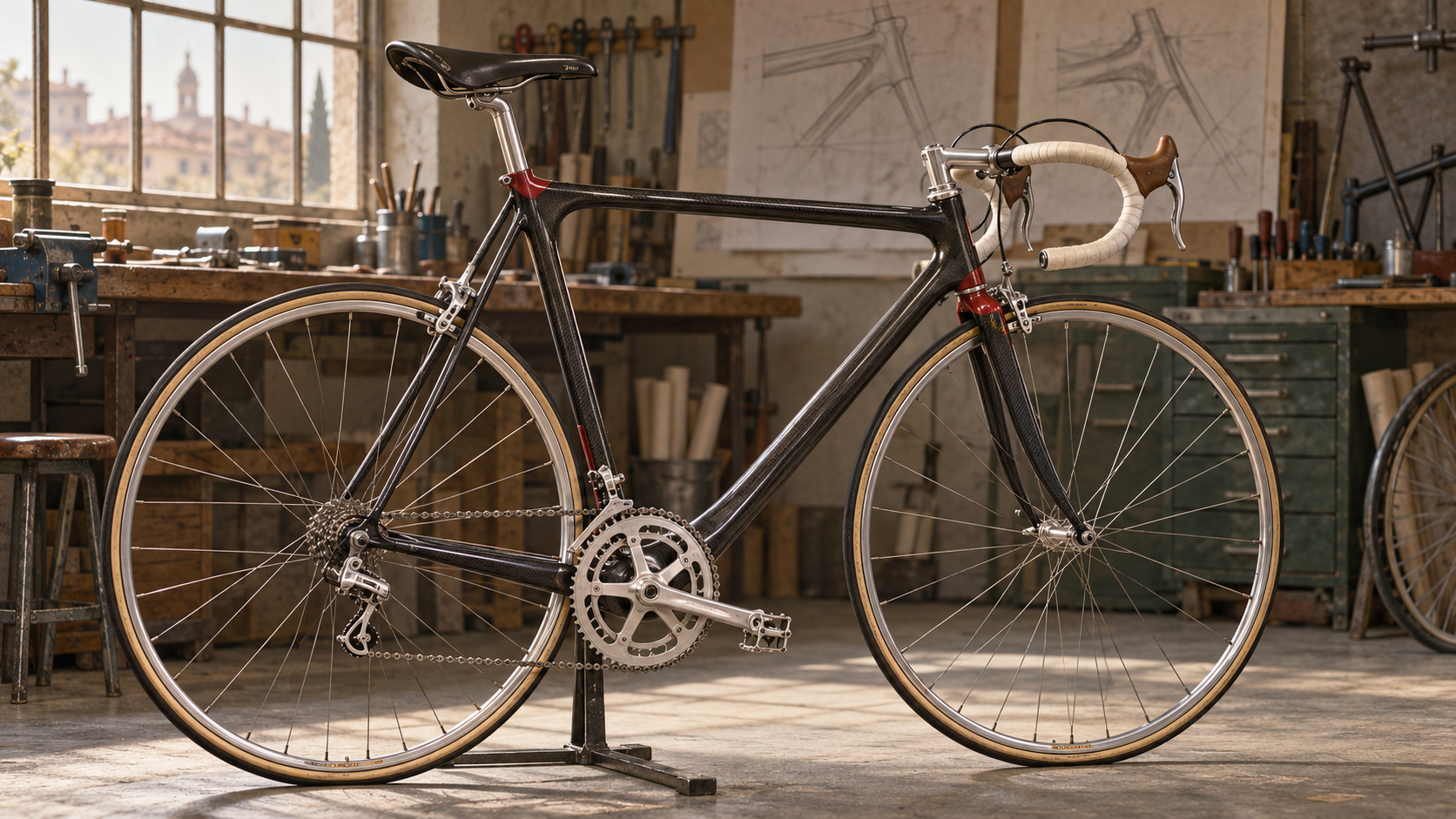
The result was called C35. The number marked Colnago’s 35th anniversary, while the letter pointed towards the carbon series that would later occupy a large place in the company’s history. Colnago describes it as its first series-produced full-carbon road bicycle.
That made it a different kind of novelty from a single prototype. A concept bicycle may be awkward, expensive and impractical if it demonstrates a direction. A production frame must also be built again, equipped and handed to a customer.
Ferrari entered the workshop
The collaboration began in 1986. Colnago wanted to apply Formula One experience in materials, construction and form to a racing bicycle. The following year, the Concept Colnago for Ferrari appeared with solutions far removed from an ordinary Italian road bike: carbon fibre, internal cable routing and special wheels and brakes.
Not everything from the concept was meant to continue unchanged. The first production item from the collaboration was instead the straight-bladed Precisa fork fitted to the Colnago Master. It remained attached to a familiar steel frame and showed that the project could produce a practical component without reinventing the entire bicycle.
The C35 took the larger step. Its shapes were not confined by round steel tubes and traditional lugs. Colnago’s own history describes a carbon construction with organic, aerodynamic forms. It was offered as an expensive anniversary model, including a special version of Campagnolo C-Record. The technology had become merchandise: not merely evidence of a collaboration, but a bicycle in the range.
A link, not an ending
The C35 did not become the pattern followed by every later Colnago road bike. Five years later the C40 arrived with carbon tubes and carbon lugs. In several respects that construction resembled the frame building Colnago knew from steel: separate parts could be assembled in different sizes and geometries. The C40 was also connected with professional victories on an entirely different scale.
That does not make the C35 redundant in the story. It shows a moment when carbon did not yet have one settled form. The material could become a continuous, sculptural frame, while its successor returned to tubes and joints made in a new material.
The Ferrari name gave the project lustre, but the C35 becomes more interesting when we look beyond the badge. Colnago was trying to move an idea out of development and into the market. The bicycle was not the final answer. It was the necessary production frame between the experiment and the C-series that followed.