ca. 1900 · Story
The centimetres between Gresse and Nasq
The rider saw little beyond the motorcyclist’s back and the roller behind the rear wheel. Everything else had to be heard, felt and trusted.
Centimetres from the roller
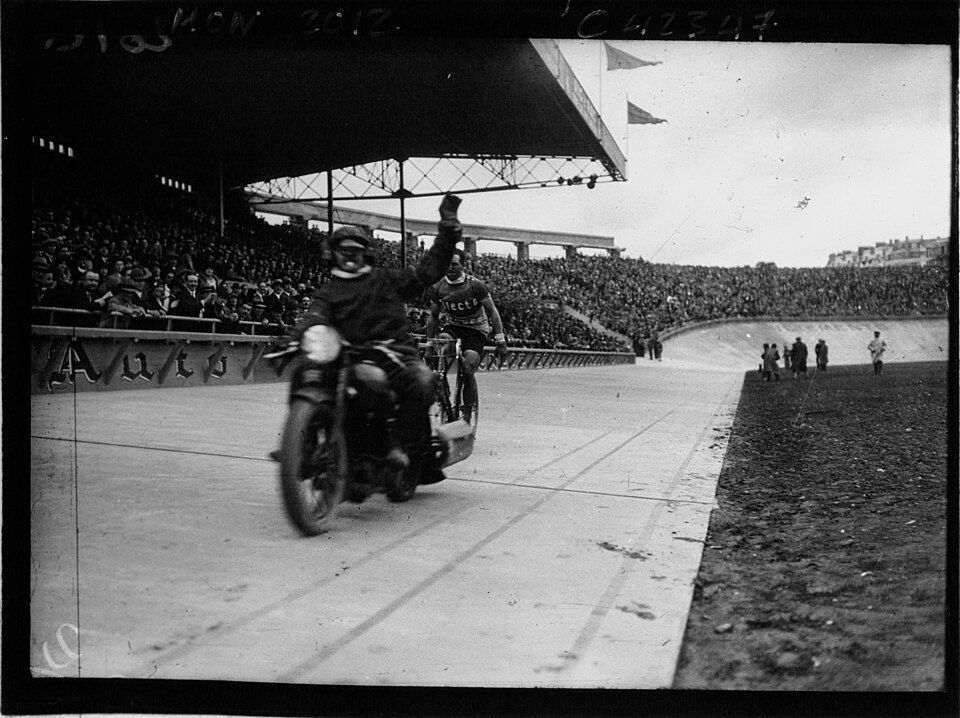
Gresse is bent over the bars, his front wheel close to the roller behind Nasq’s motorcycle. That is how a surviving postcard from the early years of motor-paced racing is described. The names appear on the card, but the two men’s full identities, the track and the precise date have not been established securely. There is no reason to decorate the gaps. What the scene does show is a method of working that shaped track racing for decades.
One man rode the bicycle. The other controlled the motor. They were presented as a pair because that was how the race worked. Gresse could have all the strength in the world; if Nasq changed line abruptly or opened the throttle at the wrong moment, the shelter disappeared. If Gresse lost the roller, the gap grew quickly. The wind arrived, his speed fell and the other combinations went past.
The pacer worked in front
The motorcycle was more than a vehicle. It was a moving windbreak. The pacer sat upright and made himself broad while the rider searched for the calmer air behind the machine. A roller behind the rear wheel kept the bicycle’s front tyre away from the motorcycle and gave the rider a clear point to follow. It did not remove the danger. It merely made the final few centimetres manageable.
The partnership operated amid engine noise, spectators and air pressure. Long explanations were of little use on a banked bend. The pair had to agree beforehand on signals for faster, slower, higher or lower on the track. The pacer read the traffic ahead. The stayer had to feel a small change of speed before the gap opened. It was a proper trade.
A bicycle pulled forwards
The stayer bicycle revealed its purpose too. A smaller front wheel and reversed fork could move the rider forwards and deeper into the motorcycle’s shelter. The bars and saddle put the body low. Gearing was large because, once up to speed, the legs had to turn the motorcycle’s pace into steady, heavy strokes. It was not a bicycle one would choose for setting off from the baker’s kerb.
The odd geometry made sense on the track. Every centimetre gained towards the roller could reduce air resistance. It also made the rider dependent on the pacer. There was no open air in which to settle down if the partnership went wrong. The rider sat inside the machine’s rhythm and accepted the movements it produced.
A pair race disguised as a solo event
The results placed the cyclist’s name first, but spectators knew the pacers. A good pacer held a steady speed, protected his rider in the battle for position and chose the line where the shelter worked best. He also had to avoid boxing in another pair or becoming trapped behind a slower motorcycle. Position was contested with much more than pedals.
That, to my mind, is why motor pacing remains fascinating. It looks thoroughly mechanical, yet the performance depended on trust between two people. The rider could not control the whole situation. The pacer could not produce the result alone. They had to find the same tempo lap after lap, with the engine shaking beneath one and the huge gear pulling at the other’s legs.
What the card can tell us
The postcard cannot safely document a particular victory or day. Its caption gives us the names Gresse and Nasq and describes the former as an English stayer paced by the latter. Until the original card and its history are better understood, it should not be made to say more.
The distance between them, however, is readable. Gresse occupies the place a stayer needed, and Nasq performs the work that made the speed possible. A few centimetres behind a roller, a huge gear and two men obliged to trust one another. It is not the whole history of motor pacing. It is a sound place to begin.
Source and further reading
The image provides historical context. Where it does not depict the specific event, the caption says so.