Danish bicycle craft · 1968–1988
When Gunnar Asmussen
made the bicycle lower
An Olympic champion, a workshop in Aarhus and a bicycle from the years when aerodynamics was allowed to change the shape itself.
Wrong on purpose
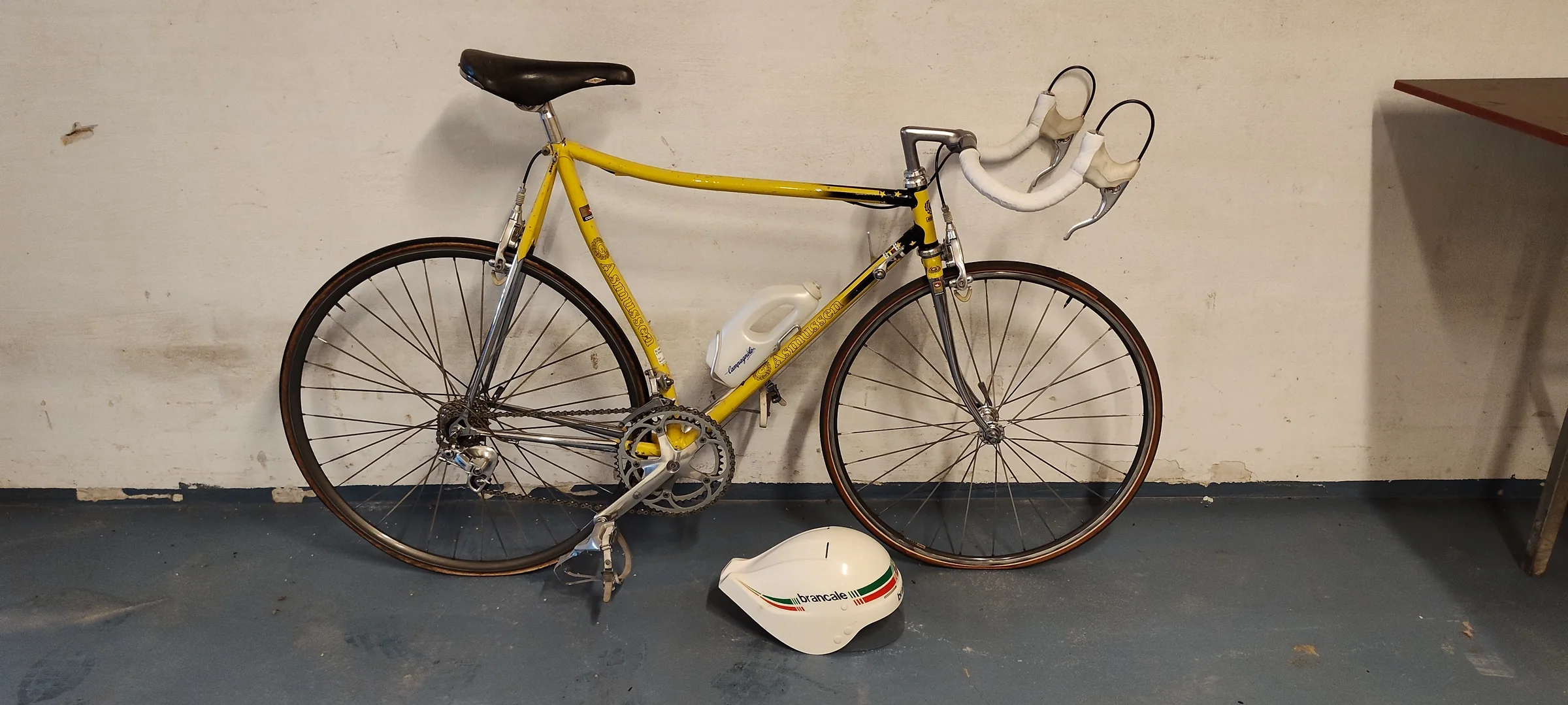
The small front wheel, sloping top tube and low front make the bicycle look uneven. That is precisely the point.
A machinist on Denmark’s gold-medal team
Gunnar Henry Asmussen trained as a machinist at Sabroe in Aarhus while becoming one of Denmark’s strongest track riders. At the 1968 Mexico City Olympics, he won gold with the Danish 4,000-metre team pursuit squad. It was a discipline in which position, pace and precision had to work like parts of a mechanism.
It is tempting to draw a straight line from the machinist to the bicycles that later carried his name. The documentation is not that simple. But his practical eye for metal, measurements and function followed him into the next part of his life.
A bicycle name in Aarhus
Asmussen opened a bicycle shop in Aarhus in the late 1970s. From 1981 it stood at Fredensgade 54. It sold more than established brands. Bicycles also appeared with the Asmussen name on the down tube, often in black, yellow or strong colours.
They occupied a space between international racing bicycle and local craft. Components might be Italian, but the name, fitting and meeting with the rider belonged in Aarhus.
The funny bike was not strange for strangeness’s sake. It was an attempt to make rider and machine occupy less space in the wind.
When front wheels became smaller
During the 1980s, the time-trial bicycle became an open experiment. Francesco Moser’s hour records in 1984 brought large rear wheels, smaller front wheels and a low riding position to a wide audience. Wind tunnels, aero helmets and new wheel shapes shifted attention from bicycle weight to the air through which rider and machine had to travel.
A smaller front wheel allowed lower handlebars. The sloping top tube followed the low front while the large rear wheel retained a familiar rolling circumference. The result became known as a funny bike: an informal name for a serious pursuit of seconds.
The bicycle in the collection
A Danish answer to an international idea
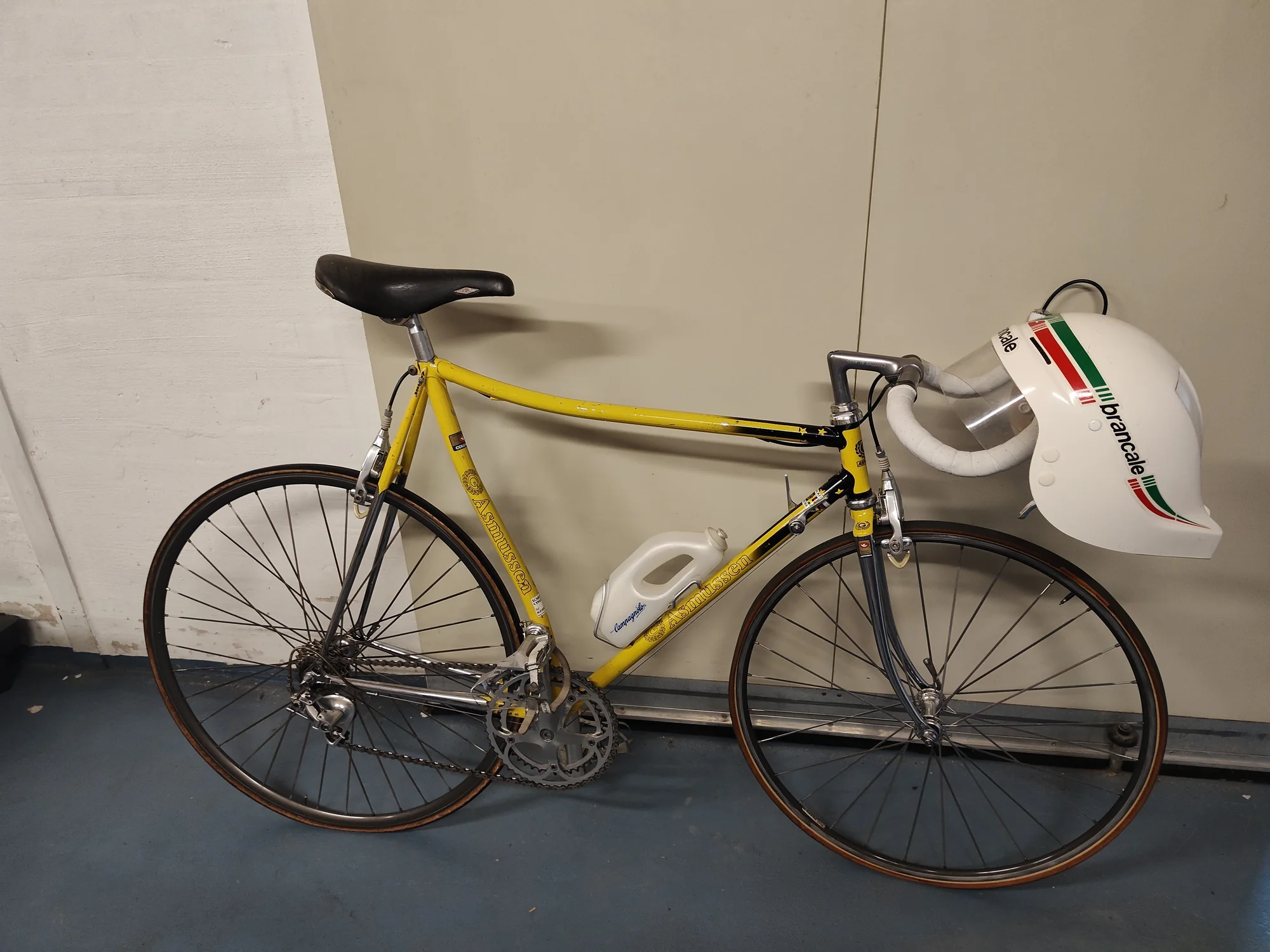
The surviving Asmussen Super Prestige is dated to about 1988. Its yellow-and-black steel frame uses funny-bike geometry and carries parts from Campagnolo’s Croce d’Aune and C-Record families. Cinelli bars and stem continue the Italian theme.
It is displayed with a period Brancale aero helmet. The helmet suits the same idea, but is not documented as the bicycle’s original companion.
What we do not know
The Asmussen name is certain. The precise hands behind every joint on this frame are not documented.
Gunnar Asmussen had bicycles made under his own name, but no workshop record or invoice has yet been found to identify who designed, cut and assembled this particular frame. It should therefore be described as an Asmussen model, not automatically as a frame he personally built from the ground up.
The uncertainty does not make the bicycle less interesting. It reminds us that Danish bicycle craft was also a network of shops, framebuilders, importers and mechanics.
After the experiment
The shape was brief. The idea remained.
Funny bikes enjoyed a relatively short heyday. Rules became tighter, and modern time-trial bicycles found other ways to make the rider low and narrow. But the basic idea survived: the bicycle could no longer be judged alone. Rider, helmet, wheels and frame formed one aerodynamic system.
The Asmussen Super Prestige therefore stands as something more specific than a curious Danish bicycle. It connects an Olympic champion and an Aarhus workshop with the international 1980s attempt to shape the entire bicycle around the wind.
Continue exploring
More from cycling history
When Bjarne Riis built Team CSC
A struggling Danish team became an international organisation built around clear roles, training data and a team spirit tested far from the road.
Read the story →
The man behind the Pirate
Marco Pantani returned from a shattered left leg to win both the Giro and the Tour. The rider’s story also contains the vulnerable man.
Read the story →
When war closed the roads
See the races, people, bicycles and changes that shaped the period.
Explore the period →