1913 · Story
The bottom bracket had to be straight before paint
Before the frame could receive its colour, it went back to the checking table. The joints had been brazed. Now the factory had to see whether the tubes still pointed the right way.
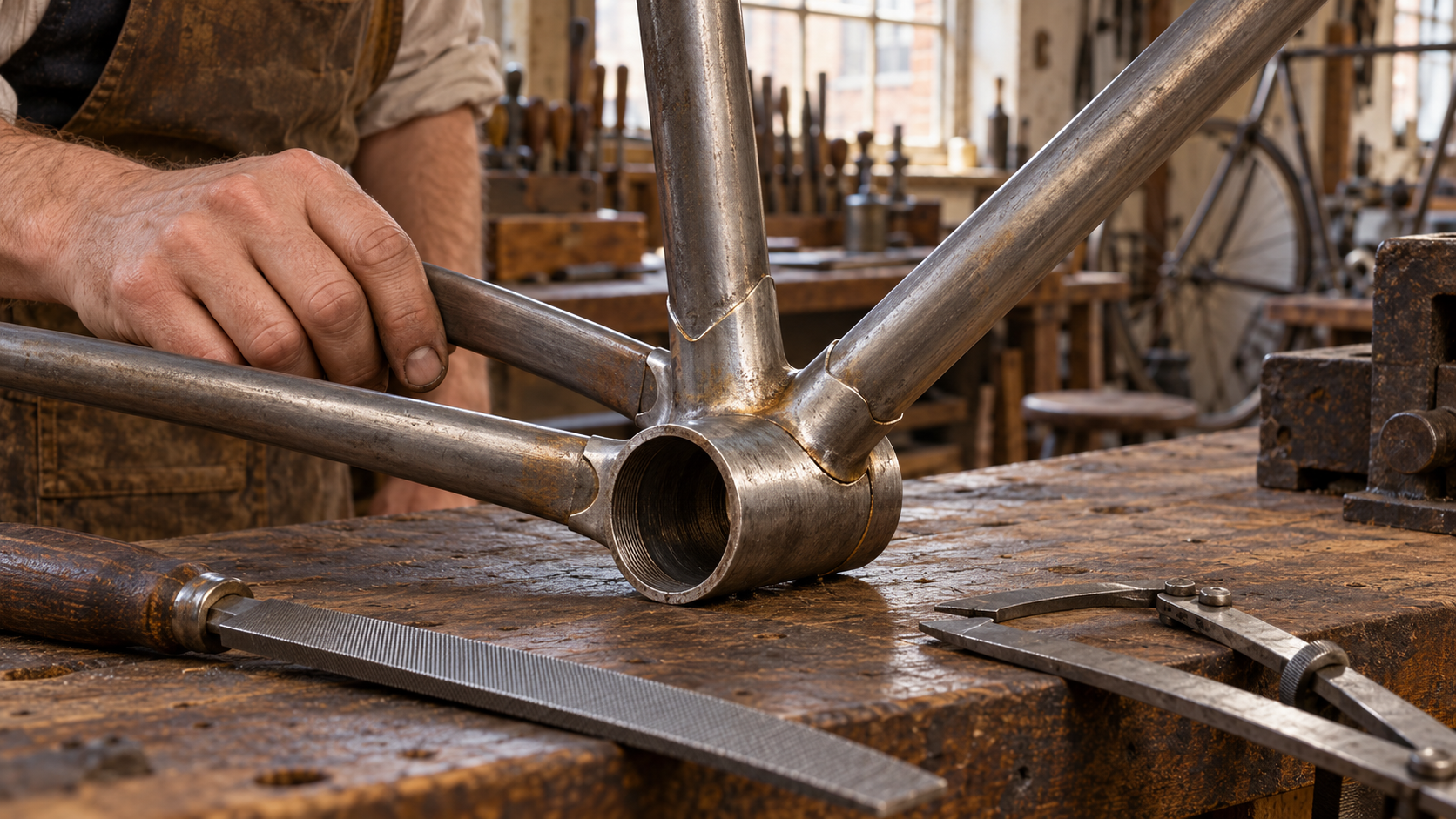
The frame before paint
At James at Greet near Birmingham, the frame had to be checked for alignment before being polished and sent for enamelling. The process is described in the factory's 1913 catalogue. On the same page, a drawing shows a hand adjusting the bottom bracket with a spanner. The finished bicycle could look simple. Beneath its paint, several different jobs had already been completed.
The bottom bracket shell was one place where a mistake could have consequences well beyond the joint itself. Seat tube and down tube met the shell together with the two chainstays. The crank axle and bearings would later occupy its interior. The tubes had to be positioned correctly relative to one another and the transverse axle.
A lugged joint gave the tube a socket to enter. Brazing material could join tube and socket while the steel retained its shape as tube and shell. This differed from melting the steel joint itself together. Fitting the pieces before heating therefore mattered to everything which followed.
Nor was the frame simply an assembly of straight lengths. Angles, lengths and the positions of their ends had to agree before they could become a usable bicycle. At the bottom bracket there was little scope for hiding a wrong direction through a later adjustment of saddle or handlebars.
Heat was only part of the job
James described its frames as jig-built. The parts were therefore held in a defined arrangement during production. The catalogue also claimed especially thorough treatment of the brazed joints so that no part would remain unjoined. This was the factory's own account of the quality it wished to sell its customers.
The practical problem is straightforward. A joint could appear closed from outside without being properly connected throughout. Paint would later conceal more of it. The builder had to control the work while the metal remained accessible and the results could still be examined.
After brazing, the surface required cleaning. James described sandblasting rather than the customary filing. The factory stressed that this avoided thinning the metal through finishing work around the joints. It is a useful reminder that bicycle construction before 1950 also involved machinery and different industrial methods.
Not every frame was made in precisely the same way. A large factory and a small frame builder could use different equipment and routines. An old bottom bracket shell cannot therefore reveal its entire manufacturing history through a tidy edge or a particular cut-out alone.
Back to the checking table
Once the joints were clean, the James frame moved to an alignment check on a surface plate. The jig had held the parts along the way, but the factory still checked the result afterwards. It was the brazed frame which had to be correct, not merely the original positions of its separate parts.
At the bottom bracket, the direction of the axle had to agree with the rest of the frame. The chain would later run from the chainring to the rear sprocket, and both wheels had to belong to the same bicycle in more than a verbal sense. A crooked frame could not be corrected by giving it a better colour.
The catalogue then sent the frame onwards to polishing and enamelling. The customer was meant to receive a finished bicycle, not the traces of each inspection. Bright surfaces and even paint were the visible result; fitting, brazing and alignment were the conditions which made that finish possible.
In the small drawing beside the text, a hand turns the bottom bracket adjustment. That is a job on the finished mechanism. Before that hand could make a bearing run smoothly, other hands had to position the shell correctly.