1972 · Story
Simplex put metal back in the foreground
The brochure placed rear derailleur, levers and front derailleur alongside one another. Above them were the words for forged light alloy. Simplex had something to show.
A front derailleur on paper
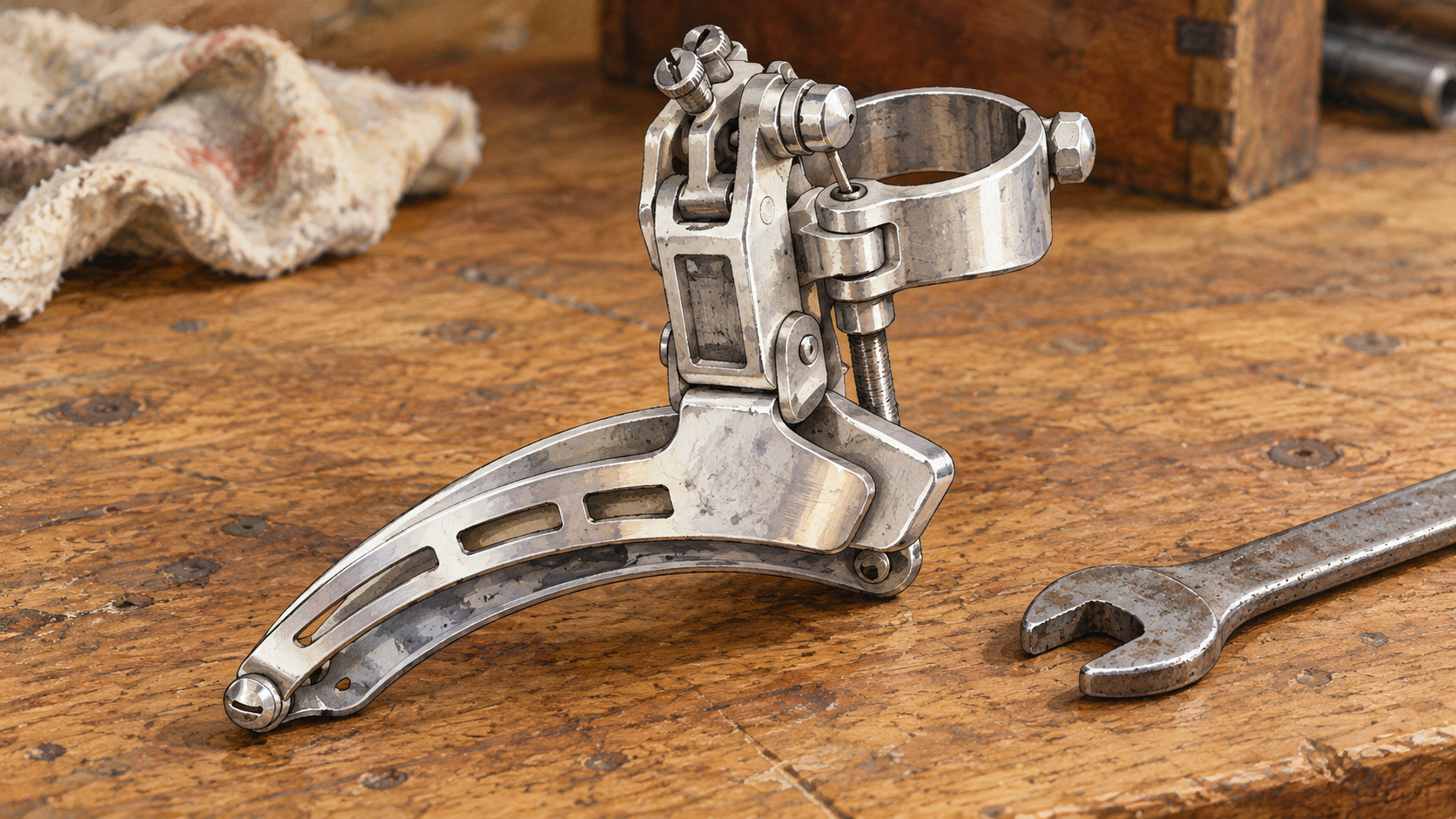
The front derailleur occupies a substantial space on the right of the Simplex brochure. Its band must fit around the seat tube, its short links must move the chain guide in and out, and a cable must set everything in motion. Beneath the drawing is AV.326. This is a small component with a definite job: getting the chain from one chainring to the other.
According to the surviving catalogue material's record, the brochure was printed for the autumn bicycle shows in 1972. The range was called Prestige Super L.J. Rear derailleur, levers and front derailleur were presented as a family. Light alloy was a visible selling point, in the words at the top and the bright surfaces of the drawings.
Simplex was already a major French derailleur name. Lucien Juy's company had supplied many different solutions over the years. In the 1960s and 1970s it became known, among other things, for parts incorporating black plastic components. Super LJ brought a different material and finish to the upper end of the range.
That did not make the other models disappear. The 1974 catalogue shows Super LJ and Prestige variants in the same programme. A dealer still served customers with different bicycles and different budgets. The new group gave Simplex an offering for those looking at more expensive equipment.
The chain still had to move
On the AV.326 the outward result was easy to see. The body, links and mounting band used light alloy, while the chain guide was steel. The materials performed different jobs. The links controlled movement; the sides of the guide were close to the chain when it changed course between the chainrings.
The parallelogram made the operation tangible. Pulling the cable moved the connected links and shifted the guide sideways. The guide had to travel far enough to take the chain with it without pushing it beyond the chainring. Adjustment and a sensible combination of the bicycle's other components were still required.
The brochure specified the front derailleur for both double and triple chainsets. It was therefore not intended solely for one narrow racing combination. The chain guide had to help a rider through different gears, while the mechanic made its movement suit the particular bicycle. Cable, links and guide still did the work, however attractive the alloy looked on paper.
Early examples had an unusual cable route, also visible in the brochure drawing. The cable housing reached a stop at the mounting band, and the cable continued forward to its fixing point. This is one of the details worth examining when fitting an old loose derailleur. A name on a box does not tell the whole story of where the cable should run.
Later versions changed the cable attachment. Two front derailleurs with a clear family resemblance can therefore need different arrangements around the seat tube. For someone holding an old frame and a bag of parts, that distinction is more useful than the catalogue's praise.
The model behind the name
The initials LJ connect the group to Lucien Juy. Yet the model number and actual construction help distinguish individual components. AV.326 on the early drawing is a firmer reference than loosely calling every silver Simplex component Super LJ.
An old front derailleur may also have acquired a replacement chain guide or a different mounting band during its working life. Such traces of use do not necessarily make the part uninteresting. They make it necessary to examine what is actually assembled before assigning a precise year.
Back on the brochure, the artist has placed the front derailleur beside a chain on the chainrings. That is where it must prove itself. It may be shinier and more finely made than a cheaper relative, but when the rider moves the lever, its task remains very ordinary: the chain must land on the chainring he asked for.