1955–1956 · Story
When Belgium lost Stan Ockers
The world champion returned to the Antwerp track in 1956. He had won there before.
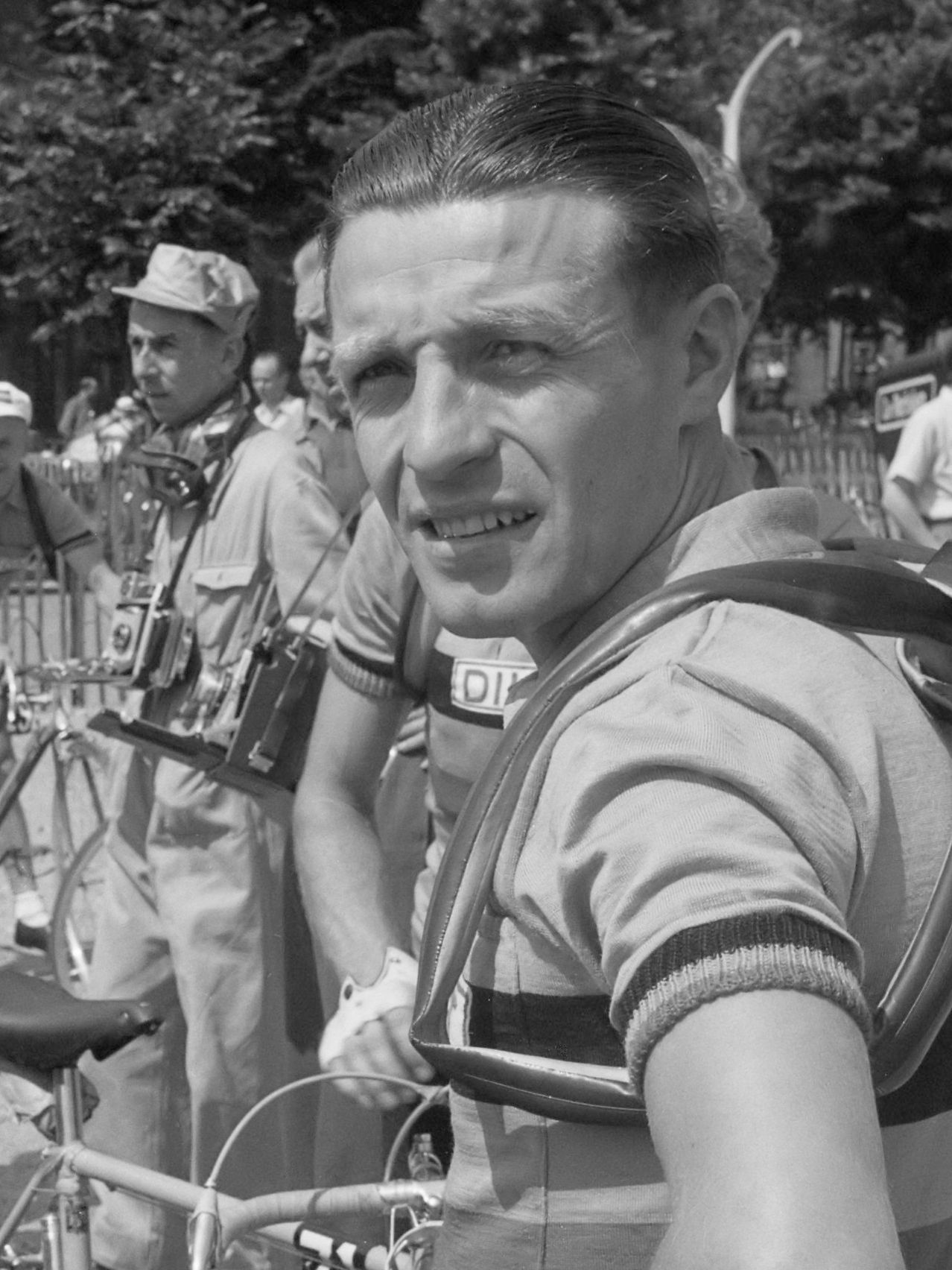
On 29 September 1956 Stan Ockers crashed at a track meeting at Antwerp's Sportpaleis. He died from his injuries two days later, aged 36. He was back in the city where he had grown up, on a track where he knew both the kind of racing and the crowd. The previous year he had won the world road championship. In Antwerp there was no long climb or stretch of open road between him and the finish. There was a field on a track, and that was where he fell.
A season with room for everything
In spring 1955 Ockers won both La Flèche Wallonne and Liège–Bastogne–Liège. Those two wins would have made a good season for most riders. Ockers still had the summer and the world championships ahead of him. He won the Tour de France points competition and, in late August, the world road title at Frascati outside Rome.
Those results asked different things of him. In a one-day race he could spend his energy on a single finish. In the Tour he had to keep picking up places, including on days when someone else got the flowers. He had already finished second overall in the Tour twice. He could handle both the stages on their own and the weeks they added up to.
He was 35 when he earned the rainbow jersey. By then he had had time to try most of what a professional cyclist could be asked to do. His results in 1955 show how much he could still do. They also explain why the name on the bill in Antwerp the following year meant something.
Back on the track
The Sportpaleis was a different place to work from the roads around Frascati. On a track, riders pass the spectators lap after lap. The crowd can see who is sitting on a wheel, who is moving up and how quickly a gap opens. They do not have to wait for the race to come back into town. It all takes place in front of them.
Ockers had raced and won on the track before. That part of his career can disappear behind the world title and the Tour because the road victories stand out so clearly in the results. But the two workplaces belonged together. A professional could race for places in a spring classic and take to the track as the road season wound down. Ockers had even won the Antwerp Six Days earlier in 1956, with Reginald Arnold and Jean Roth. The September meeting was a separate event. The victory and the crash belong to the same venue and the same year, but to different races.
The difference between the two kinds of racing can also be seen in what it takes to win. In a six-day meeting partners share the work across a programme. On the road at Frascati, Ockers stood alone as the winner in the results, though a road world championship is also ridden in teams. He could have stuck to the discipline in which he had just become world champion. His calendar and his win in Antwerp show that he kept racing on the track.
What remained
Accounts agree on the venue and that Ockers died after the crash. It is harder to establish the precise movement that caused it. The story does not require us to single out a wheel or another rider. What is certain is the date, the venue and the outcome. Ockers raced in Antwerp on the Saturday. On Monday, 1 October, he was dead.
Antwerp's museum has since described his death as a turning point for track racing in the city. A sport seldom declines for one reason, and people did not stop watching cycle races that Monday. But for those who associated the Sportpaleis with particular names, there was now one name that would not return. In a little over a year Ockers had won the world championship away from home and ridden his last race at home. The victories can still be read in the order they came. The last result is recorded elsewhere.