1934 · Story
The Scout set Forum alight
He had Olympic gold and a disputed world title. In Forum, what mattered was that the crowd knew him as the Scout.
The name from a uniform
Willy Falck Hansen gained his nickname long before Forum. As a young rider he won De Unges Cykelløb in a scout uniform, and “the Scout” remained. He became Denmark’s leading track rider, with Olympic tandem silver in 1924, kilometre gold and sprint bronze in 1928.
His 1931 sprint world title was disputed after the judge placed him ahead of Lucien Michard while photographs later fed the argument. Officially, Denmark nevertheless had a professional world champion.
Six days in Forum
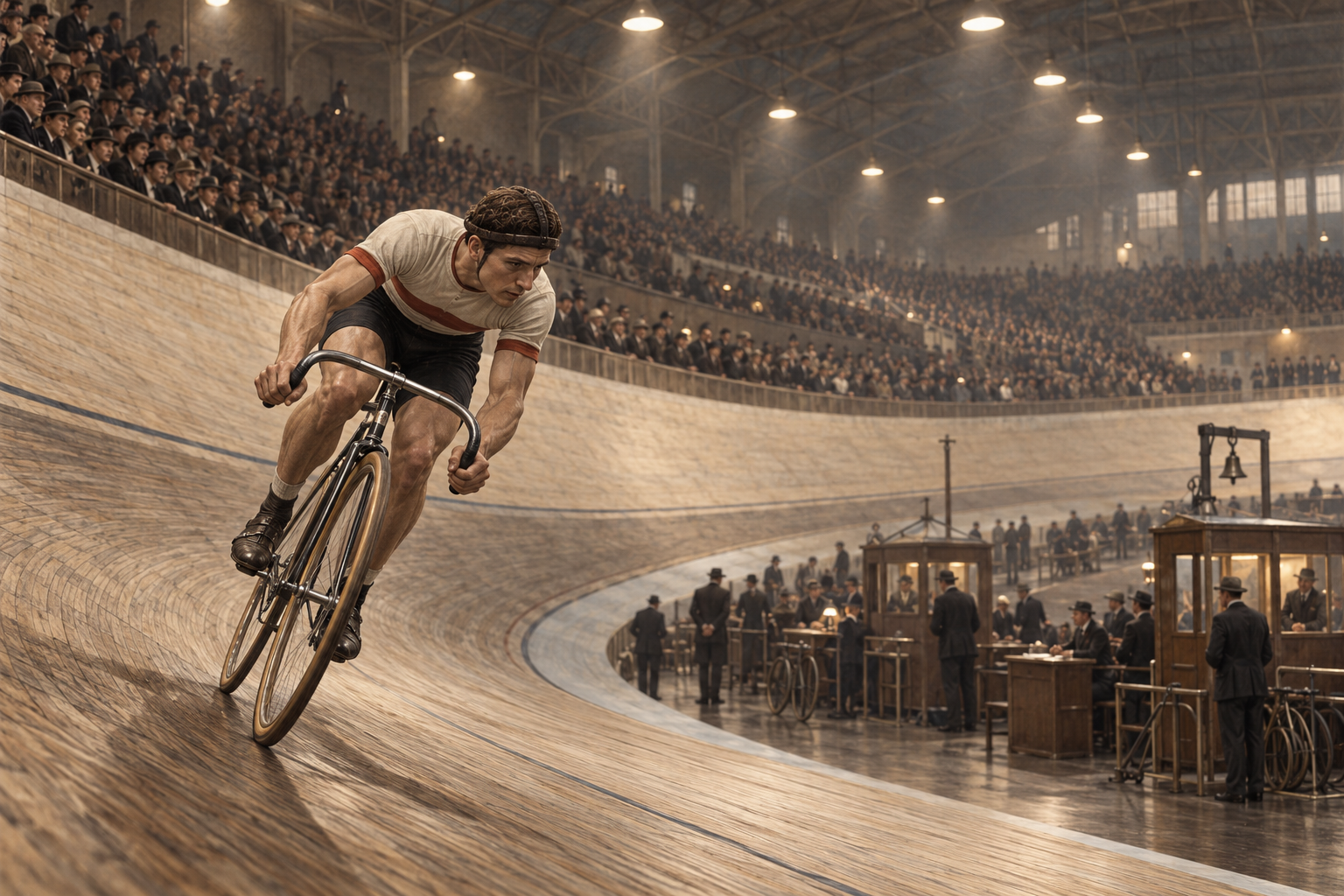
Forum installed a removable wooden track and held its first six-day race in 1933. The next year Falck Hansen returned as the local attraction with Germany’s Victor Rausch. A six-day was not six days of continuous sprinting, but pursuits, changes, rest in trackside cabins and careful accounts of laps and points.
The pair won Copenhagen’s second edition. For the crowd, Falck Hansen combined an international format and a home hero. He was not merely a Dane among foreign specialists; he was the name they came to see.
A statue left as an idea
After the race Johannes V. Jensen wrote the essay “Til Seksdagesløb”. His admiration was so strong that he floated the idea of a statue to Falck Hansen. It was never built, which perhaps suits the six-day: a great night could disappear when the temporary track came down.
Falck Hansen later became sporting director of the six-day races. In 1934 he was still the man on the bicycle. The scout uniform was long gone, but the name had followed him into Forum and onto the steep wooden banking.
A city beneath one roof
The six-day suited Forum because the track compressed everything into a small space. Spectators could follow a pursuit, see riders disappear into their cabins and hear music between the sporting decisions. In a long road race the field passed once. Here the stars returned lap after lap. That created intimacy but also confusion: one pair might lead on points while a lap down, as another waited for the right moment to launch a pursuit.
The hand sling was the visible key to Madison racing. The resting rider descended from the upper track, caught his partner’s hand and was thrown into speed. The movement saved precious energy and made the change itself part of the race. When it worked, it looked simple. When timing failed among many pairs on a short track, it could produce a crash. Falck Hansen possessed the technical assurance and short speed that the crowd could recognise within the complicated accounting.
Victory with Rausch therefore became more than another line in a results list. It showed that the Danish Olympic champion could also function in the six-day mixture of endurance, tactics and theatre. Forum gained its local figure, while Falck Hansen gained a stage on which “the Scout” could be shouted from every side. Johannes V. Jensen’s statue idea was extravagant, but it captured the mood: for six days a bicycle racer seemed large enough to fill the entire building.
The format also required the hero to share his victory. Falck Hansen could attract the crowd, but Rausch was not a prop. A pair had to judge each other’s strength, agree attacks and ensure that one man was always active in the race. The cabin provided rest, food and massage, but never complete separation from the track. The noise continued, and a new move could summon the resting rider back. That is why Madison racing suited Forum: an individual star remained visible, while victory still depended on practical cooperation sustained across all six days.
When the track was packed away, the victory and the name remained. Impermanence was part of the attraction. Forum might be an exhibition hall one week and a cycling arena the next, but during the race Copenhagen acquired an indoor cycling world of its own. Falck Hansen was the figure who made that world feel local.