1988–1999 · Story
When motor-racing aerodynamics reached the bicycle wheel
Leigh Sargent went from Indy cars to a disc wheel for a seven-speed freewheel.
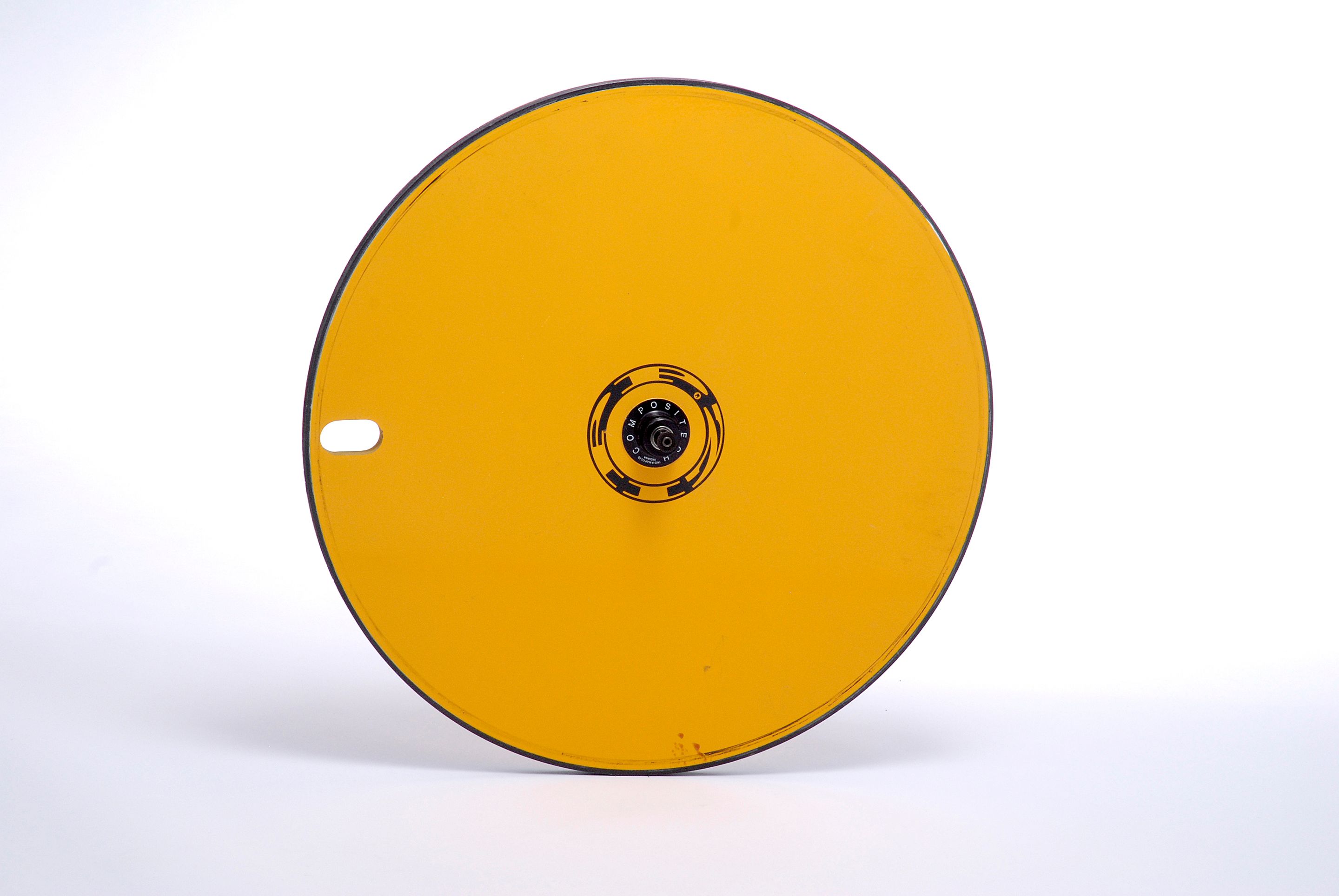
Zipp's first wheel had no visible spokes. It was a disc made for a seven-speed freewheel, and it came in four colours. In 1988 there was something both familiar and unusual about it. The sprockets still had to fit a bicycle people could ride. The rest of the wheel was an attempt to make its passage through the air a little less costly.
Leigh Sargent was behind it. He worked on racing cars in Indianapolis, building, repairing and modifying parts for cars around the Indy 500. Zipp's own history says the idea came from examining bicycle disc wheels already on the market. He brought a problem into the workshop that cyclists had been working on for some time. What he brought to it were the materials and methods he knew from cars.
A wheel has to roll and steer
A rim has a job even if we leave the air out of it. It holds the tyre and forms the outside of the wheel. In a spoked wheel, the spokes connect it to the hub. A deeper rim can shorten the exposed part of the spokes and present a different shape to the air. A full disc takes the spokes out of the airflow altogether. The three forms can do the same basic job and behave differently on the road.
Air seldom meets the wheel head-on. The rider's speed and the direction of the wind together determine where it comes from. A deep front wheel can be felt through the bars when the wind catches it from the side. The rear wheel is different because it does not turn around the steering axis. Something that works behind the saddle need not be the best choice in front.
This is also why rim depth alone cannot tell you how a wheel will behave. Its shape and tyre matter, and the rider has to hold a line while the wind changes. Motor racing gave Sargent a way to work with shape and airflow. It did not give him the conditions of a car on a two-wheeled machine whose rider accounts for so much of what the wind meets.
A mechanic can see the difference between the wheels before the bicycle has moved an inch. On the spoked wheel the connections between hub and rim are visible and the individual spokes can be worked on. On the disc it is the closed face that meets the eye. Sargent's first product kept its connection to the bicycle through a familiar freewheel. The outside of the wheel could change far more than the part that had to fit between chain and frame.
From disc to spokes
In 1989 Zipp introduced the 3000, a carbon wheel with three broad spokes. Deep rims with conventional spokes followed. The three-spoke wheel and the 440 rim both belonged to Zipp's early range in the early 1990s. They were different answers to the question of how much of the wheel should be a continuous surface and how much could stay open.
Triathlon gave these wheels a conspicuous place. Zipp counts Mark Allen's 1990 victory in Hawaii as its first win there on the company's wheels. That tells us the equipment was used in a competition where the rider had to do much of the work alone. It does not tell us how many seconds the wheels saved. There was also a man on the bicycle, and he had to swim and run.
When the company moved into its own manufacturing premises in Speedway in 1999, it stayed near the racetrack around which Sargent's working world had grown up. The bicycle wheel, meanwhile, had become a job in its own right. It had to suit a tyre, a hub and a rider who could feel a gust through the handlebars. Those were the things a racing-car engineer had to reckon with when he moved from four wheels to two.