1951 · Story
When Coppi caught Koblet in Lugano
A newspaper photograph names Koblet behind Coppi. The 1951 race and later reproductions require separate scrutiny.
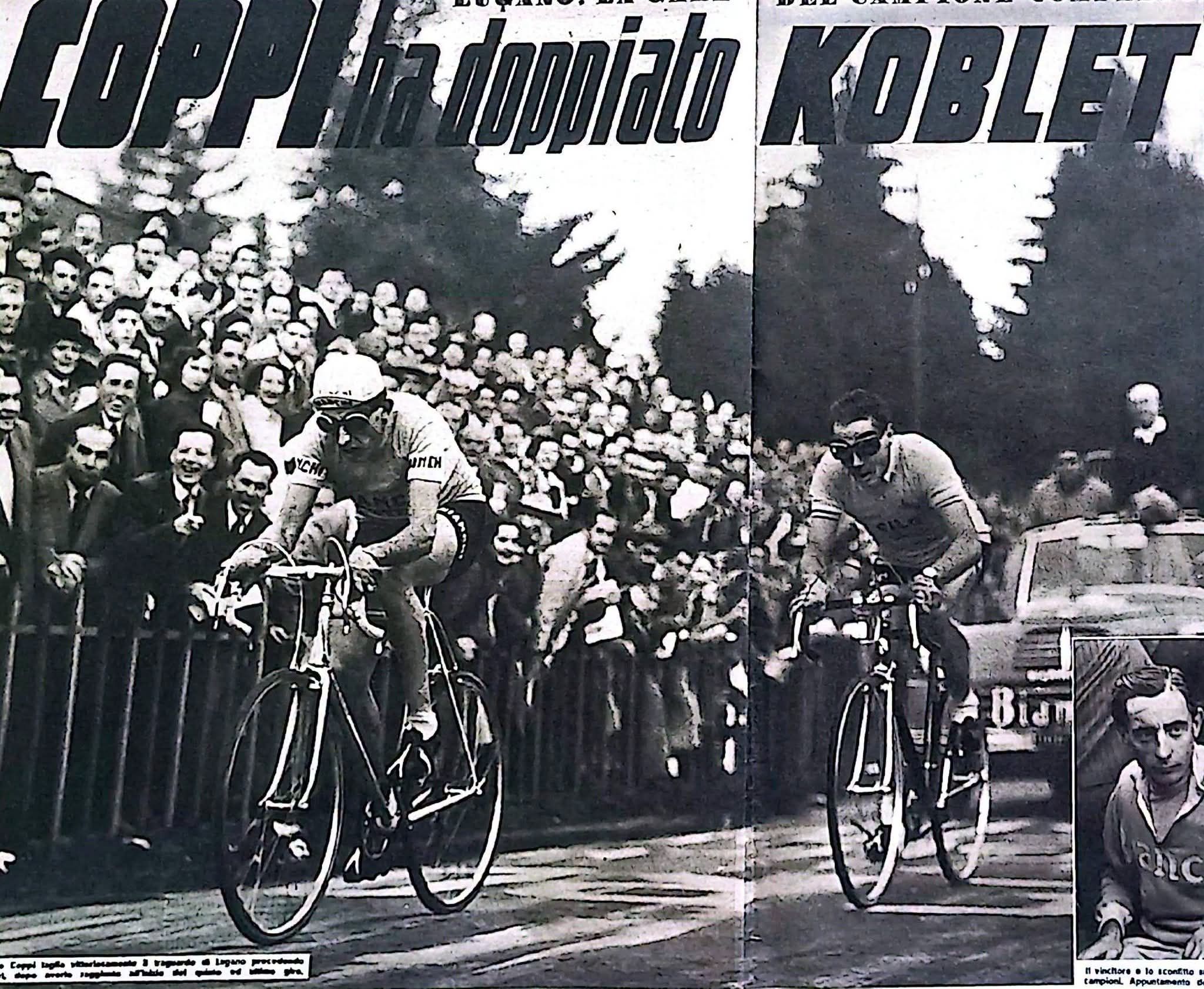
Coppi has caught Koblet. That is how simply an old photograph from Lugano presents the scene. On the left, Fausto Coppi rides in a jersey bearing Bianchi’s name. Slightly behind him, another rider crouches over his handlebars. In the locally preserved reproduction, the words naming Koblet remain part of the image.
It ought to make identification straightforward. Yet the photograph has prompted a later dispute about the rider behind Coppi. In material preserved alongside it, a collector describes objections concerning hair colour and facial appearance. Critics felt that the fair-haired Hugo Koblet did not resemble the man in the print.
Two stories intersect here. One is a Swiss time trial in the autumn of 1951. The other concerns what happens when a newspaper photograph is copied, cropped and circulated long after the race has ended.
A different encounter in Lugano
The Grand Prix de Lugano was a time trial. Riders started separately, so their positions on the road did not directly represent their positions in the race. The man ahead might have been riding the course longer than the man approaching from behind.
Results registers list Coppi as the 1951 winner ahead of Koblet and Ferdi Kübler. They date the event to 14 October. The following year he won again in Lugano, ahead of Giancarlo Astrua. That differs from 10 October in a later caption quoted by the collector. A date attached to a reproduction should not automatically accompany the photograph into a new article.
The Lugano victory should not be confused with Coppi’s world championship in the same city. That came in 1953 and was a mass-start road race. The city is the same, but year, format and circumstances differ. A photograph of Coppi in Lugano cannot be dated from the place name alone.
Two leading riders meeting on the road during a time trial make a striking moment. The photograph preserves the distance between them. It does not by itself tell us how long each has been riding. A claimed starting interval needs race documentation, not a ruler applied to a photograph.
The name above the picture
The local delivery contains three image files. Two are closely related reproductions showing both riders, while the third concentrates on the rider behind. The headline identifies him as Koblet. That is a more tangible starting point than a modern judgement of whether his hair looks light enough.
The collector’s accompanying text, however, also refers to magazines, details and a hand-coloured version not all present in the delivery. We therefore do not have the entire sequence on which the explanation rests. The dispute can be described as the collector’s account; its supporting material cannot all be checked from these three files.
Hand colouring adds another difficulty. When colour is applied to a monochrome photograph later, it becomes another layer between subject and reader. Hair, jerseys and skin tones do not gain evidential force simply by appearing in colour. The particular colour version discussed is not included in the material available here.
A race and some printing ink
The reliable starting point is narrower than a complete reconstruction: Coppi won the Lugano time trial in 1951, and the preserved print names the rider behind him as Koblet. The exact starting interval and full circumstances of the photograph still require checking in the original publications.
That does not make the photograph uninteresting. Bianchi’s name on the jersey, the riders’ positions and the newspaper’s large lettering still describe an encounter considered worth printing. The small space between the bicycles became a headline. Many years later, the name above the picture was being debated again.