1913–1947 · Story
The little ends that held the wheel
Small slots in the frame let a mechanic centre the wheel and set chain tension.
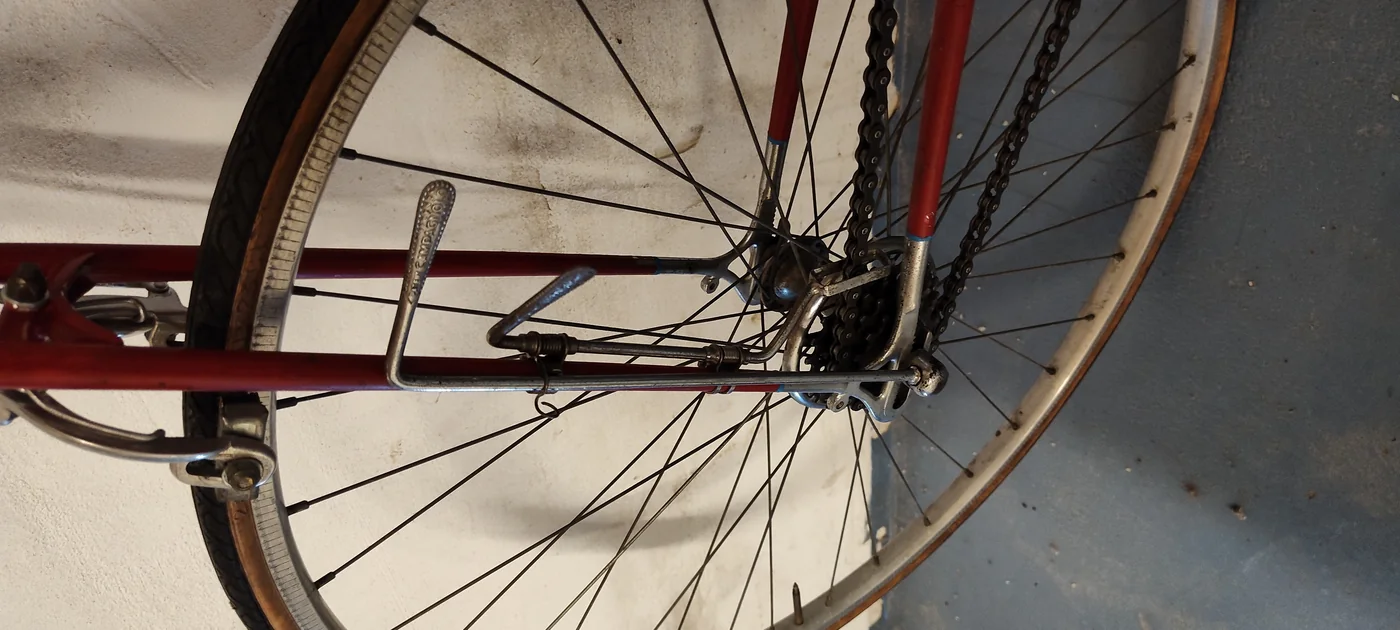
When a rear wheel goes back into an older single-speed bicycle, it can often move a little in the frame before it is tightened. The axle sits in two slots, one on either side. Pull the wheel back and the distance between the crank and rear axle increases, tightening the chain. If one side sits farther back than the other, the wheel points off-centre. There is little metal to see at the axle, but that is where the two adjustments meet.
The ends did two jobs. They gave the axle a place to sit and let the mechanic set the wheel correctly. On a bicycle with axle nuts, the axle is clamped against the faces of the ends. The slots determine where it can sit, while the clamping holds it there. It is a small distinction on paper. It is clear enough if you have ever fitted a wheel and had to loosen one nut again because the rim sits closer to one chainstay.
A wheel as a gauge
In the British workshop book Cycle Repairing and Adjusting, first published in 1913, the wheel itself is used to check the front fork. The blades and crown must fit, but an installed wheel reveals whether the parts also sit correctly in relation to one another. The book has the mechanic check that the rim is central in the fork and that the steering tube is true with the wheel. A crooked assembly is easier to spot with the wheel in place.
At the front there is no chain to tighten. The axle needs to sit properly on both sides, and the rim must run clear. At the rear, the chain length enters the calculation. A bicycle with one sprocket and no derailleur to take up slack needs enough adjustment to keep the chain from hanging loose or binding tight. That is the use of a longer slot. The two ends allow the adjustment, but the mechanic must still finish with the wheel centred.
The book also describes work on the rear ends. Their inner faces should be parallel before the hub is tightened. Otherwise tightening the nuts can put strain on the axle. The workshop could test the parts with the hub in place and check the distance to each side of the rim. The nut itself was part of the check. The parts still had to fit once tightened, not just while lying loose on the bench.
One more job for the axle
Campagnolo's Cambio Corsa also allowed the rear axle to move during a shift. This was not an ordinary rear wheel left a little loose. The system had purpose-made toothed ends and a matching axle. The rider could release the clamping with one lever and guide the chain onto another sprocket with the other while back-pedalling. The axle had to move to suit the chain's new route around the sprocket. Then the wheel had to be clamped again.
That gives the little ends some interest. On a simple frame the wheel is adjusted with the bicycle standing still. On the Cambio Corsa, movement is part of changing gear, and it takes place while the bicycle is moving. You cannot substitute one pair of ends for the other and expect the rest to take care of itself.
There were several ways to make and attach the ends. The surviving material gives no basis for making a particular plate thickness, alloy or brazing method the rule for all frames before 1950. What can be followed through the different designs is the wheel's route into the frame. Before the axle is tightened it needs room to find its seat. Afterwards the rim has to run where it belongs. That is quite a lot of work for a piece of metal almost hidden behind a nut.