1950s–1980s · Story
Seatpost diameter depended on the seat tube’s wall thickness
A drilled Giamé seatpost leads into tube walls, original manufacturers’ drawings and the tenths of a millimetre that need to match.
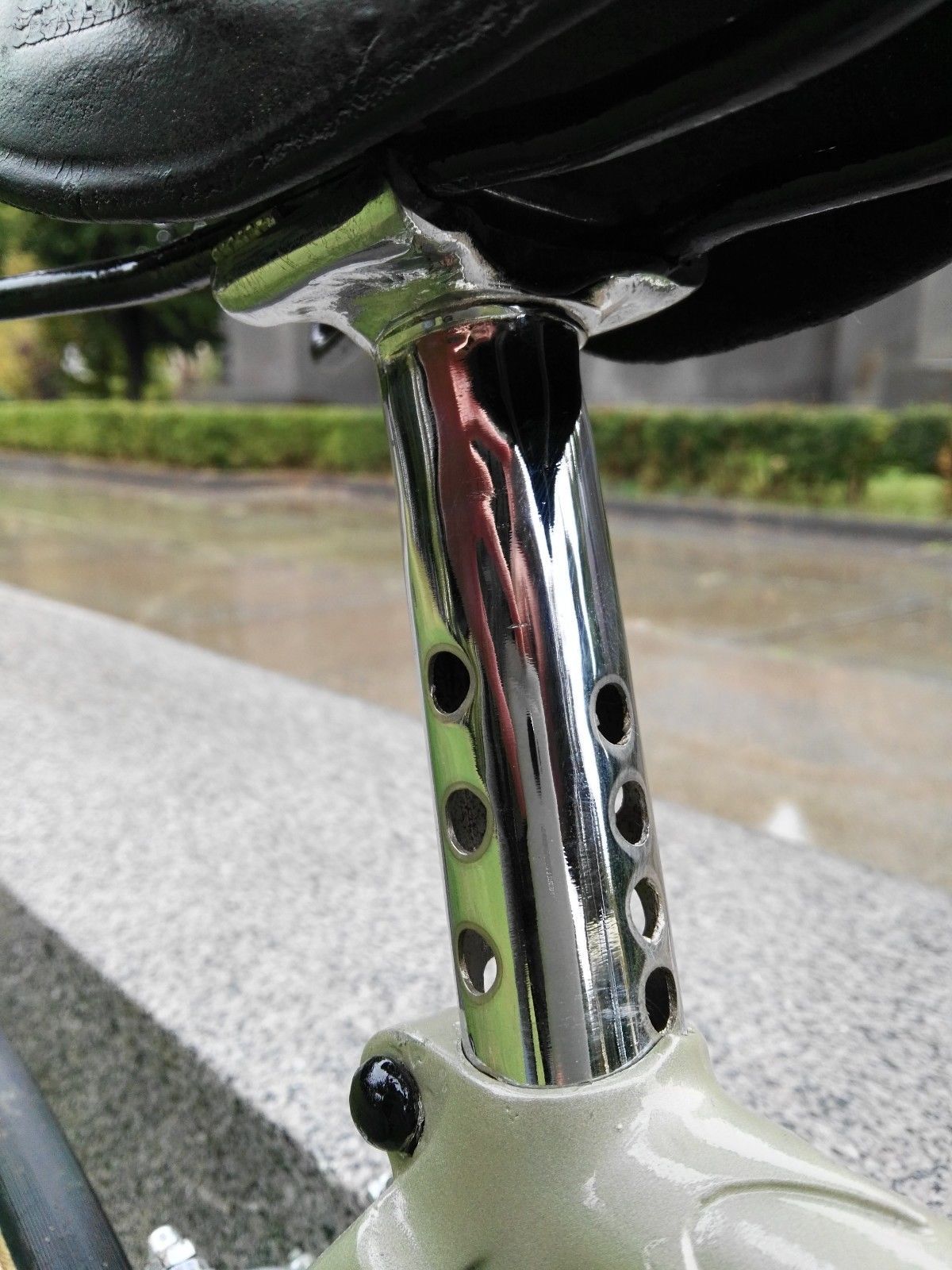
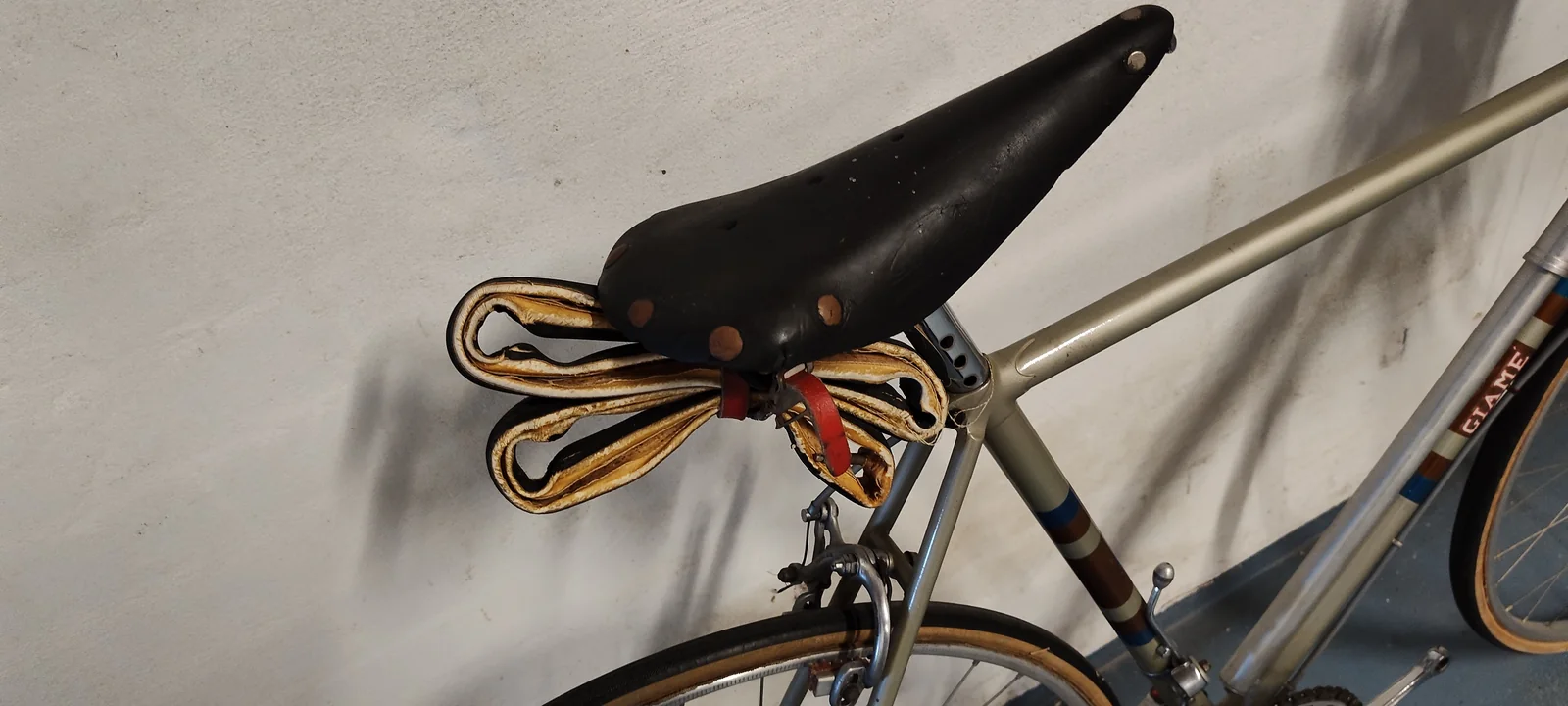
The Giamé bicycle in the collection has a seatpost drilled with a row of holes. Below the leather saddle, small amounts of metal have been removed. The holes are easy to spot. The diameter that allows the post to fit the frame in the first place is much less conspicuous.
Yet that is the measurement needed if the post ever has to be replaced. A polished replacement can resemble the old one down to its saddle clamp and still be wrong. In a steel frame, a few tenths of a millimetre can separate a part that fits from one that does not.
It sounds like an entry in a spare-parts list. Follow the measurement through the seat tube wall, however, and it leads to a small story about how framebuilders could save weight without changing the bicycle's outward shape.
The space was made inside the tube
The seatpost goes inside the seat tube. The internal opening therefore determines the space available, while the outside diameter must also suit the frame's joints and the parts fitted around it. The two measurements are not interchangeable.
Reynolds' 1978 catalogue makes the distinction tangible. Under seat tubes, the factory offered outside diameters of both 28 and 28.6 millimetres, along with different wall thicknesses. A framebuilder was not simply ordering a tube bearing the name 531. There were particular dimensions and versions to choose between.
The outside diameters came from different systems of measurement. 28.6 millimetres is approximately 1⅛ inches; 28 millimetres is the smaller metric size found, among other places, on older French frames. Even at that stage, two slim steel tubes that look alike from a distance may call for different seatposts.
Then there is the wall. An ideal tube with an outside diameter of 28.6 millimetres and a wall 0.7 millimetres thick on each side has an internal diameter of 27.2 millimetres. The calculation is simply 28.6 minus twice 0.7. Make the wall thicker and the hole gets smaller, although the tube looks just as thick from outside.
That helps explain why 27.2 became such a familiar seatpost size on lightweight steel frames. The calculation explains the geometry; it is not an ordering chart. A finished frame is not an ideal circle drawn on paper, and the post needs to move inside the tube before the clamp is tightened.
The drawing says more than the badge
There is another trap here. A lightweight frame tube does not necessarily have the same wall thickness throughout. In a butted tube, material is distributed so that particular areas are thicker than others. The weight saving is hidden inside the tube.
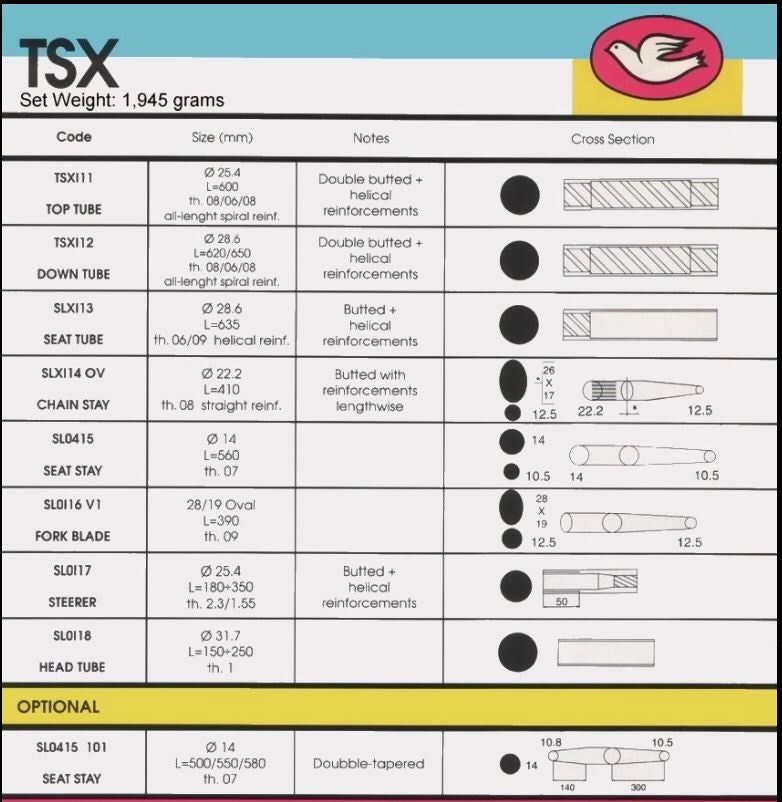
In a Columbus SL drawing held in the project's reference collection, the seat tube is listed with a 28.6 millimetre outside diameter and two wall thicknesses: 0.6 and 0.9. The down tube alongside it has three figures, 0.9/0.6/0.9. These are different tube profiles. Transfer the down tube's dimensions to the seat tube and the calculation has already taken a wrong turn, before a post has even been selected.
Reynolds described its seat tubes as single-butted in the catalogue, with one reinforced end section. The factory also warned against shortening the marked end. Where the material sat mattered. A lightweight frame tube could not be treated as an arbitrary piece of steel tubing taken off a shelf.
A Columbus or Reynolds badge therefore does not, by itself, specify the correct post. The tubing range, the version and the finished frame all matter. A chart can narrow the possibilities; it cannot measure the actual opening.
Back at the bicycle, the task becomes more modest. A size stamped on the old post is one clue. A measurement is another. A post that is too small does not become correct when the clamp bolt is tightened harder, and an oversized one does not acquire the right diameter by being forced down.
The Giamé post's holes visibly record the effort to save weight. Its actual diameter has not been documented here and cannot be read from the photograph. It needs measuring. That is a fitting end to the catalogue figures: the measurement is right only when the post fits that particular frame.
More images